Claude Fable 5.2 / Mythos 5.2
$8/$40 Pricing and Changes from 5.1
Anthropic launched Claude Fable 5.2 and Mythos 5.2 on Nov 9, 2026: $8/$40 per 1M tokens, 20% cheaper than Fable 5.1 and up to 30% faster. Benchmarks included.
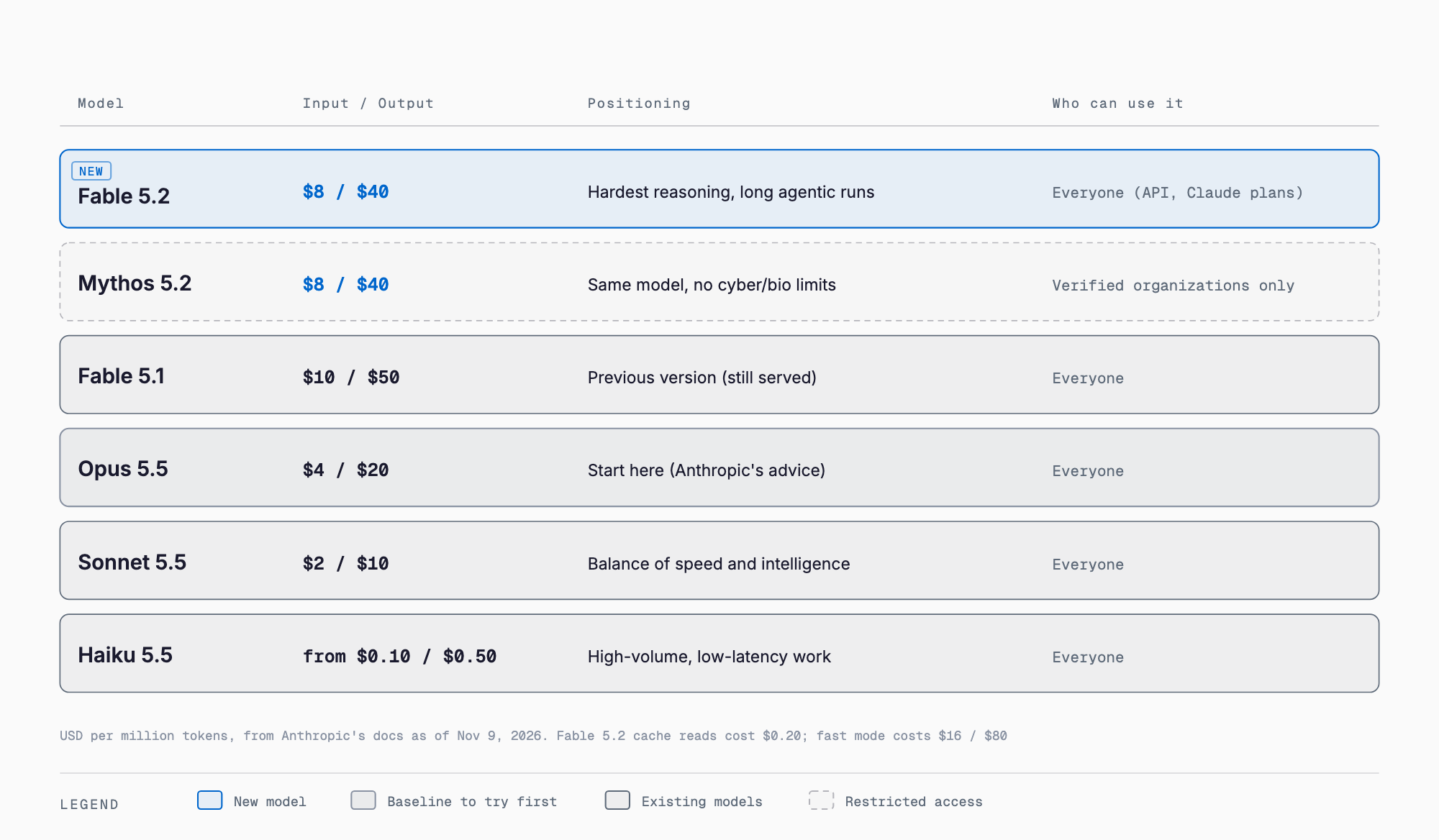
On November 9, 2026, Anthropic announced Claude Fable 5.2 and Claude Mythos 5.2. They share the same base model; the difference is whether safeguards are applied. The takeaway: faster and smarter than 5.1, and 20% cheaper. API pricing is $8 input / $40 output per 1M tokens, which works out to 20% below Fable 5.1's $10/$50. Output generation is up to 30% faster, and coding, reasoning and vision are said to have improved.
Sources are Anthropic's official announcement and the API docs: What's new, the migration guide and the models overview. Figures come from these unless noted.
What Claude Fable 5.2 / Mythos 5.2 are
Fable 5.2 ships to all users with strong cyber and biology safeguards. Mythos 5.2 is the same model with those safeguards removed, available only to organizations vetted through the Cyber Verification Program (cybersecurity professionals) or the Life Sciences Verification Program (biomedical researchers). Claude Enterprise customers can use Claude Security, which runs on a set of models including Mythos 5.2, even without Cyber Verification.
The official guidance on positioning is simple. For most coding and knowledge work, start with Claude Opus 5.5, then move up to Fable or Mythos when needed, or down to Sonnet 5.5 or Haiku 5.5. Fable 5.2 can also act as an Advisor to a smaller model, or as an Orchestrator that delegates simpler work.
What changed from 5.1
- Output generation is up to 30% faster than Fable 5.1 / Mythos 5.1
- At effort Medium, it uses fewer tokens than 5.1
- Testers report clearer explanations
- Better coding, reasoning and vision
- About 55% fewer false-positive blocks (the safety classifier refusing legitimate requests) than Fable 5.1: about 60% fewer for cyber and about 40% fewer for biology, in early tests on claude.ai, Claude Code and Cowork
- The strongest anti-distillation protections so far, with preserved thinking applied to all API accounts
Pricing: 20% cheaper than Fable 5.1
Prices are in US dollars per 1M tokens. Both input and output work out to 20% below Fable 5.1 ($10 to $8, $50 to $40).
| Item | Fable 5.2 / Mythos 5.2 | Fable 5.1 / Mythos 5.1 |
|---|---|---|
| Input | $8 | $10 |
| Output | $40 | $50 |
| Cache read | $0.20 (0.025x input) | $0.25 |
| 5-minute cache write | $10 | — |
| 1-hour cache write | $16 | — |
| Batch | $4 input / $20 output | — |
| Fast mode (up to 2.5x faster) | $16 input / $80 output | — |
For reference, Claude Opus 5.5 costs $4 input / $20 output, so Fable 5.2 is exactly twice that.
One catch: 30-day data retention is required, and zero data retention (ZDR) is unavailable unless Anthropic explicitly allows it. Enterprise Frontier Safeguards, which runs safety monitoring on the customer's own infrastructure and is compatible with ZDR, is in private beta with Bridgewater, Salesforce and Stripe.
Benchmark comparison
The figures below are from the official announcement. Each model was run at its highest effort; Fable 5.2, Fable 5.1 and Opus 5.5 had safeguards on. Bold marks the best score in each row.
| Benchmark (area) | Fable 5.2 | Fable 5.1 | Opus 5.5 | GPT-6 Astra | Gemini 4 Carbon |
|---|---|---|---|---|---|
| FrontierCode 2.0(agentic coding) | 49.1% | 32.4% | 45.5% | 42.8% | 41.1% |
| FrontierSWE v2(same) | 69.9% | 56.3% | 62.3% | 65.5% | 61.2% |
| AutomationBench(business workflows) | 51.4% | 31.4% | 42.5% | 41.4% | 53.9% |
| Terminal-Bench-Science 0.1 | 74.6% | 52.6% | 58.7% | 68.1% | 64.8% |
| WANDR(agentic search) | 82.1% | 68.7% | 72.3% | — | — |
| OSWorld 2.1(computer use) | 89.3% | 83.5% | 87.2% | 79.5% | 81.5% |
| AA-Briefcase v1.1 rubric(knowledge work) | 66.1% | 61.5% | 61.2% | 52.0% | 61.8% |
| Remote Labor Index(High effort) | 41.3% | 17.9% | 21.3% | 20.8% | — |
| Humanity's Last Exam(with tools) | 74.2% | 65.6% | 67.7% | 57.2% | — |
| Chartography(no tools) | 73.4% | 44.8% | 64.4% | 71.0% | 72.5% |
| RoboDojo Sim(robotics) | 64.9% | 27.6% | 39.4% | 29.8% | — |
Fable 5.2 does not lead everywhere. On AutomationBench (business workflows), Gemini 4 Carbon's 53.9% beats Fable 5.2's 51.4%. On the AA-Briefcase Elo, Opus 5.5 scores 1800 against Fable 5.2's 1785. Even so, Fable 5.2 beats Fable 5.1 on every row in the table.
Cost efficiency is also reported. On FrontierCode 2.0, Fable 5.2 at High effort reaches 45.3%, close to Opus 5.5's best of 45.5%, at about half the cost per task. On WANDR it matches Opus 5.5's best at Medium for about 40% of the cost. On Humanity's Last Exam it matches Opus 5.5's best at Low for less than one-tenth of the cost.
In cyber, Anthropic's internal CVE Rediscovery test (1,829 CVEs, run in October 2026) scored Mythos 5.2 at 89.6%, versus 78.3% for Mythos 5.1 and 81.3% for Opus 5.5 without safeguards. Anthropic says it found 10.2% more vulnerabilities than Opus 5.5 and 14.4% more than Mythos 5.1.
Notable examples
- Claude writes over 90% of the changes merged into Anthropic's core codebase (under human direction)
- An early Fable 5.2 migrated a production service from Python to Rust, making startup about 26x faster
- It built a prototype OS from an empty folder (8 days, over 1,000 subagents; bootable, with drivers, file storage, a login screen and an installer)
- About 1,000 Fable 5.2 agents completed a formalization of Fermat's Last Theorem in 30 hours (an earlier unreleased research model took 11 days)
- Snowflake rated it the strongest model yet on its open-source data-eng-bench (103 tasks)
- Working with Diode, it designed three working electronic devices: a voice assistant hub, a USB speakerphone and a handheld virtual pet
Availability and specs
| Item | Details |
|---|---|
| API ID | claude-fable-5-2 / claude-mythos-5-2 |
| Context | 1M tokens (default and maximum) |
| Max output | 128K tokens |
| Thinking | Adaptive thinking always on (depth set by effort) |
| Effort | low / medium / high / xhigh / max (API default is high) |
| Knowledge cutoff | June 2026 |
| Fable 5.2 availability | Claude API (all customers), Amazon Bedrock (anthropic.claude-fable-5-2), Claude Platform on AWS, Google Cloud (Anthropic managed / Google managed), Microsoft Foundry |
| Mythos 5.2 availability | Vetted organizations only: Claude API, Amazon Bedrock, Google Cloud, Microsoft Foundry |
| Fast mode | Claude API, Claude Code, Google Cloud, Microsoft Foundry (separate model claude-fable-5-2-fast). Mythos fast mode is for Verification Program organizations only |
| Retirement | Not before November 9, 2027 |
Disabling thinking or setting budget_tokens returns a 400 error. For effort, the docs recommend starting with high, using xhigh only for the hardest long-running tasks where measurement shows a benefit, and treating max as a way to measure the ceiling. Fable 5.1 remains available as a legacy model; no retirement date has been announced.
Using it on Claude (claude.ai) plans
A launch promotion covering Fable 5.2, 5.1 and 5 started on November 9, 2026 (see the support article). You must have had a paid plan before 10:00 a.m. Pacific on November 9, 2026.
- Pro and Team standard seats: For one week, November 9 to 16 (11:59 p.m. Pacific), you can use Fable up to 50% of your weekly limit. After hitting it or when the period ends, usage draws on credits if usage credits are enabled. You also get one Fable reset (through November 16)
- Max, Ultra, Team premium seats and legacy seat-based Enterprise premium seats: Fable resets based on subscription length (one for under 6 months, two for 6 to 12 months, three for over 12 months). They expire March 8, 2027
- Not eligible: Free plan, legacy Enterprise standard seats, self-serve Enterprise and usage-based Enterprise
A Fable reset restores only the portion of your weekly limit that was used on Fable; if you have a 5-hour window, it is fully restored. It does not raise the limit itself. To use one, go to Settings > Usage and choose "Reset for free."
What API users should check before migrating
The basic migration is just changing the model ID from claude-fable-5-1 to claude-fable-5-2. If you are moving from Fable 5.1, check these four breaking changes.
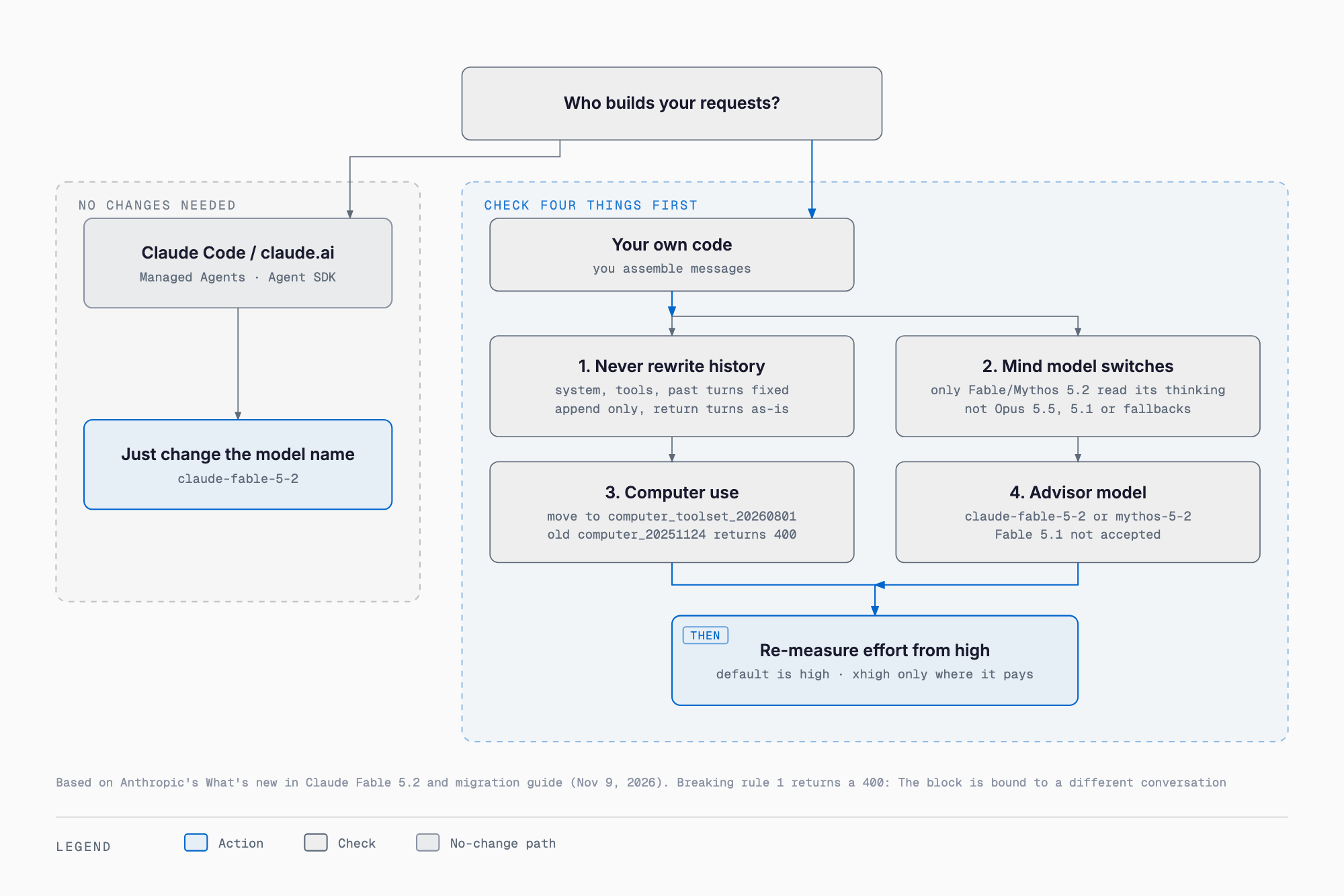
- 1. The history-rewrite check (prefix check) now applies to all accounts: sending back a thinking block after changing earlier system, tools or messages returns a 400 error ("The block is bound to a different conversation"). On Fable 5.1 it applied only to accounts created on or after August 31, 2026. As a stopgap, the beta header thinking-binding-controls-2026-08-01 lets you set prefix_mismatch_behavior to "drop_block", though output tokens may increase
- 2. Only Fable 5.2 and Mythos 5.2 can read Fable 5.2 thinking blocks: switching mid-conversation to Opus 5.5, Fable 5.1 or a fallback (Opus 4.8, Opus 5) loses reasoning continuity in the meantime. The request still succeeds and dropped blocks are not billed. Thinking blocks work only for the account that generated them (or a linked account)
- 3. Computer use needs computer_toolset_20260801: the old computer_20251124 returns a 400 error everywhere except Amazon Bedrock
- 4. The advisor tool (beta) is restricted: when Fable 5.2 is the executor, the advisor must be claude-fable-5-2 or claude-mythos-5-2 (not Fable 5.1)
Some users are unaffected. If you go through Claude Code, claude.ai, Managed Agents or the Agent SDK, check 1 is not an issue. If you build messages yourself, you are fine as long as you keep system and tools unchanged during a conversation, only append to messages, and return assistant responses as they are. As before, forced tool choice (tool_choice any / tool) returns 400, and organizations using CMEK (customer-managed encryption keys) cannot use structured outputs (strict tool use, JSON outputs).
# Change the model ID
claude-fable-5-1  ->  claude-fable-5-2

# Let Claude Code handle the migration
/claude-api migrate this project to claude-fable-5-2
Behavior differences to watch for in prompts
- Even if you write "answer without thinking," it will think at effort medium or above
- At low effort, it may stop partway through a long task with a note about what remains
- If you do not say who owns the code, it tends to add to the existing structure and only report nearby issues
- It gives fewer progress updates during long tool runs
- How much it delegates to subagents depends on the harness, which affects cost
- It follows style rules closely; very strict sentence-length limits can make the writing awkward
Refusals also need handling. When the safety classifier declines, the response is HTTP 200 with stop_reason "refusal". Server-side fallback (beta) can automatically rerun the request on Opus 4.8 or Opus 5. Per the announcement, blocked cyber questions are answered by Opus 4.8 and biology questions by Opus 5.
Safety evaluation
Anthropic rates the risk of high-risk dangerous behavior as low, as with recent models. In an automated behavioral audit of about 1,900 scenarios (10-point scale, lower is better), Mythos 5.2 scored 2.67, better than Opus 5.5 at 2.79 and Mythos 5.1 at 3.28. Details are in the system card.
Anthropic also notes that the model more often voices suspicion that it is being evaluated, which makes evaluation harder. External evaluations were carried out by organizations including the UK AI Security Institute and METR.
How to choose: a practical view for small businesses
| Who you are | Suggested move |
|---|---|
| Claude plan user | If your plan is eligible, try the offer running through November 16 (Pro/Team standard: up to 50% of the weekly limit and one reset). Max/Ultra/premium-seat resets last until March 8, 2027. The Free plan is not eligible |
| Company building on the API | Swap the model ID and test. Check the four breaking changes above and the 30-day retention (no ZDR). For most uses start with Opus 5.5 ($4/$20) and move to Fable 5.2 ($8/$40) only where needed |
| Claude Code user | Fast mode is available. /claude-api migrate this project to claude-fable-5-2 can handle migrating an existing project. The prefix check does not affect you |
| Security or research organization | Mythos 5.2 requires approval through the Cyber Verification Program or Life Sciences Verification Program. Claude Enterprise customers can use Claude Security without Cyber Verification |
FAQ
What is the difference between Fable 5.2 and Mythos 5.2?
They share the same base model. Fable 5.2 has strong cyber and biology safeguards and is available to all users. Mythos 5.2 has those safeguards removed and is available only to organizations vetted through the Cyber Verification Program or the Life Sciences Verification Program.
How much does it cost?
$8 input / $40 output per 1M tokens, which works out to 20% below Fable 5.1 ($10/$50). Batch is $4 input / $20 output, and fast mode is $16 input / $80 output.
Should I choose Fable 5.2 over Opus 5.5?
The official guidance is to start with Opus 5.5 ($4/$20) for most coding and knowledge work and move up to Fable or Mythos when needed. Fable 5.2 scores higher on most benchmarks, but Gemini 4 Carbon leads on AutomationBench and Opus 5.5 leads on the AA-Briefcase Elo.
Can I use it with zero data retention (ZDR)?
Not unless Anthropic explicitly allows it; 30-day data retention is required. Enterprise Frontier Safeguards, which runs safety monitoring on the customer's infrastructure and is compatible with ZDR, is in private beta.
Can I use it on the free Claude plan?
The free plan is not eligible for the launch promotion. The offer covers customers with a paid plan before 10:00 a.m. Pacific on November 9, 2026, such as Pro and Team standard seats. The Free plan, legacy Enterprise standard seats, self-serve Enterprise and usage-based Enterprise are not eligible.
What is the minimum to do when moving from Fable 5.1?
Change the model ID from claude-fable-5-1 to claude-fable-5-2, then check four things: the history-rewrite check, thinking-block continuity, the computer-use tool name and the advisor tool pairing. In Claude Code you can also run /claude-api migrate this project to claude-fable-5-2.
Will Fable 5.1 stop working?
It remains available as a legacy model, and no retirement date has been announced. Fable 5.2 itself will not be retired before November 9, 2027.
Can I turn thinking off?
No. Adaptive thinking is always on, and disabling it or setting budget_tokens returns a 400 error. Adjust depth with effort (low to max); the API default is high.
Sources
Feel free to contact us
Contact Us