Copier Lease Cost in Japan 2026: Counter Fees & 5-Year Total
MFP lease runs about 10,000-30,000 yen/month for an A3 color unit, plus counter fees of 0.8-3 yen (B&W) and 8-20 yen (color) per page. Includes 5-year totals.
A multifunction printer (MFP, or copier) typically costs about 10,000 to 30,000 yen per month in lease fees for an A3 color unit, plus per-page "counter" charges of roughly 0.8 to 3 yen for black-and-white and 8 to 20 yen for color. For a 10-person company, the five-year total often lands around 1.7 to 2.3 million yen; for a 30-person company with two units, around 5 to 6.5 million yen. But MFPs are easy to get wrong if you only compare the monthly lease fee. This article explains the differences between leasing, renting, and buying, price ranges by machine class, how counter charges work, what to check on a quote, common mistakes, security points, and how going paperless can reduce the number of machines you need. It is written for owners and office managers without an IT department. All figures are general guidelines and vary by contract, region, and dealer.
Three ways to get an MFP: lease, rent, or buy
There are three main options. Small and midsize companies most often choose a five-year lease plus a maintenance contract, and most dealers assume that structure when they propose. Depending on how you use the machine, though, another option can cost less overall.
| Option | How it works | Typical cost (guideline) | Best for |
|---|---|---|---|
| Lease | A leasing company buys the machine and you rent it for about five years. Generally non-cancellable | 10,000-30,000 yen/month for an A3 color unit, plus counter charges | Companies that will use it continuously and want low upfront cost |
| Rental | Short-term use (days to about a year). Often cancellable | More expensive than leasing (roughly 20,000-60,000 yen/month) | Events, short projects, or uncertain usage periods |
| Purchase | You pay for the machine upfront and sign a separate maintenance contract | Roughly 500,000-1.5 million yen for an A3 color unit | Companies with cash that will use it for close to ten years; refurbished units are also an option |
Leasing avoids upfront cost and spreads payments evenly, but its biggest catch is that you generally cannot cancel mid-term. If you downsize, move, or go paperless and no longer need the machine, you still pay the remaining lease. Buying costs more at the start, but the longer you keep the machine beyond five years, the lower the annual cost. Note that in a lease, maintenance (repairs and toner) is normally a separate contract; the lease fee covers only the machine price plus interest and fees.
Monthly lease fees by machine class
Lease fees depend on the machine price, the lease term, and the lease rate (which reflects interest and fees). For a five-year lease, a rough rule is a monthly fee of about 1.7 to 2.0 percent of the machine price. The ranges below reflect typical 2026 market levels; discounts in particular vary a lot between dealers.
| Machine class | Typical use | List price (guideline) | Monthly lease (5 years, guideline) |
|---|---|---|---|
| A4 black-and-white MFP | Small offices, sole proprietors | 200,000-500,000 yen | About 4,000-9,000 yen |
| A4 color MFP | Around 5 staff printing color documents and invoices | 300,000-800,000 yen | About 6,000-15,000 yen |
| A3 black-and-white MFP (low to mid speed) | About 10 staff, A3 drawings or documents | 500,000-1.2 million yen | About 8,000-20,000 yen |
| A3 color MFP (mid speed, 25-35 ppm) | Standard class for 10-30 staff | 1 million-2.5 million yen | About 10,000-30,000 yen |
| A3 color MFP (high speed, 45+ ppm) | 30+ staff, heavy printing, finishers | 2.5 million-5 million yen | About 30,000-70,000 yen |
Higher speed (pages per minute) and extra features such as stapling, hole punching, and large paper trays raise both the price and the lease fee. For most companies with 10 to 30 people, a mid-speed A3 color unit is enough. Buying a high-speed machine "just in case" means paying for performance you will not use for five years.
How counter charges (maintenance fees) work
The cost people overlook most is the counter charge. It is a monthly fee based on the number of pages printed or copied, and it is the price of the maintenance contract that covers repairs, consumables such as toner, and periodic inspections. The machine's meter (counter) is read each month, and you are billed pages multiplied by the per-page rate.
| Type | Per-page rate (guideline) | Notes |
|---|---|---|
| Black-and-white | About 0.8-3 yen | Most contracts count A3 and A4 as one page, but some count A3 as two |
| Color | About 8-20 yen | Full color. Some contracts have a separate rate for two-color or single-color output |
| Minimum monthly charge | About 0-5,000 yen/month | A fixed amount billed even if you print little. Some contracts bundle a set number of pages per month |
Color pages usually cost five to ten times as much as black-and-white pages. So even with the same total volume, a company with more color printing pays much more. Conversely, if you print only a few dozen color pages a month, a slightly higher color rate barely matters, and the black-and-white rate and minimum charge become what counts.
There are two common billing structures.
- Pay-per-page: you pay only for pages printed. Good for low-volume offices, though the per-page rate may be higher even when the minimum charge is low
- Bundled pages (minimum charge): a fixed fee covers a set number of pages per month, with extra billed beyond that. Easier to budget if your volume is stable, but you pay the fixed amount even if you print less
Also check whether toner, drums, and other consumables are included in maintenance. Most maintenance contracts include toner but not paper. If toner is billed separately, a low per-page rate can end up costing more in total.
Five-year total cost: examples for 10 and 30 people
Adding lease fees and counter charges over five years shows the real burden. The examples below assume typical usage patterns. They are guidelines to use as a yardstick when comparing quotes.
| Item | 10 people (1 unit) | 30 people (2 units) |
|---|---|---|
| Machine | 1 mid-speed A3 color unit | 2 mid-speed A3 color units |
| Monthly lease | 15,000 yen | 40,000 yen total |
| Monthly volume (assumed) | 3,000 B&W / 800 color | 12,000 B&W / 3,000 color |
| Per-page rate (assumed) | B&W 1.5 yen / color 12 yen | B&W 1.2 yen / color 10 yen |
| Monthly counter charge | About 14,100 yen (4,500 + 9,600) | About 44,400 yen (14,400 + 30,000) |
| Minimum charge (assumed) | 2,000 yen | 4,000 yen |
| Monthly total | About 31,100 yen | About 88,400 yen |
| Five-year total | About 1.87 million yen | About 5.3 million yen |
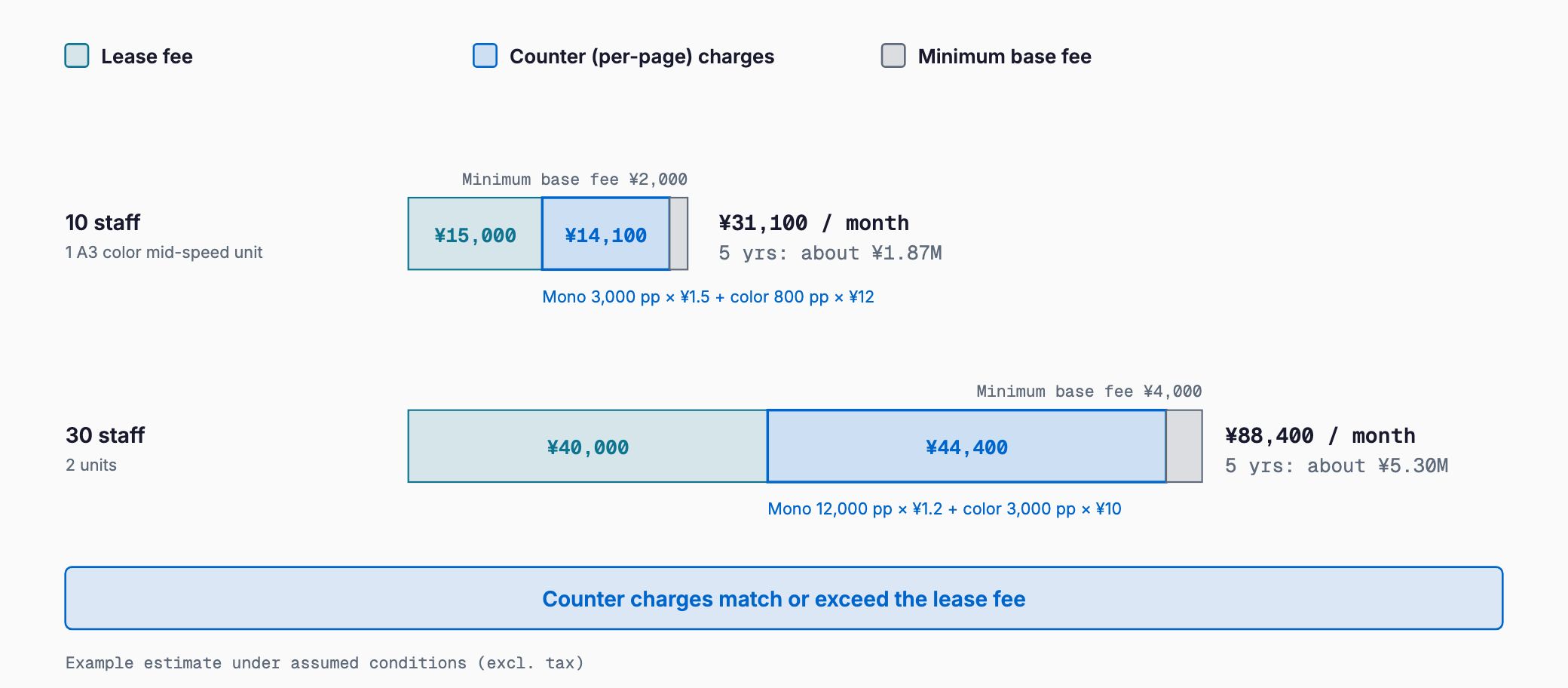
In the 10-person example, nearly half of the monthly total is counter charges. Even with a cheap lease fee, heavy color printing inflates the running cost. When reading a quote, compare the five-year total of lease fee plus counter charges plus minimum charge, not just the monthly lease fee.
These estimates exclude paper, installation, electricity, post-lease renewal or removal fees, and repairs outside the maintenance contract. Including them can raise the real burden by another 10 to 20 percent.
Lease terms and the trap of early termination
Five years is the standard lease term for MFPs, though terms of three to seven years exist. It follows the statutory useful life for copiers (five years), and leasing companies base their rates on it. A shorter term such as three years raises the monthly fee but lets you swap machines before they age.
- You generally cannot cancel early. If you must, you pay a lump-sum "liquidated damages" amount equal to the remaining lease fees
- The lease can remain even if your business shrinks, you move, or the situation changes. Needing fewer machines after a relocation does not end the contract
- If you do nothing at the end of the term, it may roll into a "re-lease." Re-lease fees are usually very low (often about one month's original fee per year), so continuing to use the machine is a legitimate option
- Firmware updates and manufacturer support endings can happen during the lease. Using a machine after support ends carries security risk
If a dealer asks you to change counter rates or maintenance terms mid-contract, do not agree casually; confirm the details in writing. Lease and maintenance are normally separate contracts with separate termination conditions.
What to check on a quote (checklist)
MFP quotes are hard to read, and the total can change a lot depending on conditions even when the numbers look cheap. Line up the following items across multiple quotes.
- Counter rates: black-and-white, color, how A3 is counted (one or two), and any separate rate for single-color output
- Minimum monthly charge: how much, and whether the "included pages" match your actual volume
- Whether toner, drums, and other consumables are included in maintenance (paper is normally extra)
- Maintenance scope: on-site repair fees, parts replacement, inspection frequency, and target response time after a breakdown
- Lease rate and total payment: whether the five-year total calculated from the term and monthly fee is reasonable relative to the machine price
- Early termination terms: how liquidated damages are calculated, and whether relocating or changing unit counts is allowed
- End-of-term handling: re-lease fee, removal and collection charges, and data erasure
- Installation, delivery, and setup fees: included in the initial cost or charged separately
- Network and scan-to-email setup fees: whether setting up scanning to PCs and email is included
- Handling of your current machine: removal costs and the treatment of remaining lease balance if you are switching
Introducing an MFP is also a chance to review your network. If you are buying one as part of a move, see IT costs for an office relocation. Note that moving a leased MFP usually requires the leasing company's approval.
Common mistakes and aggressive sales tactics
The MFP is a classic example of equipment where small businesses often end up with an expensive contract without realizing it. Here are typical failures.
| Mistake | Why it happens | How to avoid it |
|---|---|---|
| Over-specified machine | Choosing a fast, high-capacity, feature-rich unit "just in case"; actual volume was less than half of what was assumed | Check your past year's page count from the current machine's counter and narrow down the needed speed and features |
| Ignoring the color ratio | Missing how high color rates are, so bills come in at twice the estimate | List color printing uses and volumes in advance; if you mostly print B&W, prioritize those rates |
| "We'll make it cheaper" switching pitches | A phone call or visit offers to beat your current maintenance fee, but the remaining lease on the old machine is rolled into the new one, making it more expensive overall | Do not sign on the spot. Compare your current contract and the five-year total after switching, in writing |
| Lump-sum payoff of remaining lease | Canceling or switching triggers an immediate demand for the old machine's remaining fees | Check the termination clause and time replacement for the end of the lease |
| Signing without reading the contract | Lease and maintenance are separate, and people assume they can cancel just one | List each contract type (lease, maintenance, options) and manage them |
Be especially cautious of sales approaches such as "we're checking your current maintenance contract," calls that sound like they come from the manufacturer, or "we can make it cheaper than your current deal." In MFP switching pitches, the remaining balance on the old lease is sometimes added to the new lease. The monthly fee may look lower while the five-year total is higher. Do not sign by phone or on the spot; get quotes from several companies and review them internally first. If something seems off, you can consult your current provider or a local consumer affairs center.
Apart from sales pressure, reviewing IT equipment once a year, together with other IT costs such as UTM (unified security appliances), makes it easier to cut waste.
Security: an MFP is a computer sitting in your office
An MFP is effectively a PC, with a hard disk or SSD and network functions. Copied or scanned data can remain inside, and because it is on the network, it can also be a target. Including what happens at return or disposal, check the following.
- Data erasure of the HDD/SSD: at return, replacement, or disposal, will the internal data be erased and a certificate of erasure issued? Some contracts do not include this
- Encryption and overwrite functions: some manufacturers enable encryption by default. Check features when choosing a model
- Firmware updates: will the maintenance company apply the manufacturer's security updates? If you do it yourself, set a procedure
- Change the administrator password: do not leave it at the default, and restrict access to the network settings screen
- Go paperless with fax: fax is an entry point via the phone line or network, and printed documents are prone to misdelivery or being left out. Consider internet fax or cloud fax
- Restrict scan destinations: limit scan-to-email and scan-to-folder to registered destinations to prevent misdelivery
An MFP's logs, history, and network connections should be managed like PCs and network devices. For PC management, see the office PC replacement guide.
Going paperless to reduce machines and print volume
MFP cost is driven by pages times rate and by units times lease fee, so reducing print volume or the number of units is the surest way to cut it. Since the pandemic, digitization of invoices, quotes, and contracts has progressed, and print volume at small and midsize companies has been trending down.
- Electronic invoices and quotes: cloud invoicing that supports electronic bookkeeping rules reduces printing, mailing, and storing paper
- Electronic contracts: removes printing, stamping, and mailing, though it depends on whether your clients accept it
- Digital meeting materials: share documents on a monitor or tablet instead of printing
- Fax as data: internet fax delivers received faxes by email or cloud
- Use scanning: scan paper documents received and store them as data to reduce physical storage
As a rough guide, if your total monthly print volume is well under 1,000 pages, you may not need an MFP at all. Compare a compact A4 printer-MFP (roughly 50,000 to 150,000 yen to buy, even less for inkjet), convenience-store print and copy services, or print-on-demand services. Before dropping the MFP entirely, though, confirm that your fax, paper submissions, and scanning workflows will still work.
Use the following as a guide.
| Total monthly pages (guideline) | Options to consider |
|---|---|
| Under 500 | Compact A4 MFP (purchase or low-cost lease), plus network print services |
| 500-3,000 | One A4 color MFP or one mid-speed A3 unit |
| 3,000-15,000 | One or two mid-speed A3 color units (split by floor or site) |
| Over 15,000 | High-speed unit, or split work with a dedicated production printer |
Summary: choose by five-year total, not monthly lease fee
- A3 color MFP leases run about 10,000-30,000 yen/month; counter charges run about 0.8-3 yen for B&W and 8-20 yen for color (all guidelines that vary by contract)
- Leases generally cannot be canceled early; understand the differences from rental and purchase before choosing
- Compare quotes on the five-year total of lease fee, counter charges, and minimum charge
- Beware of over-specification, phone or visit switching pitches, and rolled-in remaining lease; never sign on the spot
- Check HDD data erasure, firmware updates, and fax going paperless before signing
- Reduce print volume by digitizing invoices, contracts, and fax, and reconsider unit count and class
Once signed, an MFP is with you for five years. Checking past print volume before buying, narrowing the required performance, and comparing on a five-year total is the most reliable way to avoid wasted spending.
Frequently asked questions
What is the going rate for an MFP lease?
For a mid-speed A3 color MFP on a five-year lease, about 10,000 to 30,000 yen per month is a typical guideline. An A4 black-and-white unit runs roughly 4,000 to 9,000 yen/month, and a high-speed A3 color unit roughly 30,000 to 70,000 yen/month. Counter charges (per-page maintenance fees) are billed separately, so compare on total cost. Figures are guidelines and vary by dealer and contract.
What are counter charges, and what are typical rates?
They are monthly maintenance fees based on pages printed or copied, usually covering repairs, consumables such as toner, and periodic inspections. Typical guidelines are about 0.8 to 3 yen per black-and-white page and 8 to 20 yen per color page. Some contracts also add a minimum monthly charge of roughly 0 to 5,000 yen.
Can I cancel an MFP lease early?
Generally no. If you must, you pay liquidated damages equal to the remaining lease fees in a lump sum. Because the contract remains even if you shrink or move, check the term and termination conditions before signing and time any review for the end of the lease.
A salesperson says they can make it cheaper than my current deal. What should I do?
Do not sign on the spot. There are cases where the old machine's remaining lease is rolled into the new lease, so the monthly fee looks lower but the five-year total is higher. Check the remaining balance and end date on your current contract, and compare multiple quotes on a five-year total. If something seems off, you can consult a consumer affairs center.
What happens to the data when I return or dispose of an MFP?
MFPs contain an HDD or SSD, and copied or scanned data can remain inside. Ask for the internal data to be erased at return or disposal, and check in advance whether the contract provides a certificate of erasure. Some contracts do not include this.
Related free tools (no sign-up, instant results)
Feel free to contact us
Contact Us