MEO Cost in Japan 2026: DIY, Agency & Pay-per-Result
MEO costs about 0 yen in-house, 10,000-50,000 yen/month via an agency, and up to 2,000 yen/day pay-per-result. DIY tasks, red flags, contract checklist, ROI.
MEO (Map Engine Optimization) means making your business show up high in Google Maps and in the map pack that appears for local searches such as "ramen near Shibuya" or "dentist in Ota ward." The foundation, the Google Business Profile, is free. So the real cost question is not the tool, but how much of the routine work you hand to someone else. As a rough guide, doing it yourself costs 0 yen plus staff time, a fixed-fee agency runs about 10,000-50,000 yen per month, pay-per-result plans charge a few hundred to about 2,000 yen per day of top ranking (usually with a monthly cap), and one-off setup services cost about 30,000-100,000 yen. This article covers each pricing model, the basics you can do in-house, when an agency is worth it, red flags when choosing a vendor, a pre-contract checklist, and how to measure return. It is written for owners of local businesses such as restaurants, salons, clinics, professional offices, and builders. All figures are rough guides and vary by vendor, region, and industry.
What MEO is: a free tool for getting found in map search
When you search on a phone, the results often start with a map and about three business listings. MEO is the work of getting your business into that block. What appears there comes mostly from your Google Business Profile: name, address, phone number, hours, photos, and review ratings.
The key point is that registration and basic upkeep are free. Once you verify ownership, anyone on your team can edit information, post updates, and reply to reviews without hiring a vendor. You pay only for things like having someone do the work for you, rank-tracking tools, or managing many locations at once. So when comparing MEO costs, start by deciding what you will outsource and what you will keep in-house.
Google has said local rankings depend mainly on relevance (how well your listing matches the search), distance (how close you are to the searcher), and prominence (reviews, ratings, and how well-known you are online). You cannot change distance, but you can improve relevance and prominence through steady daily work. That is what MEO actually consists of.
MEO pricing models and typical costs compared
MEO pricing falls into five broad types. The figures below are rough guides only and vary widely with the vendor, service area, industry, and number of locations. Even "30,000 yen a month" can mean completely different work from one vendor to the next, so never compare on price alone.
| Model | Typical cost (guide) | What it usually includes | Best for |
|---|---|---|---|
| In-house | 0 yen plus staff time (a few hours a month) | Updating info, posting, replying to reviews yourself | Few locations and someone who can set aside regular time |
| Fixed monthly agency fee | About 10,000-50,000 yen/month | Post writing, draft review replies, info updates, monthly report | Owners who lack time but want steady improvement |
| Pay-per-result | A few hundred to about 2,000 yen per day ranked high (monthly cap) | Charged by the number of days you rank high for chosen keywords | Those who want low upfront cost, if the terms are checked carefully |
| One-off setup | About 30,000-100,000 yen | Account creation, ownership verification, initial categories and photos | New openings or moves, when you only need the foundation built |
| Review tools / multi-location SaaS | A few thousand to tens of thousands of yen/month | Bulk review viewing and replies, batch info updates, rank tracking | Multi-location operators who want to save staff effort |
Be especially careful with pay-per-result plans. "You pay nothing if you don't rank" sounds appealing, but in practice the target keywords may be narrow terms that are easy to win, rankings may be measured by the vendor's own method (for example from one specific spot), and contracts may have minimum terms. Even with a monthly cap, you may hit the cap nearly every month and end up paying more than a fixed-fee plan. More on this in the red flags section below.
Also keep in mind that MEO tends to fade when you stop. Posting and replying only help when they continue, so "hire a vendor intensively for a short period" is hard to justify, apart from the initial setup.
Checklist of basics you can do yourself
Most MEO basics need no special expertise. Getting these ten items in order is often enough to produce real improvement for a typical shop. If you do hire a vendor later, knowing how many of these are already done helps you judge whether a quote is reasonable.
- Ownership verification: make sure you can manage your listing in Google Business Profile (by postcard, phone, video, etc.)
- NAP consistency: use the same business name, address, and phone number on your website, social media, and listing sites
- Categories: choose a primary category that matches what you really do, and add secondary ones only where they fit
- Hours and special hours: reflect holidays, year-end closures, and temporary closures early
- Photos: add exterior, interior, products, and staff photos regularly, and avoid leaving only old pictures
- Posts: share news, campaigns, and new menu items on a regular basis
- Review replies: answer both good and bad reviews politely and as quickly as you can
- Products, menu, and services: list them clearly with price ranges and descriptions
- Q&A: post and answer common questions yourself, and respond to questions from users
- Insights: look once a month at calls, directions requests, and website clicks
Two items make the biggest difference: NAP consistency and review replies. If your name appears as "Maru Co., Ltd.," "Maru (Inc.)," and "Maru Shibuya Branch" on different sites, Google may have a harder time treating them as the same business. Review replies also serve as evidence for people deciding whether to visit. Answering critical reviews calmly, with facts and a willingness to improve, builds trust.
When to hire an agency and when in-house is enough
Whether you need an agency depends on your situation. These criteria help.
| Factor | In-house is enough | Consider an agency |
|---|---|---|
| Locations | 1-2 | 3 or more, or planning to expand |
| Staff time | About an hour a week is available | The floor is busy and posts or replies keep stalling |
| Competition | Few similar businesses nearby | Crowded area such as near a station, hard to stand out |
| Know-how | You understood the basic setup | Unsure about categories, photos, or post strategy |
| Reviews | A few a month, easy to reply to | Many reviews, can't keep up, or worried about handling disputes |
| Opening or moving | Already running with tidy information | Just opened or moved and want everything set up quickly |
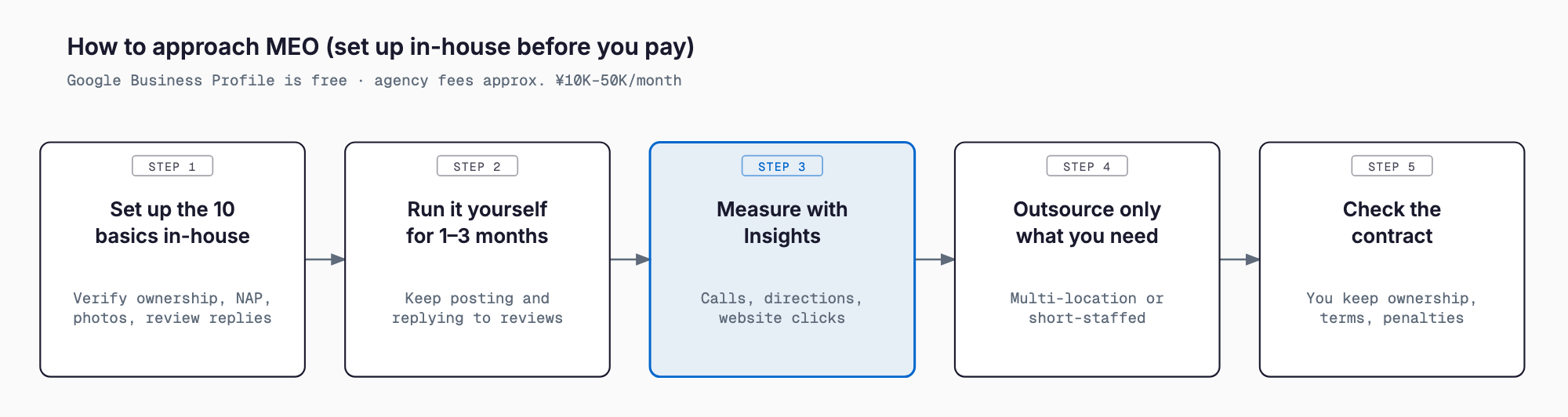
A safe approach is to complete the ten-item checklist yourself, run it for one to three months, and then decide whether an agency is needed. If you sign a monthly contract before your basics are in place, most of the fee goes to initial cleanup that you could have done for free.
Agencies tend to be worth it when (1) you don't want operations to stop if the person in charge leaves or moves, (2) you need consistent quality across several locations, or (3) writing posts and review replies has become a burden. Even then, instead of "do everything," choose a narrower scope, such as draft posts and a monthly report, to keep costs down.
Choosing a vendor: red flags and contracts to avoid
Some MEO vendors take advantage of small businesses' limited familiarity with the field. If you see any of the signs below, don't rush. Take the proposal home and think it over.
1. A guarantee of "number one, for sure." Google's rankings change with the searcher's location, time, and device. No one can guarantee first place for every person from every spot. Vendors that make this promise may be measuring under narrow conditions.
2. Long lock-in and heavy cancellation fees. Be wary of one- to two-year minimum terms where early cancellation means paying the rest of the term. Check whether you can start with three to six months, and confirm the notice period and any penalty.
3. Fake reviews or paid review requests. Having staff or acquaintances write reviews, or paying strangers to do so, violates Google's policies. It risks deleted reviews and a suspended account, and in the worst case your business can vanish from the map. Reviews that hide the fact they are advertising can also be a problem under Japan's stealth marketing rules, which took effect in October 2023 under the Act against Unjustifiable Premiums and Misleading Representations. Do not offer compensation for reviews. Stick to good service and natural invitations, such as a QR code after the visit.
4. Stuffing keywords into the business name. Naming your listing "Shibuya Lunch Recommended Maru Diner" instead of your real name breaks Google's guidelines. Rankings may rise briefly, but you can be forced to correct it or have the account suspended. Use the actual name you use on your sign, business cards, and website.
5. The vendor holds the owner rights. This one is critical. If the vendor creates and controls the profile under its own account and won't hand over ownership, you may lose your reviews and photos when the contract ends. Your own Google account (or your representative's) should always be the owner, with the vendor given a manager-level role. Being able to grant and revoke access yourself is your best protection.
6. Cold calls pretending to be "Google" or "Google-certified." Some callers claim to be from Google and warn that your listing will stop appearing unless you pay. The basic features of Google Business Profile are free. Don't sign on the spot. Hang up, then check the company name, address, and contact person before deciding.
Pre-contract checklist
Before signing a quote or contract, check each of the items below. What matters is that they are written in the document, not just explained verbally.
- Will your company be the owner of the Google Business Profile, with the vendor as a manager only?
- Is the scope of work clearly stated (number of posts, review replies, photography, reports)?
- For pay-per-result plans, are the target keywords, measurement method, measurement location, and monthly cap stated?
- Minimum contract term, cancellation notice period, and any penalty and its amount
- Confirmation of how reviews are gathered (no paid requests or fake reviews)
- Can you review and approve the business name and registered information beforehand?
- Report contents (does it include calls, directions requests, and website clicks from Insights?)
- Contact person, communication channel, and typical response time
- Handover after termination (account access, post and photo data)
- Conditions for extra charges (photography, multilingual support, adding more locations)
Collecting quotes from two or three vendors under the same conditions (scope, term, target keywords) is also effective. If each quote is built differently, you cannot tell which is expensive or cheap. Avoid deciding on a single vendor's explanation.
Measuring return: use Insights
You can't judge MEO by rank alone. Rankings change with where and when someone searches, so treat them as a reference. What really matters is the actions that came from your profile. Google Business Profile's performance Insights show numbers like these.
| Metric | Meaning | How to read it |
|---|---|---|
| Calls | Number of calls made from the profile | Closely tied to bookings and inquiries; check time-of-day patterns |
| Directions requests | Times someone started route guidance | Shows intent to visit; especially important for walk-in businesses |
| Website clicks | Visits to your official site | Check alongside traffic to booking and contact pages |
| Search views and queries | What words people used to find you | Unexpected terms can suggest information worth adding |
For return on investment, keep it simple: monthly fee divided by the number of inquiries or visits you gained from calls, directions, and website clicks. For example, if a 30,000 yen monthly service brings 10 extra inquiries or bookings that month, that is 3,000 yen each. Compare that to the average revenue or profit per customer. A clinic, professional office, or builder with high value per customer can accept a very different cost than a restaurant with a low spend per visit.
Record your numbers before you start. Without a baseline, you can't tell whether growth came from the vendor or from seasonal change. Save at least three months of Insights before the contract, then compare with the three to six months afterward. If bookings come via phone, forms, and online reservations, it also helps to ask "how did you find us?" at the visit or inquiry.
MEO alone is not enough: the website and SEO
MEO is powerful, but it does not complete your marketing alone. After finding you on the map, people often check your website for the menu, prices, track record, and access. If the information on your site and your Business Profile disagrees, you lose trust. Update hours, closed days, phone number, address, and services in both places at once.
Your website also helps Google understand what your business specializes in. The clearer the area, industry, and services are on the site, the easier you are to find in both map search and regular search. For regular search, see SEO対策の費用相場 (SEO service cost guide, in Japanese). For budgets when building or rebuilding a site, see ホームページ制作費用 (website production cost guide, in Japanese). Think of MEO and your website as two wheels of one vehicle, not alternatives.
It is also important to turn the inquiries and visitors MEO brings into repeat customers. If you gather new customers but don't record their information, you can't invite them back. For practical steps at small shops, see 商店の顧客管理デジタル化 (digitizing customer management for local shops, in Japanese). Looking at the whole path from attracting customers (MEO and SEO) to booking, visit, customer records, and return visits shows where your money is best spent.
Summary: get the basics right first, outsource only what you need
As a rough guide, MEO costs 0 yen in-house, about 10,000-50,000 yen per month for a fixed-fee agency, a few hundred to about 2,000 yen per day of top ranking for pay-per-result, and about 30,000-100,000 yen for one-off setup, all varying by vendor, region, and industry. Start with the basics: ownership verification, consistent NAP, categories, hours, photos, and review replies. These are free and doable in-house. If you then lack time, face heavy competition, or need consistency across locations, consider an agency with a narrowed scope.
When choosing a vendor, watch for guarantees of first place, long lock-ins, review manipulation, keyword-stuffed names, loss of owner rights, and calls pretending to be official. Verify the paperwork with the checklist. Measure results not by rank but by calls, directions, and website clicks in Insights, and by monthly fee divided by inquiries, so you can judge the return calmly.
FAQ
Can I do MEO myself, and does it cost anything?
Registering and running a Google Business Profile is free, and you can do the basics in-house. The main tasks are ownership verification, consistent name/address/phone, categories and hours, photos, posts, and review replies, which take roughly a few hours a month. Costs arise only if you outsource the work or use rank-tracking or multi-location tools.
Should I avoid pay-per-result MEO?
Not necessarily, but you must check the terms. Confirm in writing that the target keywords are not unusually narrow, how and from where rankings are measured, the monthly cap, and the minimum term and penalties. Some plans hit the cap almost every month and end up costing more than a fixed fee. Be especially careful with vendors guaranteeing first place.
Is it safe to let the vendor own my account?
We recommend that your company always holds the owner role. If the vendor's account is the owner, you may not be able to take reviews and photos with you when the contract ends. Make your own Google account the owner and give the vendor a manager role, so you can revoke access whenever you need to.
Can I give customers a perk in exchange for reviews?
Offering discounts or gifts for reviews violates Google's policies and risks review removal or account suspension. Reviews that hide that they are advertising can also be an issue under Japan's stealth marketing rules in force since October 2023. It is safer to invite reviews naturally, for example with a QR code at checkout or after the visit.
Related free tools (no sign-up, instant results)
Feel free to contact us
Contact Us