Offshore Development: Costs and How SMBs Avoid Failure
Offshore development outsources system building abroad. Covers monthly rates by country, why cheap rates do not mean a cheap total, lab vs fixed-price.
Offshore development means outsourcing the development of a system or app to a company or team in another country, such as Vietnam, the Philippines or India. Its main appeal is a lower monthly rate per engineer (the cost of one engineer working for one month) than in Japan. However, a low rate does not automatically mean a low total, and for projects that do not fit, offshore can end up costing as much as or more than hiring domestically.
In short, offshore development is a strong option for projects with settled requirements, a certain scale, and someone on your side (or at an intermediary company) who can organize specifications. It tends to go wrong for small businesses whose requirements are still vague, whose projects are small and change often, or who have no IT contact at all. This article is written for owners and non-IT staff, and covers the definition, rate ranges by country, why totals grow, which projects fit, contract types, common failure patterns and a pre-order checklist. All figures are general market ranges that move with exchange rates and skill levels.
What offshore development is
Offshore development means handing all or part of the development work to a base overseas. A Japanese company may contract directly with a Vietnamese firm, or it may contract with a Japan-based window company whose own overseas site does the actual work. The former is a direct contract and the latter is via a Japanese entity. For a small business trying offshore for the first time, the latter, where a Japanese-speaking contact handles communication, is usually more realistic.
Several similar terms exist, so here is how the options differ. Nearshore means using a regional base within Japan (Okinawa, Fukuoka, Hokkaido and so on), which has few language or business-practice barriers. Domestic outsourcing means a typical development company, often in Tokyo. A freelancer is an individual you contract directly.
| Item | Offshore | Nearshore | Domestic outsourcing | Freelancer |
|---|---|---|---|---|
| Where work happens | Overseas | Regional base in Japan | Japan (mostly cities) | Individual, in Japan or abroad |
| Monthly rate (guide) | Low | Somewhat low | High | Wide range |
| Language / business practice gap | Large (needs an interpreter role) | Almost none | Almost none | Depends on the person |
| Time difference | Often 0-3 hours | None | None | Depends |
| Suitable scale | Medium to large | Small to medium | Small to large | Small |
| Main risk | Misunderstandings and rework | Limited price advantage | Higher cost | Key-person dependence, continuity |
For the differences between freelancers and development companies, see freelancer vs development company. Offshore does not replace any single column in the table above. It is one option for the goal of lowering cost or securing more engineers.
Monthly rates by major country
Countries known as offshore destinations include Vietnam, the Philippines, India, Bangladesh and China. Each differs in strengths, engineer headcount and the number of Japanese speakers. Vietnam has many firms serving Japanese clients and a relatively good supply of Japanese-speaking bridge staff (explained below). India has deep talent in advanced areas such as AI and cloud, and the Philippines is often said to suit English-friendly work and support-type operations.
The table below shows general market ranges for one engineer for one month. Actual amounts vary with the size of the vendor, years of experience, exchange rates and contract type, and may fall outside these ranges. Labor costs are rising in many countries, so older figures may no longer hold. Please use it only as a reference for comparison.
| Destination | Monthly rate guide (JPY) | Characteristics |
|---|---|---|
| Vietnam | approx. 350K-650K | Many firms serve Japan; relatively many Japanese-speaking bridge staff |
| Philippines | approx. 350K-700K | English works well; track record in business systems and web |
| India | approx. 400K-900K | Deep talent pool; many firms strong in AI and cloud |
| Bangladesh | approx. 300K-550K | Lower rates; still few firms focused on Japan |
| China (e.g. Dalian) | approx. 500K-1M | Some bases have many Japanese speakers; rates rising |
| (Reference) Domestic | approx. 900K-1.8M | Japanese throughout; wide range by role and firm size |
Comparing rates alone, offshore looks like roughly 30 to 60 percent of the domestic figure. But this compares only the engineers' working cost. As the next section explains, other costs are added to the total you actually pay.
Why a low monthly rate does not mean a low total
There are four main reasons the total does not fall as much as expected. First is the cost of a bridge engineer (a bridge SE), who acts as interpreter and coordinator between Japan and the overseas team. This person receives specifications in Japanese and conveys them in a form the overseas engineers understand, and typically adds headcount equal to 10 to 20 percent of the project. Because Japanese-speaking staff are expensive, this noticeably affects the total.
Second is communication cost. A confirmation that takes a quick conversation domestically must be written down, sent and answered in offshore work. Interpreting at meetings, translating minutes and answering chat questions add effort other than building. Third is rework. Vague Japanese expressions such as "make it nice", "as appropriate" or "handle it sensibly" do not carry across. Rebuilding because of a different interpretation is usually the client's cost unless the contract is fixed-price. Fourth is the client's own project management effort: progress checks, quality checks and decisions on specifications always need someone on your side.
| Cost item | Domestic | Offshore |
|---|---|---|
| Engineers' working cost | High | Low |
| Bridge SE / interpretation | Almost none | Roughly 10-20% of project size |
| Writing and translating specs | Light | Detailed documents needed; increases |
| Rework | Relatively low | Tends to rise with misunderstandings |
| Client-side PM effort | Normal | Higher (more checks and decisions) |
| Total trend | Baseline | 20-40% cheaper if conditions fit; equal or higher if not |
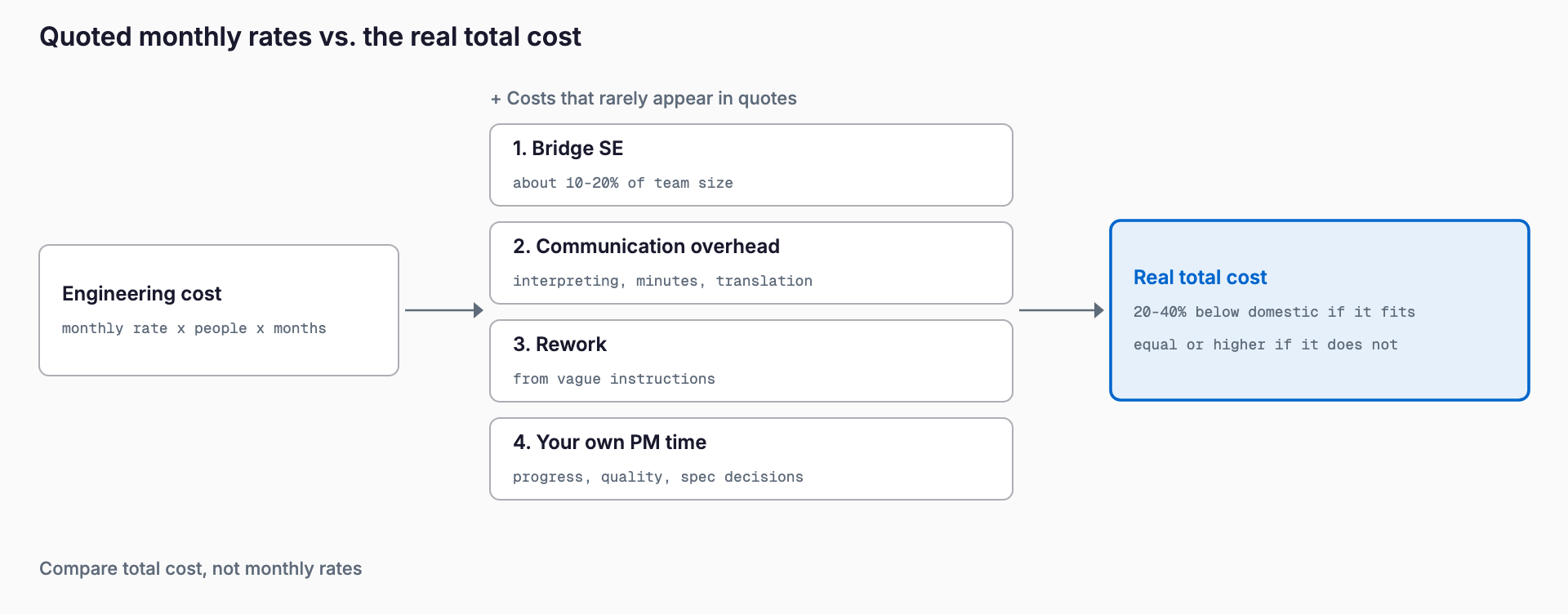
The 20 to 40 percent in the last row is only for good conditions: settled specifications, a large scale and someone on your side able to coordinate. For small projects, fixed costs such as the bridge SE take a larger share, and the total can match or even exceed the domestic one.
Benefits of offshore development
- Lower rates make it easier to secure more people or a longer period on the same budget
- Easier access to engineers hard to hire in Japan (especially AI, mobile and legacy languages)
- Easier to stand up a multi-person team for a large project
- Some countries allow work to continue after the Japanese team leaves for the day
- Working with the same team over the long term builds up knowledge of your system (for lab-type contracts)
Drawbacks and risks
- Language and cultural differences easily cause misunderstandings
- The burden of writing documents such as specifications increases
- Quality is unstable if the client is not involved in management
- Depending on the country and company, turnover can be high and the team may change
- Time differences, public holidays and cultural leave mean some days have no contact
- Information security (personal data, trade secrets) and legal compliance must be secured by contract and operation
- If the contract is not in yen, exchange rates change the cost
Projects that fit and projects that do not
Whether offshore fits is largely decided by how firmly you can pin down specifications in writing and by scale. Use the table below as a guide.
| Aspect | Fits well | Fits poorly |
|---|---|---|
| Specification maturity | Requirements, screens and business rules are documented | You want to decide while building |
| Scale | A few to dozens of person-months or more | Small changes of 1-2 person-months |
| Frequency of change | Few changes, or a defined change process | Specifications change almost weekly |
| What you build | Replacing existing systems, core business systems, adding features to apps | Exploratory prototypes for new ventures, designs needing deep industry knowledge |
| Client-side structure | At least one person who can judge specifications | No IT contact; nobody to confirm or decide |
| Duration | Ongoing development of six months or more | One-off short job of 1-2 months |
If a small business has no one who knows IT, avoid contracting overseas directly and choose a form in which a Japanese window company handles everything from organizing specifications to acceptance. Even then, confirming specifications and setting priorities remains the client's job. There is essentially no form in which you can leave everything to the vendor.
Lab-type vs fixed-price contracts
Offshore contracts broadly come in two types: fixed-price ("ukeoi") and lab-type. The idea is simple. Fixed-price means a defined deliverable for a defined amount. Lab-type means reserving a dedicated team for a period and developing within that capacity.
| Item | Fixed-price | Lab-type (dedicated team) |
|---|---|---|
| Payment | Lump sum or installments per deliverable | Headcount x monthly fee (fixed each month) |
| Specification changes | Tend to need extra cost or re-quotes | Easier to change within the capacity |
| Best for | One-off development with settled specs | Ongoing or additional development with changing specs |
| Responsibility for completion | Vendor (depending on contract) | Client manages |
| Cost predictability | Easier | Total grows if the period extends |
| Client's burden | Mainly acceptance | Daily instructions and prioritization |
For a small business with no dedicated IT staff, lab-type is a difficult contract. You must handle daily prioritization and specification decisions yourself, and if you cannot, the team's time simply accumulates as cost. For a first project, starting with fixed-price (or a two-step approach: fix the specifications first, then proceed on a fixed-price basis) keeps the risk lower. In either case, whether the contract is fixed-price or quasi-delegation changes the scope of responsibility, so confirm it beforehand.
Total cost by project size
The table below sketches totals for the same scope ordered domestically versus offshore. It varies greatly with conditions, so treat it as a rough feel for the comparison. It assumes the total the client pays, including the bridge SE and similar costs.
| Size (effort guide) | Domestic total | Offshore total | Trend of the gap |
|---|---|---|---|
| Small (about 3 person-months) | approx. 3M-5M yen | approx. 2.5M-4.5M yen | Almost no gap; can reverse |
| Medium (about 10 person-months) | approx. 10M-16M yen | approx. 7M-12M yen | Possibly 20-30% cheaper |
| Large (30+ person-months) | approx. 30M yen or more | approx. 20M-25M yen | Possibly 30-40% cheaper |
The benefit is hard to see at small scale and the gap widens as size grows. This is because costs needed regardless of size, such as the bridge SE and writing specifications, shrink as a share of a larger total. For domestic cost levels, see the system development cost guide as well.
Common failure patterns
Offshore troubles follow nearly fixed patterns. Knowing them in advance lets you avoid most of them.
Failure 1: ordering with vague requirements
This is the most common cause. With instructions like "I want member management" or "I want online booking", overseas engineers fill the gaps with their own experience. That may not match how the Japanese business actually works, and a large fix appears near completion. Organizing requirements and writing down the client's wishes matters domestically too, but offshore it is essential. How to write an RFP is covered in RFP basics.
Failure 2: too little specification, with different interpretations
Verbal agreements and the unwritten rules that are taken for granted at Japanese workplaces do not carry across. Record screen flows, input fields, behavior on errors and how data is held, using diagrams and concrete examples as far as possible. Writing not only the normal case but also errors and exceptions is the most effective way to prevent rework.
Failure 3: no acceptance criteria
The vendor says it is complete, but the client feels it is not what was wanted. Decide in writing before the contract what counts as complete, which tests must pass for acceptance, and who bears the cost of fixing defects. The points to check are summarized in the acceptance checkpoints guide.
Failure 4: not checking source code rights
It is easy to overlook who holds the copyright to the deliverables, whether you receive the source code, and which country's law governs a contract with an overseas company. If the rights remain with the vendor, you may be unable to move maintenance to another company later. The basic ideas are explained in source code copyright. For overseas contracts, also check the governing law and the jurisdiction for disputes.
Failure 5: underestimating time zones and language
Vietnam and the Philippines are only one to two hours from Japan, but India is about three and a half hours away, which shortens overlapping working hours. Public holidays and long breaks (such as Lunar New Year) differ by country, and there is no contact during them. Trying to convey detailed requests only through chat text also increases misunderstandings. Agreeing in advance on regular meeting times, contact channels and expected response times reduces missed signals.
Pre-order checklist
Before considering offshore, check the items below. If many are answered no, domestic outsourcing may suit you better.
- Can you put the purpose, target users and required features in a document?
- Can you assign one person in-house to confirm and decide on specifications?
- Is the scale a guide of 10 person-months or more, or ongoing development of six months or longer?
- Have you chosen a Japanese-speaking window company (with a bridge SE)?
- Do you understand fixed-price, quasi-delegation and lab-type, and have you chosen the contract that fits the project?
- Did you put acceptance criteria and the test scope in writing before the contract?
- Does the contract state who owns the source code and copyright, and what you receive?
- Did you check the handling of personal and confidential information, and whether subcontracting is allowed?
- Did you check how exchange-rate changes affect cost (is it a yen contract)?
- Did you ask in advance under what conditions extra fees arise (specification changes, additional requests)?
- Did you confirm who takes on maintenance and operations, and the handover if staff change?
- Do you plan to start small (a 1-2 month limited scope) to test compatibility?
What small businesses should watch in the first step
A small business using offshore for the first time should not hand over a large project right away, and should instead start small. Choose something with a clear scope and limited impact if it fails, such as adding one feature or a few screens to an existing system. Use it to check how well you can write specifications, how fast communication is, the quality and the accuracy of estimates, then widen the scope. That is the sound path.
Always get quotes from several companies and compare not only the monthly rate but also the number of bridge SEs, the scope of specification writing, the scope of testing and whether a warranty period is included. An extremely low quote may omit these. Asking each company for a list of what is and is not included makes comparison easier.
Frequently asked questions
How much does offshore development cost?
A guide for one engineer per month is roughly 350K-700K yen in Vietnam and the Philippines and 400K-900K yen in India, lower than the roughly 900K-1.8M yen for domestic outsourcing. However, bridge SE costs, specification writing and rework are added, so the total gap is about 20-40 percent in good conditions, and small projects may show no gap. Treat these as guides that vary with exchange rates and skill levels.
Can a small company use offshore development?
It can, but it is not for everyone. It suits projects with settled specifications, a scale of around 10 person-months or more, and an in-house person able to judge specifications. For small changes of 1-2 person-months, or projects where you want to decide while building, a domestic development company or freelancer is often cheaper in total and safer.
How should I choose between Vietnam, the Philippines and India?
As a general tendency, choose Vietnamese or Chinese bases if Japanese-language support matters most, India if you need English communication and advanced technology such as AI or cloud, and the Philippines for English-based business systems and web work. Differences between individual companies are larger than differences between countries, so always check track record with Japanese clients and whether a Japanese-speaking contact is provided.
Which is better, lab-type or fixed-price?
Fixed-price suits one-off development with settled specifications, and lab-type suits ongoing development where specifications change. Small businesses without dedicated IT staff find lab-type hard to run, so starting with fixed-price is the safer choice. Whether the contract is fixed-price or quasi-delegation changes the scope of responsibility, so confirm it before signing.
Who owns the source code?
It depends on the contract. The contract must state whether copyright in the deliverables transfers to the client or stays with the vendor, and whether you receive the source code. If the rights stay with the vendor, you may be unable to move maintenance to another company later. For contracts with overseas companies, also check the governing law and the jurisdiction for disputes.
What matters most for avoiding failure in offshore development?
Putting specifications into documents and deciding acceptance criteria before the contract. Most failures come from misaligned understanding rather than technical skill. Organizing requirements, describing screens, inputs and error behavior concretely, and starting with a small scope to test compatibility greatly reduces risk.
Related free tools (no sign-up, instant results)
Feel free to contact us
Contact Us