Owned-Media Blog Costs: In-House vs. Outsourcing Guide
Owned-media blogging runs 20,000-80,000 yen per article, or 100,000-400,000 yen monthly for full management, as of Aug 2026. Covers in-house vs. vendor split.
Running an owned-media blog typically costs 20,000-80,000 yen per outsourced article, or roughly 100,000-400,000 yen a month if planning, writing, and publishing are all handled together (figures as of August 2026). Beyond the price tag, it's just as important to understand whether in-house writing or outsourcing fits your company better, and how many articles it usually takes before results start to show, so you can budget for this as a real investment rather than a one-off expense.
Why "just start a blog" rarely works
It's common for a company to launch a website, get told that regular blogging helps with SEO, publish a handful of posts, and then quietly stop updating. Usually the root cause isn't lack of motivation — it's that nobody decided upfront who would write, how often, and at what budget. An owned-media blog isn't a one-time project; the ongoing operating structure is what actually determines whether it pays off, so it's worth setting cost and staffing expectations before you begin.
A frequent pattern is starting to publish on a vendor's recommendation without ever setting aside a budget. Months pass without anyone clearly owning the task, and either nobody writes at all, or the owner ends up writing articles on the side and burning out. Nearly all of this is avoidable by deciding two things upfront: how much you're willing to spend, and who is actually responsible for writing.
What outsourcing actually costs
Outsourced blogging is usually sold in one of two ways: per-article pricing, or a monthly retainer. Per-article pricing charges for each piece individually, which suits one-off requests or teams that want to adjust volume month to month. A monthly retainer bundles planning, writing, publishing, and light performance review into a flat fee, which tends to make costs easier to forecast for teams committed to ongoing publishing.
Price differences mostly come down to whether interviews are involved, how specialized the topic is, how many revision rounds are included, and whether keyword research is part of the scope. An article built around interviewing an executive or field staff, one requiring industry-specific expertise, or one with custom diagrams and original images all take more effort than simply organizing existing information, so they tend to cost more. When comparing quotes, check what's actually included, not just the headline price.
| Item | Estimated cost (as of Aug 2026) | Notes |
|---|---|---|
| Per article | 20,000-80,000 yen | Varies with length, expertise, interviews |
| Article + keyword research | 30,000-100,000 yen/article | Includes SEO planning |
| Monthly retainer (4+ posts) | 100,000-250,000 yen | Planning, writing, publishing included |
| Monthly retainer (8+ posts, w/ analysis) | 200,000-400,000 yen | Includes performance review |
| Custom diagrams/images | 5,000-30,000 yen/piece | Often billed separately from the article fee |
As covered in what SEO services cost, the fee for writing articles and the fee for SEO strategy work are usually quoted separately. Deciding in advance whether you're only asking for blog updates, or also for search-ranking improvements, makes it much easier to compare quotes apples-to-apples.
In-house or outsourced: which fits your team
Writing in-house avoids paying an outside vendor, but it requires someone with the bandwidth and know-how to keep it going. In small companies, the person assigned to blogging on top of their regular job often burns out within a few months, and updates stop. Outsourcing costs more, but tends to sustain a consistent publishing cadence and gives you access to writers who already understand SEO.
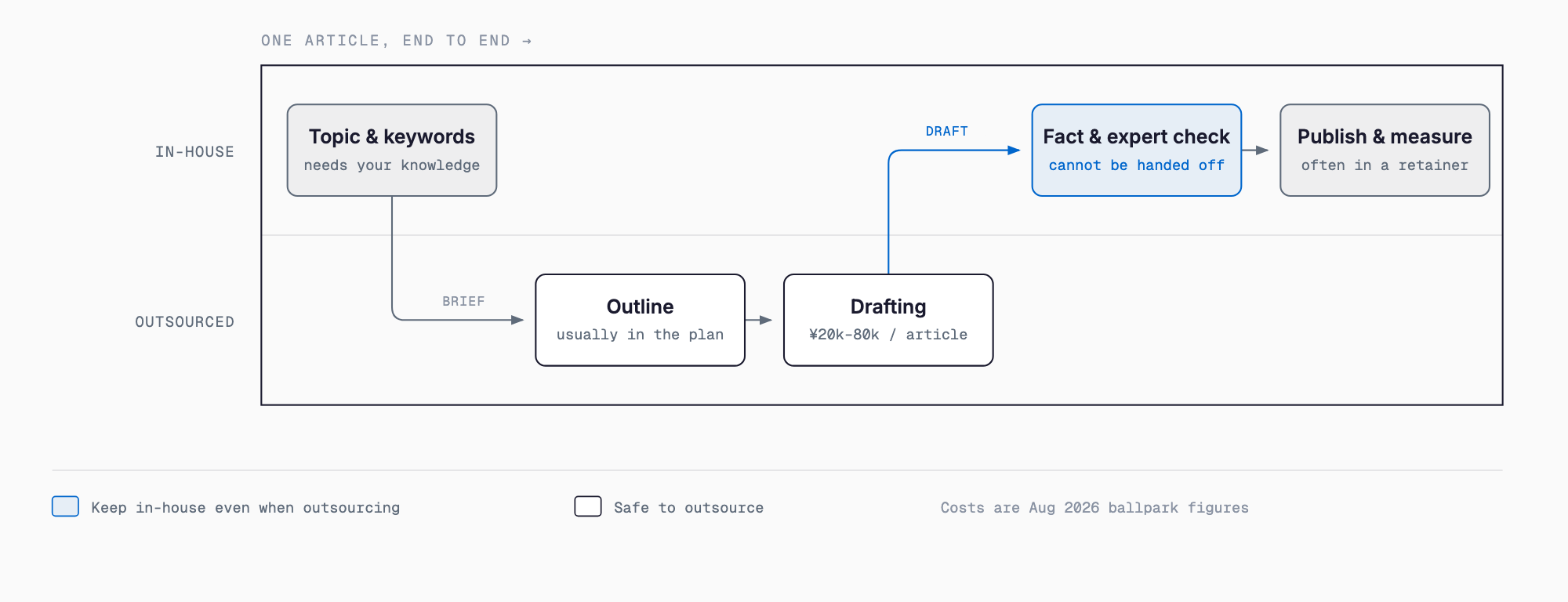
A practical middle ground that more companies are adopting is a hybrid approach: keep topic selection and subject-matter expertise in-house, while outsourcing the actual writing, structuring, and publishing to an outside writer. This lets you reflect your company's own perspective and first-hand knowledge while offloading the writing workload itself, so you're not forced to choose fully in-house or fully outsourced. Starting with one or two outsourced articles a month while building internal know-how is also a realistic way to phase into it.
- Have a staff member with industry knowledge who can spend several hours a month → in-house often works well
- Have staff but no confidence in sustaining it, or no SEO know-how → outsource, or try a hybrid of in-house planning with outsourced writing
- No one available, or updates have stalled before → outsourcing is usually more realistic
- Frequent need for technical depth or interviews → outsource, or in-house with an expert reviewer
How many articles, and how long until results
Organic search traffic rarely grows right after publishing a few articles; noticeable change typically takes around six months to a year of consistent publishing. As a rough benchmark, many companies aim for roughly 4-8 articles a month, adjusted for how competitive their target keywords are. Prioritizing volume at the expense of quality tends to backfire, so pacing yourself at a sustainable rate is usually more productive than a short burst of publishing followed by silence.
It also helps to judge success by more than search traffic alone. Articles can double as sales material, build trust with prospects during an inquiry, or give job candidates a way to learn about your company beforehand. Companies that track only search rankings often see little movement early on and give up before results appear, so weighing several kinds of value can make it easier to stay the course.
It's also worth folding this into your budget when planning a new site, as discussed in typical website build costs — deciding on an ongoing operating structure at the same time as the initial build helps avoid the common pattern of updates stopping right after launch.
Where AI-assisted drafting helps, and where it doesn't
Generative AI can meaningfully cut the time spent on drafting and brainstorming, which is why it's gaining attention as a way to lower costs. That said, publishing AI output as-is carries a real risk of factual errors and generic-sounding content, which can undermine reader trust. It works best as an assistant for outlining and organizing information, with a human still responsible for fact-checking, adding a genuine company perspective, and catching mistakes before publication. For more on where generative AI fits for smaller companies, see a small company's first steps with generative AI.
A checklist before you start publishing
An article isn't done the moment it's published — ongoing updates and periodic review are what turn a blog into a result. Confirming the following before you commit budget helps keep the effort from stalling out.
- Have you assigned who writes each article (in-house or outsourced) and how many per month?
- Have you set a monthly budget cap and chosen between per-article and retainer pricing?
- Is your schedule built around results taking 3-6 months to appear, not immediately?
- If using AI drafting, has someone been assigned to do the final review?
- Have you budgeted this alongside overall website maintenance costs as part of your annual site budget?
How much does it typically cost to outsource one article?
Costs vary by topic and depth, but a common range is 20,000-80,000 yen per article. Pieces that require interviews, custom diagrams, or specialist research tend to land at the higher end, while articles that mainly organize existing information can come in near the lower end. Word count, the number of revision rounds, and whether keyword research is included also affect the price, so it's worth asking for an itemized quote before committing.
How many articles per month are needed to see results?
This depends on your industry and how competitive your target keywords are, but many companies start seeing changes in search traffic after publishing roughly 4-8 articles a month for six months to a year. Whether you prioritize quality with fewer articles or volume with more depends on your available resources, but in either case it's important to plan for a sustained effort rather than expecting quick results.
Can using AI to write articles reduce outsourcing costs?
AI can speed up drafting and brainstorming, but fact-checking, adding your company's own perspective, and catching inaccurate statements still require human editing. Publishing AI-generated text without review tends to produce generic or occasionally incorrect content, so even if you expect cost savings from AI, it's advisable to keep a final human review step in the workflow.
Should we handle this in-house or outsource it?
If you have a staff member with industry knowledge who can consistently set aside time for writing, handling it in-house is often the more cost-effective option. If finding that person is difficult, your team lacks SEO know-how, or updates keep stalling, outsourcing — or a hybrid of in-house planning with outsourced writing — tends to be easier to sustain over time.
Related free tools (no sign-up, instant results)
Feel free to contact us
Contact Us