Quality Management & Traceability System Costs (2026)
A cost guide to quality management and traceability systems for small manufacturers, comparing cloud tools to custom builds with cost ranges by company size.
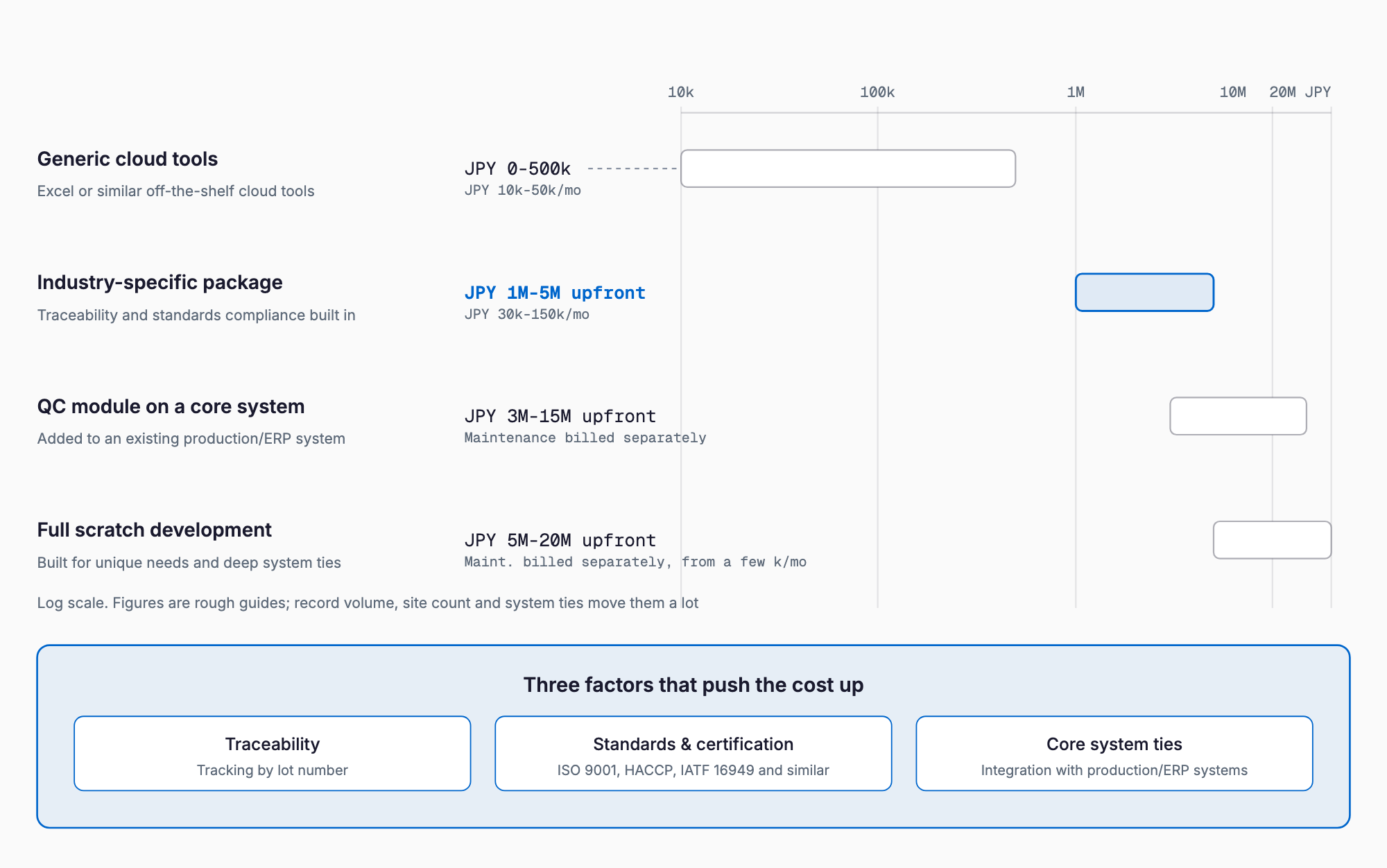
Adopting a quality management and inspection-record (traceability) system typically starts at around JPY 200,000 for a cloud tool that replaces spreadsheet logs, runs JPY 1,000,000-5,000,000 for an industry-specific package that covers standards such as ISO 9001 or HACCP, and reaches JPY 5,000,000-20,000,000 for a fully custom build integrated with core systems. Costs jump further once you require traceability — tracking a lot from raw material intake through production to shipment — rather than simply logging inspection results. This article lays out typical costs, functional scope, how to choose, and common pitfalls for small manufacturers' owners and plant managers.
The Functional Scope These Systems Cover
A quality management and inspection-record system logs the results of incoming, in-process, and outgoing inspections, and centrally manages pass/fail decisions, root-cause analysis of defects, and corrective actions. At many small manufacturers, inspection results are scattered across paper inspection sheets or department-specific spreadsheets, making it time-consuming to trace which lot or process step caused a defect once one is found. When multiple inspectors record results in different formats, even aggregating the numbers at month-end takes considerable effort, often leaving no time left for trend analysis. Adding traceability links raw-material receiving lots through the production process to the shipping destination, which makes it dramatically faster to identify the scope of impact when a recall or a customer quality complaint occurs. If you also want to manage process progress and inventory together, Production Management System Cost is a useful companion reference.
Comparing Costs by Implementation Approach
Ways to build a quality management and inspection-record system fall into four broad categories: a general-purpose cloud tool aimed at moving off paper and spreadsheets, an industry-specific package built for traceability and standards compliance, a quality module within a core system, and fully custom (scratch) development. The right choice depends on the functional scope you need and which standards you must satisfy, so it helps to first clarify how much recording and traceability precision your company actually requires before comparing options.
| Approach | Typical Initial Cost | Typical Monthly Cost | Best Suited For |
|---|---|---|---|
| General-purpose cloud tool | Roughly JPY 0-500,000 | Roughly JPY 10,000-50,000/month | Small operations starting with paperless inspection records |
| Industry-specific package (traceability & standards included) | Roughly JPY 1,000,000-5,000,000 | Roughly JPY 30,000-150,000/month | Businesses where ISO 9001, HACCP, or lot tracking is mandatory |
| Quality module within a core system | Roughly JPY 3,000,000-15,000,000 | Separate maintenance fees often apply | Mid-size companies wanting quality unified with production and inventory |
| Fully custom (scratch) development | Roughly JPY 5,000,000-20,000,000, tens of millions for large scale | Separate maintenance fee from a few tens of thousands of yen/month | Complex, unique inspection items or pass/fail criteria that off-the-shelf products cannot fit |
*These figures are general reference points only and vary significantly by requirements. Always obtain and compare quotes from multiple vendors.*
Cost Ranges by Company Size and Process Count
Cost varies considerably with the number of inspection steps, how granular lot tracking needs to be, and whether standards compliance is required. The following ranges by employee count are a general tendency only.
| Company Size | Likely Approach | Typical Initial Cost |
|---|---|---|
| Roughly 10-30 employees | Cloud tool covering inspection records only, as a first step | Roughly JPY 0-800,000 |
| Roughly 30-70 employees | Industry-specific package including traceability | Roughly JPY 1,000,000-6,000,000 |
| Roughly 70-100 employees | Core system integration or fully custom development | Roughly JPY 5,000,000-20,000,000, more for complex cases |
Why Traceability Drives Cost
A system that merely logs inspection results and a system that can trace a product from raw material to shipment require very different designs. True traceability means holding data that links incoming material lot numbers, production lots, and shipping destinations, and being able to search backward and forward from any given lot. If barcode or QR-code lot scanning is built into floor operations, handheld terminals and label printers add hardware cost on top of the development needed to connect them to the system. In industries such as food and medical devices, where lot management is required by law, this capability is close to mandatory and should be built into requirements early rather than added later. It also pays to decide, at the design stage, how far back retrospective searches need to reach and what format any traceability certificates you hand to customers should take — leaving these undecided tends to force a rebuild later.
Additional Cost from Standards and Audit Compliance
If your company holds or maintains certifications such as ISO 9001, HACCP, FSSC 22000, or the automotive-industry IATF 16949, the system needs to satisfy the record fields, retention periods, and change-history (audit trail) requirements those standards demand. Choosing a general-purpose package that already ships with templates built for these standards often keeps additional customization cost down. Bringing standards compliance in later as an afterthought, on the other hand, tends to force a redesign of forms and approval workflows, adding cost and delay. Maintaining a certification also carries ongoing administrative cost for audit response, which is worth budgeting for alongside the system itself.
Main Factors That Inflate Cost
- Complexity of inspection items and pass/fail criteria: the more finely each product's unique inspection items and criteria are custom-built, the more development effort it takes
- Traceability granularity: whether tracking is done by lot or by individual unit (serial number) changes data design and hardware requirements significantly
- Standards and audit compliance: designs need to satisfy the record and audit-trail requirements of ISO 9001, HACCP, IATF 16949, and similar standards
- Hardware integration: automatic data capture from barcodes, QR codes, handheld terminals, or inspection equipment adds integration development cost
- Insisting on replicating an existing ledger: demanding the same look as the current Excel form pushes the build outside a package's standard features and drives up customization cost
- Statistical quality control (SQC) features: requesting control charts or process capability indices (Cpk) increases development cost
- Multi-language or multi-site support: sites with overseas locations or a workforce that includes foreign technical trainees often need multi-language displays and data integration across sites, which requires additional development
Pre-Order Checklist
- Has the scope (incoming / in-process / outgoing inspection / traceability) been clearly defined?
- Have the mandatory standards and certifications (ISO 9001, HACCP, FSSC 22000, IATF 16949, etc.) been identified?
- Has the traceability granularity (lot-level vs. unit-level) been decided?
- Have hardware requirements been identified, such as barcodes, QR codes, or handheld terminals?
- Does the quote include the scope and cost of migrating existing inspection sheets and ledger data?
- Have retention period and audit-trail (change history) requirements been communicated to the vendor?
- Have quotes been obtained from multiple vendors and compared on total cost, including initial, monthly, and maintenance fees?
For how to compare quotes, see How to Get Competitive Quotes, and for how to read a vendor's quote once you receive one, see Guide to Reading a Development Quote — both are worth checking before placing an order.
Implementation Steps and Timeline
A quality management and inspection-record system is best rolled out in stages — from requirements review through master data setup and a pilot run before full operation — to reduce rework. A typical timeline is as follows.
| Step | Main Activities | Typical Duration |
|---|---|---|
| Current-state review and requirements | Define target processes, standards requirements, and traceability granularity | 2 weeks to 1 month |
| System selection | Compare cloud, industry package, core-system integration, or custom build; select vendor | 1-2 months |
| Master data and form design | Set up inspection items, pass/fail criteria, and product masters; design record forms | 1-2 months |
| Pilot run | Run on a subset of lines or products to validate record accuracy and floor workload | 1-2 months |
| Full rollout and operation | Company-wide rollout across lines, inspector training, ongoing review as standards change | Ongoing |
Common Failure Patterns
- Adopting a system solely to go paperless on inspection records, only to discover traceability requirements later and having to rebuild
- Skipping interviews with floor inspectors, so the finished system keeps running alongside paper records because there are "too many fields to fill in"
- Bringing standards compliance in as a later requirement, forcing a redesign of forms and approval workflows that adds cost and delay
- Leaving hardware costs such as handheld terminals and label printers out of the quote, leading to unexpected additional cost
- Signing a contract without confirming maintenance and support terms, then facing high fees every time a standard is updated or inspection items change
Are a quality management system and an inspection-record system the same thing?
Strictly speaking, the scope differs. An inspection-record system centers on logging and storing the results of incoming, in-process, and outgoing inspections, while a quality management system often also covers root-cause analysis of defects and management of corrective actions. Whether traceability (lot tracking) is added on top changes both the required design and the system cost significantly.
Do small companies really need traceability?
In industries such as food and medical devices where lot management is legally required, it is close to mandatory. Even outside those industries, being able to quickly identify the scope of impact (other products from the same lot) when a customer raises a quality complaint has real value for recall response and maintaining trust. If it is not mandatory, starting with digitizing inspection records and adding traceability later as a staged rollout is a realistic option.
Is it safe to just pick a system that supports ISO 9001 or HACCP?
A product that ships with templates for these standards tends to keep customization cost down, but how closely your own inspection items and approval workflow match that template varies by product. Before adopting one, it is important to present your own record formats and approval workflow and confirm with the vendor how much of it the standard features can actually cover.
If a quote comes in higher than expected, what should we reconsider?
First, consider whether the traceability granularity can be relaxed - lot-level tracking may be sufficient rather than unit-level. It is also worth identifying features that are not strictly necessary, such as statistical quality control (SQC) functions or hardware integration, and deferring them to a later phase, which is an effective way to bring down initial cost.
Summary
Costs for a quality management and inspection-record system range widely: digitizing inspection records alone can start with a cloud tool for a few hundred thousand yen, while adding lot-level traceability and compliance with standards such as ISO 9001 or HACCP can push the total into the millions or tens of millions of yen. Rather than trying to build every capability at once, a realistic way to avoid cost overruns is to start by digitizing inspection records and add traceability in stages as legal requirements or customer expectations demand it. Because actual costs vary significantly by requirements, it is advisable to obtain and compare quotes from multiple vendors before deciding.
Related free tools (no sign-up, instant results)
Feel free to contact us
Contact Us