Fleet & Dispatch Management System Cost and Selection Guide
A cost guide to fleet and dispatch systems for firms running 10-100 vehicles: cloud, telematics and custom pricing, hidden device costs and common pitfalls.
Fleet and dispatch management systems typically cost around ¥2,000-8,000 per vehicle per month for a cloud-based plan, tens of thousands of dollars up front (including hardware) when linking to an existing telematics device, and upwards of ¥5 million for a fully custom build. It's not just trucking companies that hit this wall - construction firms running material trucks, and field-service businesses like elder-care transport or facility maintenance, tend to run into the same pain points once their company fleet passes roughly 10 vehicles: nobody knows where a given vehicle is, and daily logs eat up too much time. This article lays out realistic cost ranges and a selection checklist in plain terms for non-technical managers. For a broader look at digitizing logistics operations, see Logistics DX.
What a fleet management system is - and how it differs from digital tachographs, dashcams, and dispatch software
"Vehicle management" covers several distinct devices and systems with different jobs. A digital tachograph is primarily a legally mandated recorder of speed, distance, and driving/rest time. A dashcam's main job is capturing video footage. A fleet management system, by contrast, centralizes GPS location, utilization, fuel efficiency, and inspection records in the cloud, while a dispatch management system goes a step further and optimizes which vehicle and driver get assigned to which job or visit. Most cloud services on the market pull in data from tachographs and GPS devices while covering both fleet management and dispatch in one package.
| Device / system | Primary role | Data it records |
|---|---|---|
| Digital tachograph | Meets legal recording requirements | Speed, driving time, rest time |
| Dashcam | Video evidence for accidents and incidents | Driving footage, impact detection |
| Fleet management system | Centralizes vehicle location, usage, and condition | Location, utilization, fuel efficiency, inspection history |
| Dispatch management system | Optimally assigns jobs to vehicles and drivers | Dispatch plans, visit order, routes |
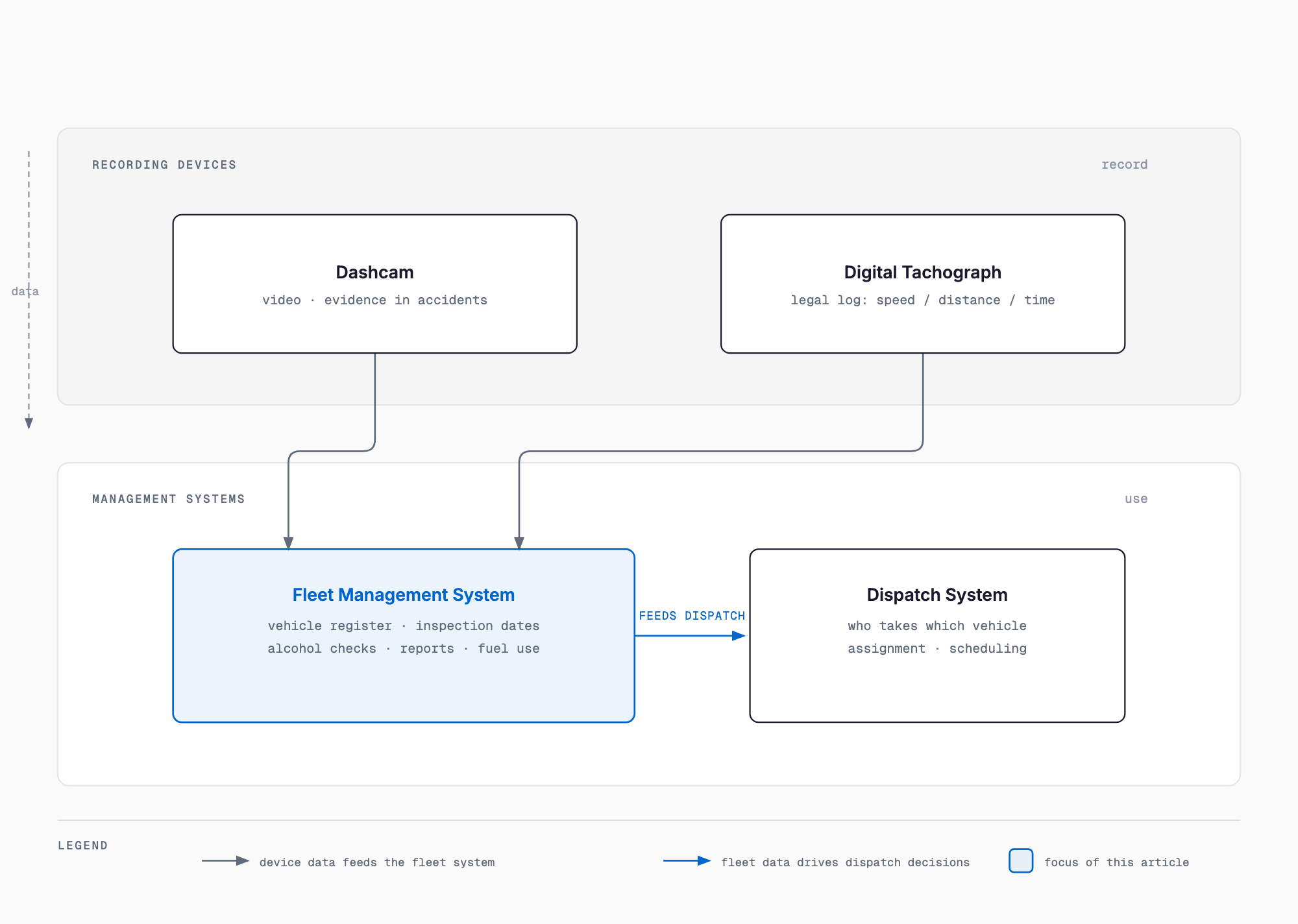
What problems a fleet management system solves
- Alcohol-check logging compliance: since the check became mandatory in December 2023, visual and breathalyzer-based alcohol checks can be logged and stored automatically in the system
- Time spent on daily logs: driving data is recorded automatically, cutting down the time drivers spend writing reports by hand
- Centralized fuel and vehicle records: fuel efficiency is calculated automatically from fuel purchases and mileage, and inspection/renewal dates can be tracked in one place
- Visibility into utilization: see in real time which vehicles are in use and which are free
- More efficient dispatch adjustments: when a job is added or a visit changes last-minute, dispatchers can reassign vehicles while viewing driver locations on a map
- Records for accidents and incidents: retained location and driving history make it easier to reconstruct what happened and respond to inquiries
Typical cost ranges
Costs vary significantly by delivery model. The figures below are rough guidelines only - actual pricing shifts with fleet size, whether you're installing new telematics hardware or linking to existing devices, and how much customization is involved. Since cloud plans are billed per vehicle per month, the total monthly cost scales roughly in proportion to fleet size. Before signing, it's worth asking a vendor to project the annual cost at 10, 50, and 100 vehicles.
| Delivery model | Typical upfront cost | Typical monthly cost (per vehicle) | Best fit |
|---|---|---|---|
| Cloud-based (GPS device rental included) | ¥0-50K range (device cost sometimes folded into monthly fee) | ¥2,000-8,000 range | 10-100 vehicles, companies wanting to start small |
| Telematics-linked (cellular tachograph) | ¥200K-1M range (including tachograph hardware) | ¥3,000-10,000 range | Companies already running telematics tachographs, or wanting compliance logging unified with fleet data |
| Fully custom build | From ¥5M | Maintenance/operations quoted separately | Companies needing custom dispatch logic or core-system integration |
Costs beyond the software license
One thing companies often overlook is the cost that sits outside the software subscription itself. GPS in-vehicle devices are often bundled into the monthly rental fee, but if purchased outright they typically run ¥10,000-50,000 per unit. Installation can require wiring work, adding a few thousand to ¥10,000 or so per vehicle in labor. Telematics tachographs and GPS devices also need a cellular data connection (a SIM), adding a few hundred to about ¥1,000 per vehicle per month. It's also worth confirming, up front, the purchase cost of alcohol-detection devices and any hardware replacement needed if you want the check results to sync directly to the cloud.
Pre-rollout checklist
- How many vehicles do you operate, and of what types (trucks, kei-cars, passenger vehicles)?
- What tachograph, dashcam, or GPS devices are already in use, and can they be linked directly?
- Is alcohol-check logging mandatory for your business? (White-plate operators using vehicles above certain thresholds should confirm this specifically.)
- How is dispatch currently handled - phone, fax, or handwritten?
- What's the age range and comfort level of your drivers with smartphone apps?
- Do you need integration with payroll or an existing order management system?
- Are there areas your vehicles travel through with poor cellular coverage, such as mountainous regions or underground parking?
Common pitfalls
A few failure patterns show up repeatedly. First, choosing on price alone and stripping down to a bare-bones plan, only to later need alcohol-check logging or dispatch features and end up signing a second, separate contract. It's worth factoring in features you expect to need down the road at the initial selection stage. Second, skipping driver communication and training - drivers can be uneasy about constant GPS tracking, and without buy-in, logging discipline tends to slip. Explaining that the goal is safety and efficiency, not surveillance, is often the key to adoption. Third, rolling out without checking coverage first, leading to gaps in utilization data in mountainous areas or underground parking where signal doesn't reach. Fourth, budgeting from general system development cost benchmarks alone and forgetting to account for device costs, data plans, and installation labor, which pushes the total well past initial estimates.
Rollout steps and rough timeline
A typical rollout allows 1-2 weeks to inventory current fleet size and pain points, 2-4 weeks to compare vendors and quotes, 2-4 weeks for device installation (scaling with fleet size), and 2-4 weeks for driver training and a trial run. For a cloud-based system, budget 1-2 months overall; when integrating with existing tachographs or core systems, 3-4 months; for a fully custom build, six months to a year. Since installation takes vehicles out of service temporarily, it's worth scheduling around your busy season rather than during it.
Frequently asked questions
Is it worth adopting a system with only a small fleet?
Even at around 10 vehicles, you can still cut down on manual daily logs and automate alcohol-check records. Many cloud services now offer plans suited to small fleets, so starting small and expanding later is a realistic path.
Do we need to replace our existing tachograph or dashcam?
Some services can ingest data directly from an existing telematics tachograph or GPS device. Whether replacement is required depends on device compatibility, so it's worth sharing your current hardware model with vendors before signing.
Which businesses are required to log alcohol checks?
White-plate (privately registered) operators using a certain number of vehicles or more are required to perform and log visual checks and breathalyzer-based checks. The exact thresholds can change, so confirm the current requirements with your local police authority.
How long does a rollout typically take?
For a cloud-based system, about 1-2 months from vendor selection through trial operation is a reasonable estimate. Timelines shift depending on the scope of tachograph integration and fleet size, so it's worth aligning on a schedule with your vendor early.
Does the monthly cost just scale linearly with fleet size?
Most cloud services bill per vehicle per month, but some vendors offer volume discounts once you cross certain fleet-size thresholds. If you're rolling out at 50 or 100 vehicles, it's worth asking about tiered pricing when you request quotes.
Related free tools (no sign-up, instant results)
Feel free to contact us
Contact Us