AI Voicebot & Phone Automation Cost Guide for SMBs (2026)
AI voicebot reception costs for SMBs: cloud SaaS is 0-100K yen setup plus 10-50K monthly, PBX voice options 100-500K, CTI work 500K-3M, custom builds from 3M.
When phones ring and no one can pick up — or when handling first-line calls eats up staff time — many small and midsize businesses turn to AI voicebots (AI phone reception) for automated call handling. Costs range widely: a cloud-based AI phone SaaS can start from just a few thousand yen per month, while a fully custom-built system can run into the millions of yen. Compare this against the cost of cloud PBX and business phone systems or the cost of internal AI chatbots to judge return on investment.
What Is AI Voicebot / Phone Automation?
An AI voicebot answers incoming calls with synthesized speech, understands what the caller says using speech recognition and natural language processing, and handles tasks such as routing, answering FAQs, taking reservations or orders, and transferring to staff when needed — all without a human operator. Unlike traditional IVR, which relies on button-press menus, AI voicebots can interpret free-form speech, making them well suited to after-hours reception, order intake, and reducing the burden of first-line call handling for small businesses short on staff.
Four Ways to Implement AI Phone Automation
| Approach | Overview | Typical Cost Range |
|---|---|---|
| 1. Cloud AI phone SaaS | Subscription service linked to your phone number | Setup: ¥0-100K / Monthly: ¥10K-50K |
| 2. Cloud PBX + IVR + speech recognition option | Add AI response features to an existing cloud PBX | Setup: ¥100K-500K / Monthly: ¥30K-100K |
| 3. Custom AI integration with existing CTI | Add AI response to your existing phone/CTI infrastructure | Setup: ¥500K-3M / Monthly: ¥50K-200K |
| 4. Full custom development | Build a voice response system from scratch for your needs | Setup: ¥3M-¥10M+ |
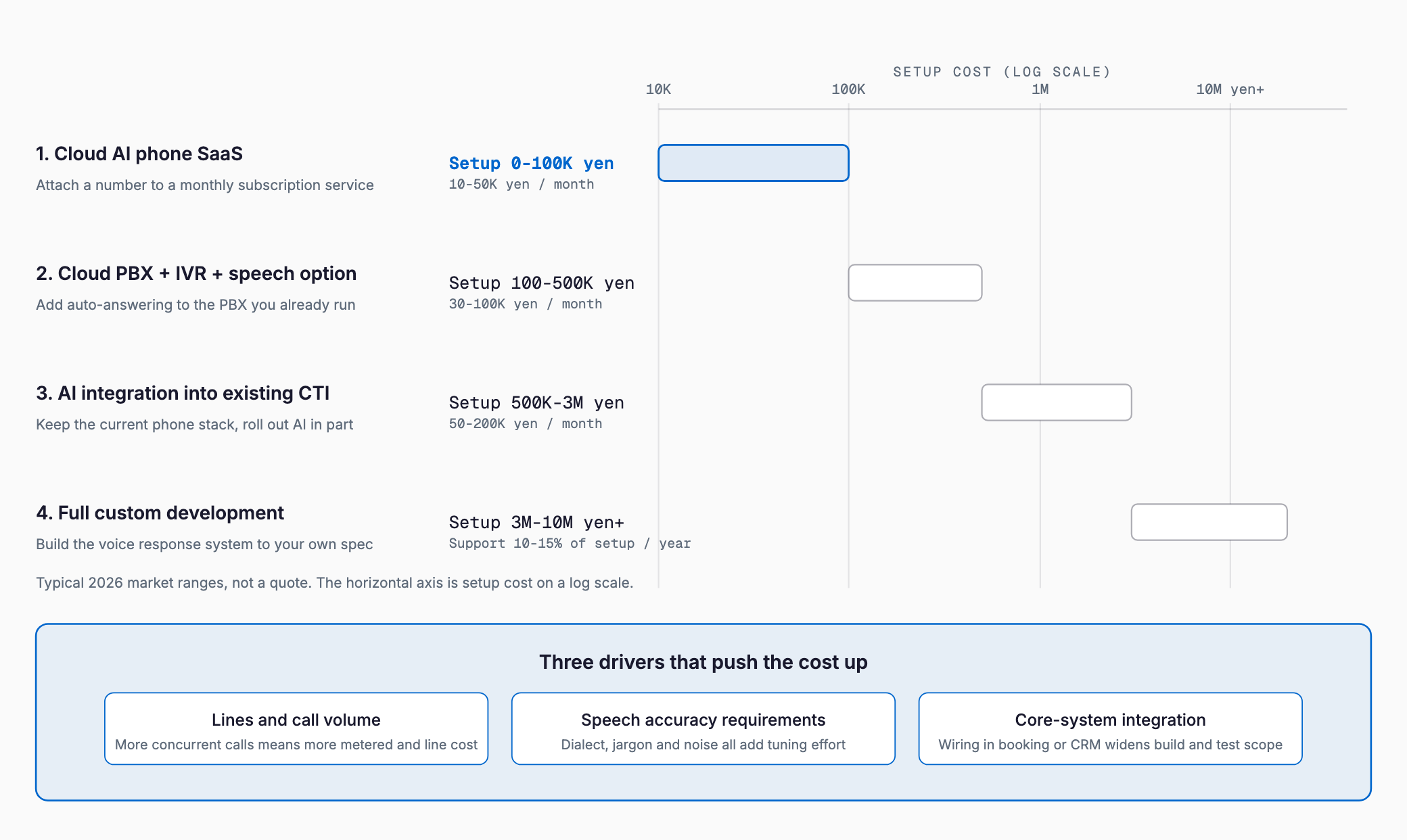
These figures are general market ranges as of 2026, not individual quotes. Actual costs vary significantly based on the number of phone lines, expected call volume, integration complexity, and the scope of customization. Always obtain quotes from multiple vendors before deciding.
Which Approach Fits Which Business
- Cloud AI phone SaaS: Best for small shops or sole proprietors with one or a few phone lines who want to start quickly with minimal upfront cost.
- Cloud PBX + IVR + speech recognition option: Suited to businesses with multiple locations or departments already using a cloud PBX.
- Custom AI integration with existing CTI: Fits call centers or reservation desks that want to add AI response while keeping their existing phone infrastructure.
- Full custom development: An option for mid-size to large companies needing complex, industry-specific call handling or deep integration with other systems.
Expected Benefits
Automating first-line reception during off-hours or busy periods reduces missed opportunities and frees up staff time. Many services can transcribe and log call content, which pairs well with an inquiry management system so phone inquiries can be managed and analyzed alongside other channels. That said, complex consultations or emotional complaints still often call for a human touch, so it's important to design the handoff between AI and staff in advance.
Selection Checklist
- Do you know your expected call volume (daily/monthly) and required number of phone lines?
- Have you clearly listed which tasks you want automated (reservations, orders, FAQs, transfers)?
- Have you confirmed whether you can keep your existing number, PBX, or CTI, or need to switch?
- Have you tested speech recognition accuracy with real trial calls (dialects, jargon, background noise)?
- Can call content be transcribed, logged, exported, and integrated with other systems?
- Do you understand what's included in the monthly fee (call charges, maintenance, feature updates) and any usage-based charges?
- Have you confirmed the contract term, cancellation terms, and data retention/deletion policy?
Points to Watch During Implementation
AI voicebots are convenient, but without a clear fallback for unexpected requests, they can confuse callers. Always design an escape route to a human operator when the AI cannot help, and avoid loops that leave callers stuck. Whether you can keep your existing phone number also varies by vendor, so check this alongside your current cloud PBX and business phone setup before signing up.
Common Pitfalls and Countermeasures
| Common Pitfall | Countermeasure |
|---|---|
| Underestimated call volume led to ballooning usage fees | Measure actual call volume during a trial period and re-select the pricing plan |
| Low speech recognition accuracy caused frequent mishearing | Test with real conversations including industry-specific terms and names before signing |
| Handoff to a human operator was clunky, causing callers to give up | Always provide an operator transfer path and cap response time |
| Couldn't integrate with the existing number/PBX, resulting in duplicate operations | Check compatibility and migration steps with existing equipment before implementation |
How long does it take to implement an AI voicebot?
A cloud AI phone SaaS can typically go live within a few days to two weeks of signing up. Custom CTI integration or full custom development can take several months from requirements definition to launch.
Can I keep my existing phone number?
Most cloud services support number portability, but whether it's supported varies by provider, so confirm this before signing a contract.
What happens if the AI can't understand the caller?
Most services are designed to transfer the call to a human operator or staff member when the AI can't understand the request or after a set number of failed attempts. How you configure this handoff is key to smooth operation.
Are there costs beyond the monthly fee?
Call charges may be billed separately, and usage-based fees can apply once call volume exceeds a certain threshold. Review the full pricing structure before signing up.
Is it worth it for a small shop?
If you're missing calls while serving customers in person, or losing after-hours reservations, starting small with a low-cost cloud SaaS option can be worthwhile.
How should I measure results after implementation?
Check metrics like number of calls handled, transfer-to-human rate, and after-hours calls answered in the service dashboard, and compare them against pre-implementation missed opportunities.
Summary
AI phone automation ranges from cloud AI phone SaaS to full custom development across four tiers, with costs spanning from a few thousand yen a month to several million yen. Working through the checklist against your call volume, task complexity, and existing phone infrastructure makes it easier to right-size your investment. These figures are general market ranges as of 2026 — compare quotes from multiple vendors before making a final decision.
Related free tools (no sign-up, instant results)
Feel free to contact us
Contact Us