Mercury 2.5: Diffusion LLM Speed and Pricing Explained
Mercury 2.5, Inception's diffusion LLM launched Sept 8, 2026, hits 1,107 tokens/sec at $0.20/M tokens (80% off at launch), 260K context, API-only, no weights.
Mercury 2.5 is a diffusion LLM (dLLM) that Inception (Inception Labs) announced on September 8, 2026. Inception reports a generation speed of 1,107 tokens/sec on widely available NVIDIA GPUs and claims a 40% intelligence improvement over its predecessor, Mercury 2, positioning it among cost-optimized frontier-class models. There are no open weights — it is available only via API.
What makes a diffusion LLM different
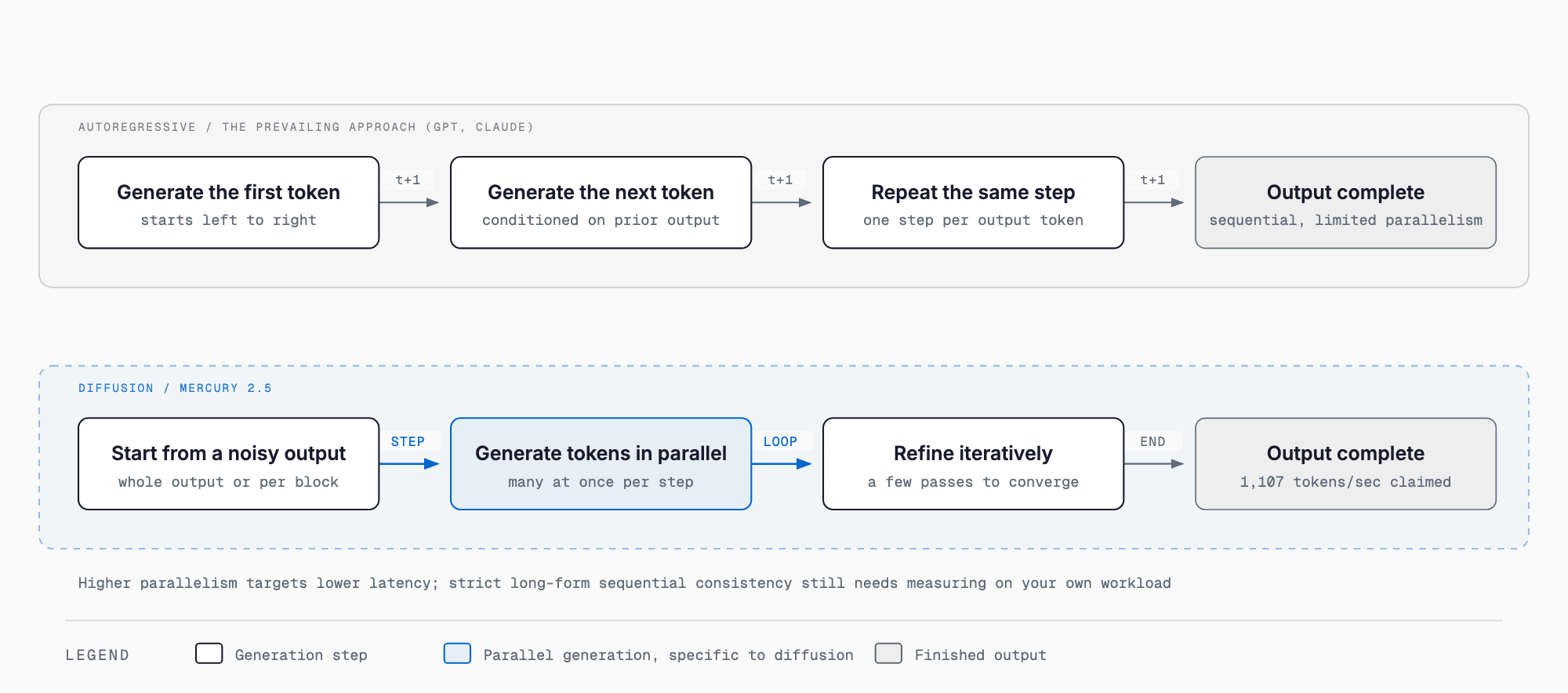
Mainstream large language models like GPT and Claude are autoregressive: they generate text left-to-right, one token at a time. Diffusion LLMs instead borrow the approach used in image-generation diffusion models — starting from a noisy draft of the full output (or a block of it) and iteratively refining it, generating multiple tokens in parallel across each refinement pass.
The theoretical advantage is higher parallelism than strictly sequential, one-token-at-a-time generation, which can translate into lower latency. The trade-off is that existing tooling and inference stacks optimized around autoregressive assumptions may not transfer cleanly, and strict sequential coherence over very long outputs is a more open question. For a related model from Google, see our DiffusionGemma explainer.
Spec sheet at a glance
| Item | Mercury 2.5 |
|---|---|
| Announced | September 8, 2026 |
| Vendor | Inception (Inception Labs) |
| Generation speed | 1,107 tokens/sec (official figure, widely available NVIDIA GPUs) |
| Context window | 260,000 tokens |
| Max output tokens | 65,536 tokens |
| Standard pricing | $0.20 input / $0.75 output per million tokens |
| Launch discount pricing | $0.04 input / $0.15 output (80% off standard) |
| Cache read pricing | $0.004 per million tokens |
| Open weights | None (API-only) |
| Access | Inception API / OpenRouter / Baseten (OpenAI-compatible endpoint) |
Reading the pricing: standard vs. launch discount
Mercury 2.5 pricing comes in two tiers: standard pricing ($0.20 input / $0.75 output per million tokens) and a launch discount (80% off, at $0.04 input / $0.15 output). The discounted pricing is a promotional, time-limited offer and should not be treated as permanent. When budgeting or integrating the API, be explicit about which tier you're modeling, and run a separate cost estimate for after the discount ends.
How to access it
Mercury 2.5 is available through Inception's own API as well as model aggregators OpenRouter and Baseten. The endpoint is OpenAI-compatible, so integrating it typically means swapping the base URL, API key, and model name in an existing OpenAI SDK setup rather than rewriting client code. Key points:
・Choose between the Inception API directly or OpenRouter / Baseten
・OpenAI SDK-compatible endpoint minimizes code changes
・Supports parallel tool calling and schema-conformant JSON output
・Reasoning level is tunable depending on the use case
・Dedicated enterprise capacity is available as an option
How it compares to other models
| Axis | Mercury 2.5 | Mercury 2 (predecessor) | DiffusionGemma (diffusion) | Typical low-cost autoregressive models |
|---|---|---|---|---|
| Architecture | Diffusion | Diffusion | Diffusion | Autoregressive |
| Generation speed | 1,107 tokens/sec (official) | Not disclosed | Not disclosed | Varies, not standardized |
| Intelligence (vs. own prior gen) | Claimed +40% over Mercury 2 | Baseline | Not disclosed | Not disclosed |
| Standard input pricing (per million tokens) | $0.20 | Not disclosed | Not disclosed | Varies, not standardized |
| Open weights | None | Not disclosed | Yes (released by Google) | Depends on model |
| Primary fit | Low-latency responses, agent workflows | Same (prior generation) | Research/validation of text diffusion | General chat, lightweight tasks |
As the table shows, Mercury 2.5-specific standard benchmark scores are not publicly available as of this writing. The "40% more intelligent" claim is Inception's own qualitative comparison against its prior generation, not a figure backed by third-party benchmark results. For pricing and benchmark context on other recent models, see our explainers on GPT-6 Astra and Muse Spark 1.3.
Where it fits, and where it doesn't
The speed advantage is most valuable where low latency directly matters: responsive chat-UI completions and suggestions, and agent loops that repeatedly call tools back and forth. Support for parallel tool calling and schema-conformant JSON output reinforces this fit for agentic workloads.
On the other hand, tasks that require strict sequential reasoning over very long outputs, or that depend heavily on evaluation pipelines and prompt-engineering assets built around autoregressive assumptions, warrant individual testing given the architectural differences. With no published per-benchmark scores yet, running your own evaluation against your specific use case is advisable before committing.
Things to watch right now
・Standard per-benchmark scores are not publicly disclosed as of this writing
・No open weights are available, so local or self-hosted deployment isn't possible
・The 80% launch discount is promotional and may end, reverting to standard pricing
・API-only access means vendor lock-in risk should factor into architecture decisions
What is Mercury 2.5?
Mercury 2.5 is a diffusion LLM announced by Inception (Inception Labs) on September 8, 2026. It generates multiple tokens in parallel and iteratively refines them, reporting a generation speed of 1,107 tokens/sec on widely available NVIDIA GPUs.
How much does Mercury 2.5 cost?
Standard pricing is $0.20 per million input tokens and $0.75 per million output tokens. A launch discount of 80% brings this to $0.04 input / $0.15 output, though that pricing is promotional and time-limited. Cache reads cost $0.004 per million tokens.
How is a diffusion LLM different from a traditional LLM?
A traditional autoregressive LLM generates text left-to-right, one token at a time. A diffusion LLM instead refines the full output iteratively, generating multiple tokens in parallel per pass, which favors low latency but raises open questions about strict long-form sequential coherence.
Can Mercury 2.5 be run locally?
No. Mercury 2.5 has no open weights and is available only via API, through the Inception API, OpenRouter, or Baseten.
Where can I access Mercury 2.5?
You can access it through Inception's own API, OpenRouter, or Baseten. All three expose an OpenAI-compatible endpoint, making it straightforward to integrate from existing OpenAI SDK-based code.
Feel free to contact us
Contact Us