What Is Ox Alpha? OpenRouter's Free 1M-Context Stealth Model
Ox Alpha: free, developer-undisclosed stealth model, ~1M-token context, on OpenRouter/OpenCode since Aug 2026. GLM-5.3 talk runs strong. Updated August 2026.
What Is Ox Alpha?
Ox Alpha is a "stealth model" whose developer has not been disclosed, and it appeared on a free tier on OpenRouter and OpenCode around August 20, 2026. Its context window reaches roughly 1.04 million tokens, and strong coding performance made it a fast-spreading talking point on social media and forums. On OpenRouter it's listed under the model ID stealth/ox-alpha, with the provider field showing only "undisclosed third party."
A stealth model is a release pattern where a provider lets the public use a model without revealing its identity, in order to gather real-world feedback and evaluation data. OpenRouter and OpenCode have hosted several stealth models on free tiers before, but Ox Alpha has drawn outsized attention for its context length and coding results almost as soon as it appeared.
The naming origin, any logo, and the composition of the team behind it remain entirely undisclosed. What's known comes only from the OpenRouter dashboard, metadata embedded in responses, and reports from users who have tested it directly. This article therefore separates "observed facts" from "independent-researcher inference" throughout, and flags anywhere a claim can't be confirmed.
Confirmed Specs
| Item | Value |
|---|---|
| Model ID | stealth/ox-alpha |
| Developer | Undisclosed (shown as third party) |
| Context length | 1,048,576 tokens (~1M) |
| Max output | 131,072 tokens |
| Input modalities | Text, image, video (audio rejected) |
| Tool / function calling | Supported |
| Structured JSON output | Supported |
| Reasoning | Mandatory, with effort levels |
| Pricing | Free (as a stealth-period measure) |
The explicit rejection of audio input is one of the traits cited later as evidence for its likely origin. The fact that reasoning is mandatory and an effort level can be specified is also flagged as overlapping with the published spec of GLM-5.3.
What It Can Do
Coding performance is the main draw. Reviewers highlight the ability to load an entire large codebase into context while issuing edits or refactors, and tool-calling support that makes it easy to plug in as the execution layer for coding agents. The roughly 1M-token context is well suited to understanding sprawling multi-file repositories or sustaining a long pair-programming session without losing conversation history.
Because it accepts image and video input, people have also tested multimodal workflows such as feeding it UI screenshots or screen-recorded videos to guide debugging or implementation instructions. Audio input is not supported, though, and that specific rejection behavior is itself one of the clues used in the identity speculation discussed below.
How to Use It — Fastest Path
There are currently two main ways to try Ox Alpha, and both require little more than pointing to the model ID stealth/ox-alpha.
- Via OpenRouter: Issue an API key from your OpenRouter account, then search the model list for stealth/ox-alpha and select it. Any existing OpenAI-compatible client or SDK can call it simply by changing the model name to stealth/ox-alpha
- Via OpenCode: In OpenCode's model settings, set the provider to OpenRouter and the model ID to stealth/ox-alpha. Setting it as the default agent model lets your usual coding tasks run through Ox Alpha directly
- Neither path requires billing setup since it's offered on a free tier, though rate limits may apply
- Since reasoning is mandatory, using a client or SDK that lets you set an effort level makes the behavior easier to tune
How to Read the Benchmarks
| Model | Unofficial 10-task Pass@1 |
|---|---|
| Ox Alpha | 80% |
| Claude Fable 5 | 65% |
| GLM-5.3 | 62% |
| GPT-5.6-sol | 52% |
These figures come from one user's personal, unofficial test of ten hand-picked DeepSWE-style tasks — not an audited public leaderboard. With so few tasks and no disclosed selection criteria or test environment, it would be premature to generalize this single result into a claim that "Ox Alpha is the strongest model." Treat it as a rough signal and re-validate against tasks close to your own workload. For a broader sense of where it sits, it's worth cross-checking the benchmarks in the Gemini 3.7 Flash pricing and benchmark article and the Qwen3.8-Max writeup.
Is It Actually GLM? — Evidence and Its Limits
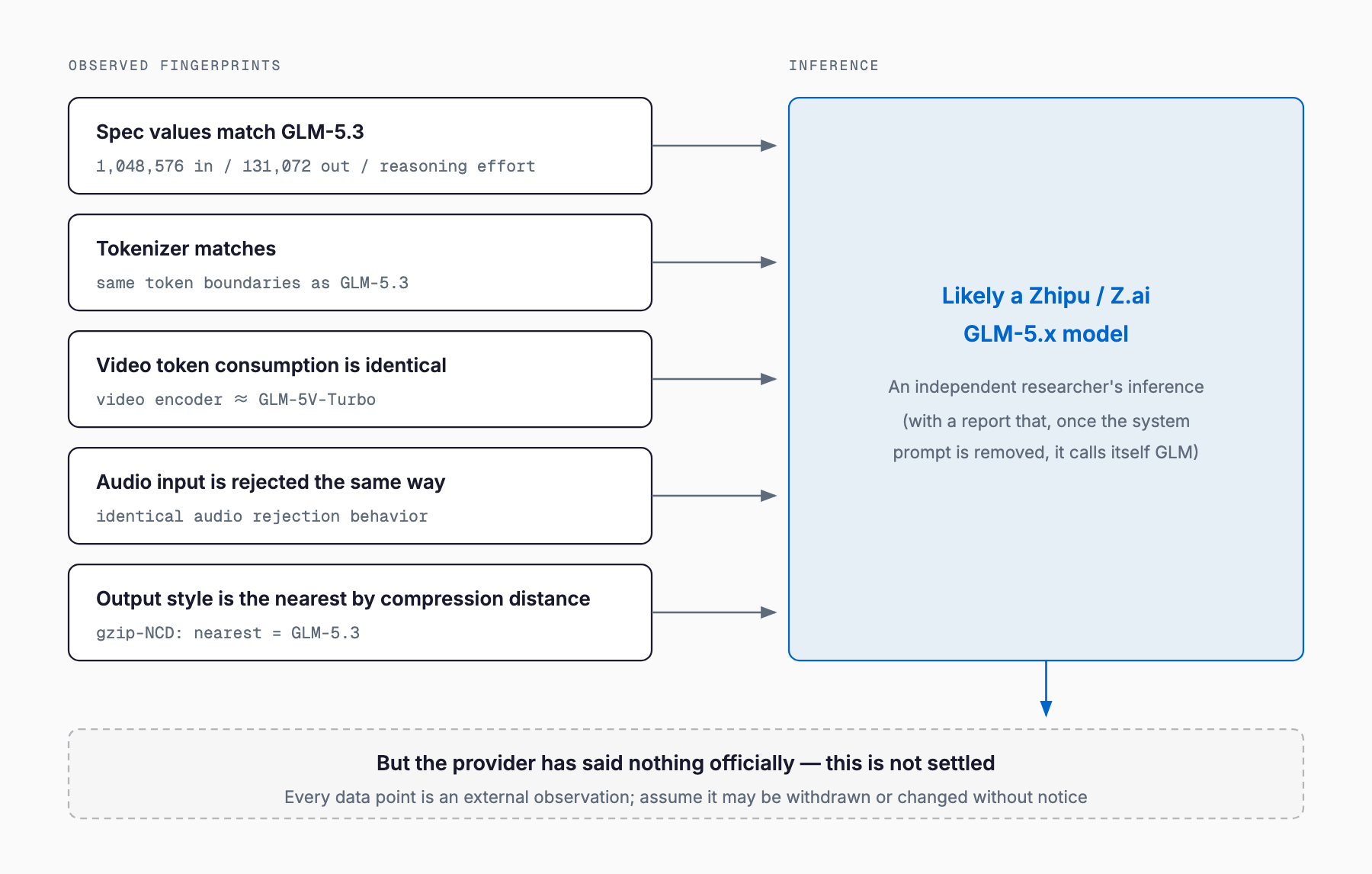
- Matching specs: The 1M context, 131K max output, mandatory reasoning effort, and default sampling settings overlap with GLM-5.3's published specification
- Matching tokenizer: Independent testing reports tokenizer behavior consistent with the GLM family
- Video encoder behavior: Token consumption patterns for video input reportedly resemble known GLM-5V-Turbo patterns
- Audio rejection: Matches the audio-input rejection behavior seen in GLM-family models
- Output style: Stylistic traits such as emoji usage rates are reportedly similar
- Extracted system prompt reports: One report describes a system prompt instructing the model to identify as "ox-alpha" and withhold its organization; removing that instruction reportedly made it answer that it is "GLM from Z.ai"
- gzip-NCD analysis: Comparing outputs against a reference corpus of five known models by compression distance classified 7 of 14 samples as closest to GLM-5.3 (versus 3 for Claude Opus 5)
- Caveat: All of the above comes from unofficial, independent research; Zhipu / Z.ai has issued no public comment. There is precedent for the company testing models via stealth releases before, but no official acknowledgment has been made regarding this one
Independent researcher Ben Davis has said he is "99% confident," but that remains one individual's personal assessment rather than an official confirmation from Zhipu / Z.ai, and should be read with that caveat in mind.
Cautions for Using a Stealth Model at Work
It is commonly noted that stealth models may have their prompts and responses collected by the provider for evaluation purposes. Since Ox Alpha's developer and operating policy remain undisclosed, there is no way to confirm how any code or documents you submit will be handled. It's prudent to avoid sending proprietary source code or customer information, and to keep testing limited to public information or sample code meant for evaluation.
Free access, model availability, and output reproducibility are all unguaranteed. Access could end when the evaluation period wraps up, and behavior could change without notice, so it's best not to depend on it as the primary model in a CI/CD pipeline or a production coding agent — treat it as one option for evaluation and comparison rather than a dependable default.
How It Compares to Existing Models
| Item | Ox Alpha | GLM-5.3 | Gemini 3.7 Flash | Qwen3.8-Max |
|---|---|---|---|---|
| Context length | ~1M | ~1M (published spec) | ~1M (1,048,576) | ~1M |
| Release form | Stealth (hosted only, undisclosed) | Open weights | Closed, API-only | Open weights |
| Pricing | Free (possibly time-limited) | Free to paid, depending on usage | Paid, usage-based | Open weights + API ($2.00 in / $6.00 out) |
The overlap in context length and reasoning-related specs with GLM-5.3 is a key piece of the identity speculation, yet the release forms are a study in contrast: GLM-5.3's weights are published openly, while Ox Alpha is currently available only as a hosted stealth model, with no way to run it locally or inspect its weights. For detailed pricing and benchmarks, see the write-ups on GLM-5.3, Gemini 3.7 Flash pricing and benchmarks, and Qwen3.8-Max.
Frequently Asked Questions
How long will Ox Alpha stay free?
There has been no official announcement, so the exact end date is unknown. Stealth slots on OpenRouter are typically free only for an evaluation period rather than as a permanent offer, and the free tier could end abruptly or shift to paid pricing or rate limits. It's safer not to build production workflows that assume it will stay free.
Can Ox Alpha be used commercially?
Because the developer and terms of use are undisclosed, commercial usage rights cannot be confirmed. Any use would fall under OpenRouter's own terms, but since the model's own licensing conditions remain unknown, it is prudent to wait for clearer information before relying on it for core business use.
Has it been confirmed that Ox Alpha is GLM-5.3?
No, it has not been confirmed. Independent researchers have pointed to circumstantial evidence—gzip-NCD output analysis, extracted system prompts, and matching tokenizer and sampling defaults—that points toward GLM-5.3, but these remain unofficial findings and Zhipu/Z.ai has not commented publicly. It's best treated as a strong but unconfirmed hypothesis.
Can Ox Alpha be run locally?
As of now it is only available as a hosted model via OpenRouter and OpenCode, and its weights have not been released, so local execution isn't possible. If the theory that it's based on GLM-5.3 holds, GLM-5.3 itself has been released with open weights separately, so that could be tried locally instead.
How reliable are the Ox Alpha benchmark numbers?
The figures cited come from an individual's unofficial test of ten DeepSWE-style tasks, not an audited public leaderboard. With such a small task count and no reproducibility checks, treat the numbers as a rough signal and validate against tasks close to your own workload before making any important decision.
Feel free to contact us
Contact Us