WeatherNext 3: Google's Hourly, 5km-Resolution Weather AI
A technical look at WeatherNext 3, Google DeepMind's weather AI launched Sep 2026, covering direct satellite training for hourly 5km forecasts and API access.
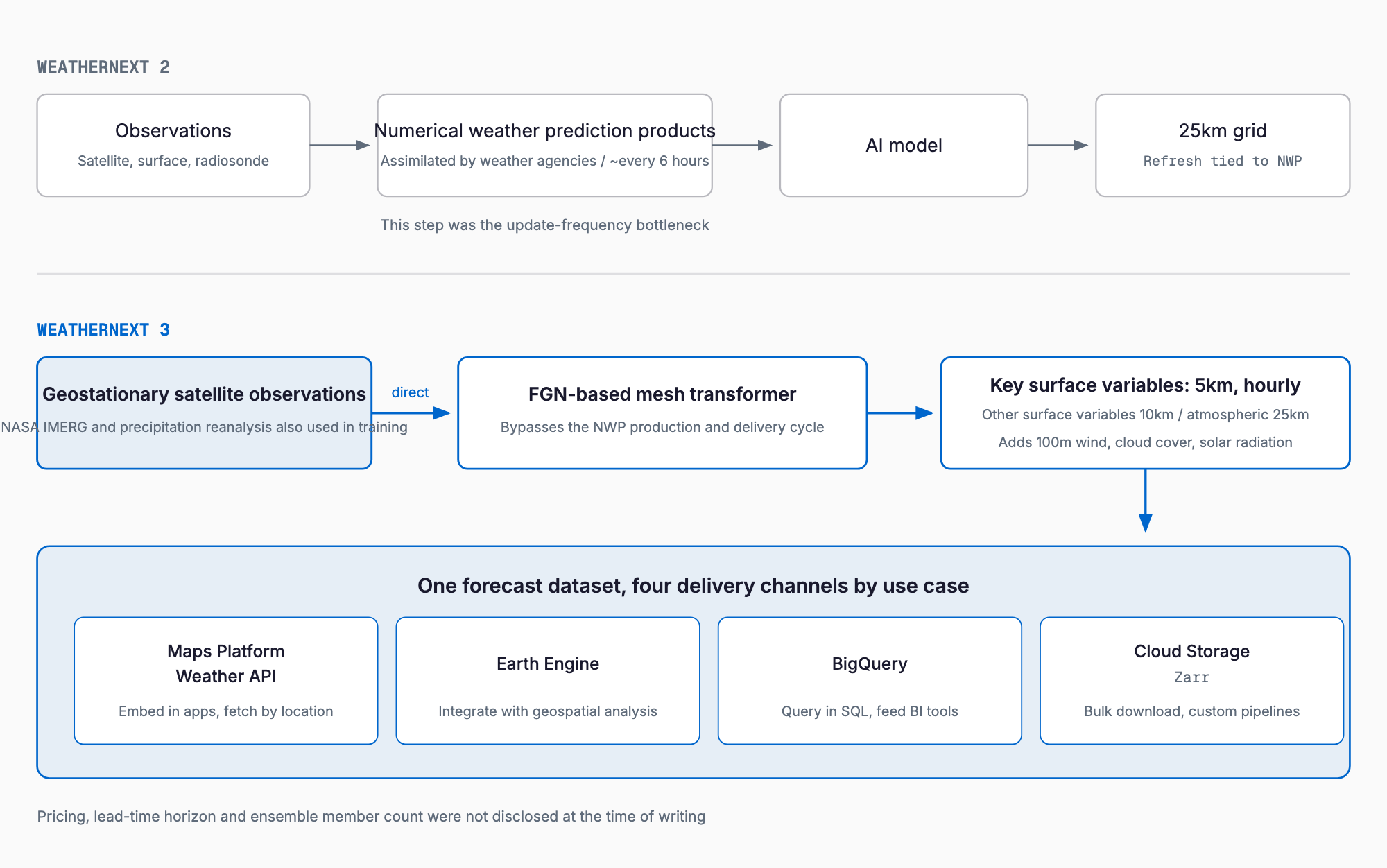
On September 3, 2026, Google DeepMind and Google Research unveiled WeatherNext 3, a global weather AI model built on a Functional Generative Network (FGN) based mesh transformer. Key surface variables such as temperature and humidity are now resolved at 5km grid resolution. The biggest architectural change is that the model trains and infers directly from geostationary satellite observations rather than numerical weather prediction (NWP) data, letting it refresh forecasts hourly instead of waiting for NWP's roughly six-hour public data update cycle. The model is available from September 3, 2026 through Google Search, the Gemini app, Google Maps, the Google Maps Platform Weather API, Google Earth Engine, BigQuery, and bulk Zarr downloads from Cloud Storage.
What changed from WeatherNext 2
| Item | WeatherNext 2 | WeatherNext 3 |
|---|---|---|
| Resolution (key surface variables) | 25km | 5km |
| Resolution (other surface variables) | 25km | 10km |
| Resolution (upper-air variables) | 25km | 25km |
| Update frequency | Tied to NWP updates (roughly every 6 hours) | Hourly |
| Primary training data | Numerical weather prediction (NWP) products | Direct training on geostationary satellite observations |
| Precipitation training data | Not specified | NASA IMERG satellite data plus Google's own precipitation reanalysis |
| New forecast variables | None | Wind speed at 100m above ground, cloud cover, solar radiation (for renewable energy use) |
Why training directly on satellite data matters
Conventional NWP-based AI weather models train on numerical prediction products that national weather agencies have already assimilated and analyzed. In that setup, the update frequency of the input data itself becomes the bottleneck, forcing the model to wait for public data refreshes roughly every six hours. WeatherNext 3 instead trains and infers directly from geostationary satellite observations, bypassing the NWP product generation and distribution cycle entirely and letting it reflect the latest observations without delay. The result is hourly forecast updates. This should not be read as a claim that NWP is fully replaced; rather, it is a technical change that shortens the input pipeline and decouples the AI model's update cycle from NWP's.
How to read the accuracy claims
Google reports up to a 60% improvement in medium-range precipitation forecasts against the IMERG baseline and a 30% improvement against MRMS, which it summarizes for end users as forecasts that are 'up to 50% more accurate.' Worth noting is that the comparison points are IMERG (a satellite-observation-based precipitation estimate product) and MRMS (a radar-driven, high-resolution precipitation product), each with its own characteristics as a baseline. The magnitude of improvement can vary by region, season, and forecast lead time, so a single improvement figure should not be generalized across all conditions. Organizations evaluating adoption should validate performance independently for their own target regions, variables, and lead times.
Access channels and when to use each
| Channel | Primary use |
|---|---|
| Google Search / Gemini app / Google Maps | Forecast display for general users |
| Google Maps Platform Weather API | Embedding forecasts in apps and services, location-based lookups |
| Google Earth Engine | Integrating with geospatial analysis and large-scale time-series processing |
| BigQuery | Querying and aggregating forecast data with SQL, connecting to BI tools |
| Cloud Storage (Zarr format) | Bulk downloads of forecast data for custom, high-volume pipelines |
Likely use cases
- Renewable energy: estimating wind and solar power output from 100m wind speed, cloud cover, and solar radiation forecasts
- Logistics and delivery planning: adjusting routes and load plans up to the last hour using hourly-updated forecasts
- Agriculture: feeding improved precipitation and temperature accuracy into irrigation and harvest-timing decisions
- Event operations: using near-real-time forecast updates to decide whether outdoor events proceed
- Insurance: using the data for weather risk assessment and parametric insurance design
Caveats and limitations
As of this writing, WeatherNext 3's pricing, specific forecast lead times, and ensemble member counts have not been publicly disclosed. More broadly, AI weather models as a category share known limitations: rapidly intensifying extreme events such as typhoons or narrow bands of intense rainfall can be difficult to predict, physical consistency is not guaranteed as explicitly as in traditional NWP, and generalization to rare weather patterns absent from the training data remains unproven. In operational use, it remains advisable to treat AI model output as one input among several rather than a sole source, cross-checking it against official meteorological agency forecasts and other models.
FAQ
What is different about WeatherNext 3 compared with WeatherNext 2?
The biggest difference is that it trains and infers directly on geostationary satellite observations instead of numerical weather prediction data. This raised the resolution of key surface variables from 25km to 5km and shortened forecast updates from roughly every six hours to hourly.
Where can WeatherNext 3 be accessed?
It is available from September 3, 2026 through Google Search, the Gemini app, and Google Maps for display, and through the Google Maps Platform Weather API, Google Earth Engine, BigQuery, and bulk Zarr downloads from Cloud Storage for programmatic access.
How was the precipitation accuracy improvement measured?
Google compared results against the NASA IMERG satellite precipitation product and the MRMS radar precipitation product as baselines, reporting up to a 60% improvement against IMERG and 30% against MRMS in medium-range forecasts. Note that the two baselines measure different things.
How much does WeatherNext 3 cost to use?
Specific pricing has not been publicly disclosed as of this writing. It is likely to follow the existing billing structures of the Google Maps Platform Weather API, BigQuery, and Cloud Storage, but this should be confirmed against official documentation.
Which regions are expected to benefit most from WeatherNext 3?
Latin America, Africa, and Asia-Pacific regions, where the computational cost of running traditional NWP supercomputing has historically been a major constraint, are expected to see the largest benefit from the satellite-data-direct training approach.
Feel free to contact us
Contact Us