AI Agent Implementation Costs for SMBs
SaaS vs No-Code vs Custom
AI agent costs for SMBs: about ¥0-300K for SaaS, ¥300K-1.5M for no-code, ¥1.5M+ for custom builds. Compares approaches, cost breakdown, running costs, PoC.
As a general guide for the Japanese SMB market as of October 2026, an AI agent costs roughly ¥0–¥300,000 up front and ¥10,000–¥150,000 per month if you use an off-the-shelf service (SaaS); ¥300,000–¥1,500,000 up front and ¥20,000–¥100,000 per month if you build it yourself with no-code or low-code tools; and ¥1,500,000–¥8,000,000 or more up front and ¥50,000–¥300,000 per month for custom development. These are rough ranges that vary with conditions, not prices for any specific vendor or company. Here, an AI agent means an AI that receives an instruction, works out the steps itself, and carries out the work by operating external tools such as email and internal systems. The concept itself is covered in What Is an AI Agent? A Guide for Executives, so this article focuses on what it costs and how to choose an approach.
The short answer: cost is driven by approach, number of integrations, and scope of delegation
The cost of an AI agent is determined less by the price of the AI model itself and more by three things: which approach you use, how many business systems it connects to, and how much you let it do automatically. The AI adoption cost guide lays out overall AI costs by stage. Because an agent operates external tools, the key difference from a chat-style AI is the added cost of integration work, permission design, and monitoring.
In summary:
- For routine tasks that look similar across companies (first-line inquiry replies, meeting notes, email drafts), an off-the-shelf service is often enough
- For tasks that depend on your own procedures and tools but are simple in structure, building with no-code or low-code tools tends to give the best value
- Consider custom development only when deep integration with core systems or proprietary data is needed, or when security requirements are strict
- Whichever approach you choose, starting with a small proof of concept (PoC) rather than going straight to production usually keeps the total lower
How the cost structure differs between a chat AI and an AI agent
A chat-style AI such as ChatGPT is mainly used by a person asking questions and getting answers, and its cost is easy to read as a monthly fee per user. An AI agent, by contrast, works through several steps on its own without a person instructing each one. This changes how costs work in three ways.
- Autonomous execution: a single request can trigger many model calls, including rethinking and retries, so the volume of processing (tokens) per task tends to be larger
- External tool integration: connecting to email, calendars, accounting software, or a CRM requires setup or development, and the work grows with the number of connected systems
- Usage-based billing is central: costs rise with usage, so unlike a flat subscription, monthly costs are harder to predict
Because an agent can operate other systems, the impact of a wrong action is also larger. That means you also pay for permission design (what the agent is allowed to do) and monitoring (recording and reviewing what it does). This is a cost specific to agents that chat AI rarely involves.
Cost estimates for the three approaches
There are three broad ways to introduce an AI agent. The figures below are general guides for the Japanese SMB market as of October 2026. Actual amounts vary with the target task, integrations, and security requirements.
| Approach | Initial cost (guide) | Monthly cost (guide) | Timeline (guide) | Best suited for |
|---|---|---|---|---|
| 1. Off-the-shelf service (SaaS) | ¥0–¥300,000 | ¥10,000–¥150,000 | A few days to 1 month | Companies with routine tasks that want to try quickly |
| 2. Self-built with no-code / low-code | ¥300,000–¥1,500,000 | ¥20,000–¥100,000 | 1–3 months | Companies that want to match their own procedures without complex development |
| 3. Custom development | ¥1,500,000–¥8,000,000 or more | ¥50,000–¥300,000 | 3–6 months or more | Companies with core-system integration or many unique rules that off-the-shelf tools cannot handle |
In approach 1, you subscribe to agent features offered for specific uses such as inquiry handling, sales support, or accounting assistance. The initial cost is small and you can start fast, but what you can do is limited to the service's scope, and handling your own unique procedures is difficult. Approach 2 uses automation or AI-building tools that connect multiple services, assembling an agent around your procedures; if you outsource the build, that cost is the bulk of the initial spend. Approach 3 covers everything from requirements through design, development, and testing. It offers the most freedom, but also the highest cost and longest timeline.
Cost breakdown: what you are paying for
When reading a quote, look not only at the total but at what each amount covers. The cost of an AI agent generally consists of five components.
| Component | What it covers | Cost tendency |
|---|---|---|
| Requirements and design | Deciding which task, by which steps, and how much to delegate to the AI | Roughly 10–25% of the total; skipping it causes rework later |
| Integration development and setup | Connecting external tools such as email, accounting, CRM, and internal databases | Tens of thousands to hundreds of thousands of yen per integration; varies greatly depending on whether an API (an interface for operating a system from outside) exists |
| API usage fees (AI model usage) | Pay-per-use charges each time the AI model is called | Proportional to usage; from a few thousand yen to several hundred thousand yen per month |
| Permissions, monitoring, logging | Limiting what the agent can do, approval flows, activity records, emergency stops | Design cost up front plus monitoring cost in operation; easy to underestimate but important |
| Maintenance and improvement | Keeping up with changes in connected systems, tuning accuracy, revising prompts | Monthly; some budget about 10–20% of the initial cost per year |
The most commonly overlooked items are permissions and monitoring, and maintenance. An AI agent is not finished once built: changes to connected services or updates to the AI model can change its behavior. You need to include the cost of ongoing checks and adjustments in your budget from the start.
Cost examples by use case: three tasks
Here are cost images by approach for tasks that SMBs often ask about. All are rough estimates based on hypothetical assumptions, and actual amounts vary with conditions.
Example 1: First-line inquiry handling (around 300 email or web-form inquiries per month). The agent drafts replies to common questions and routes inquiries to the right person. An off-the-shelf service might run about ¥0–¥100,000 up front and ¥20,000–¥80,000 per month; a no-code build about ¥300,000–¥800,000 up front and ¥20,000–¥60,000 per month. Rather than sending replies to customers automatically, having a staff member review them first keeps the risk of wrong answers low.
Example 2: Invoice processing (around 100 invoices per month: reading them, drafting journal entries, and registering them in accounting software). Because integration with accounting software is required, integration costs are higher than in Example 1. A no-code build might be about ¥500,000–¥1,500,000 up front and ¥30,000–¥100,000 per month; if deep integration with accounting software and approval flows or custom account rules are needed, custom development of about ¥1,500,000–¥4,000,000 up front is a guide. Because money is involved, designing in a human approval step is essential, which also affects cost.
Example 3: Building a sales prospect list (gathering information on companies that match criteria, compiling a list, registering it in a CRM, and drafting a first email). This is relatively easy to start with an off-the-shelf service or no-code build, at about ¥0–¥500,000 up front and ¥10,000–¥60,000 per month. However, you must consider how collected information is handled and rules on sending email (such as Japan's Act on Regulation of Transmission of Specified Electronic Mail). Whether the agent only drafts or actually sends changes the design and monitoring cost.
Example 4: Assisting order processing across multiple systems (reading order emails, checking inventory and core systems, drafting a delivery-date reply). Because it requires core-system integration, custom development of about ¥3,000,000–¥8,000,000 up front and ¥80,000–¥300,000 per month in maintenance is possible. At this level, you should treat it as ordering a full system development project, not just an AI agent.
What makes costs grow
- Number and age of integrations: older business systems with no API, or systems that can only be operated through their screens, require much more integration work
- Breadth of delegation: drafting only is light, but the more you let the agent execute (approve, send, pay), the more permission design, testing, and monitoring you need
- Data preparation: if the internal documents the agent refers to are in inconsistent formats or out of date, preprocessing is needed
- Required accuracy: whether "mostly right" is acceptable or errors are unacceptable changes how much verification and human review is needed
- Security and compliance requirements: handling personal or confidential information adds cost for data storage location, log management, and conformity with internal rules
- Growth in usage: if it is used more than expected, pay-per-use API charges swell
Thinking about running costs, with a monthly example
It helps to split the monthly cost of an AI agent into a fixed part and a variable part. The fixed part is the subscriptions for the tools and services used, plus any outsourced maintenance and monitoring. The variable part is AI model API usage, which increases in proportion to the number of items processed.
For example, take Example 1 (first-line inquiry handling) built with no-code and processing 300 inquiries a month. Suppose each item calls the AI model several times, so API fees are about ¥10,000–¥40,000 per month, the automation tool is about ¥5,000–¥20,000 per month, and outsourced maintenance and review is about ¥20,000–¥50,000 per month. The total is roughly ¥35,000–¥110,000 per month. If volume doubles, the API portion approaches double.
Comparison with labor cost matters too. Suppose handling 300 inquiries takes 10 minutes each, and the AI drafts half of them, saving 5 minutes each. That frees 300 × 5 minutes = 1,500 minutes (25 hours), which at ¥2,500 per hour is about ¥62,500 per month. In this example, a monthly running cost of ¥35,000–¥110,000 may not pay for itself. In other words, tasks with few items, or tasks that already take little effort per item, may not justify the cost. Measure current workload before introducing an agent.
API fees can also change when providers revise prices or you switch models. Before signing, check whether you can set a spending cap and alerts, so you can prevent unexpected bills.
Starting small: from PoC to production
The most reliable way to hold down cost is not to build too much at the start. One example of how to proceed:
- Step 1: Choose a task (1–2 weeks): pick one task with high volume, clear procedures, and a small impact if it goes wrong
- Step 2: PoC (1–2 months): build a small version with an off-the-shelf service or no-code tools and measure accuracy and effort reduction on real data
- Step 3: Decide: check whether the success criteria set in advance (time saved, error rate) were met, and decide to proceed, revise, or stop
- Step 4: Production and expansion: put permissions and monitoring in place, run in production, and widen scope starting where results appear
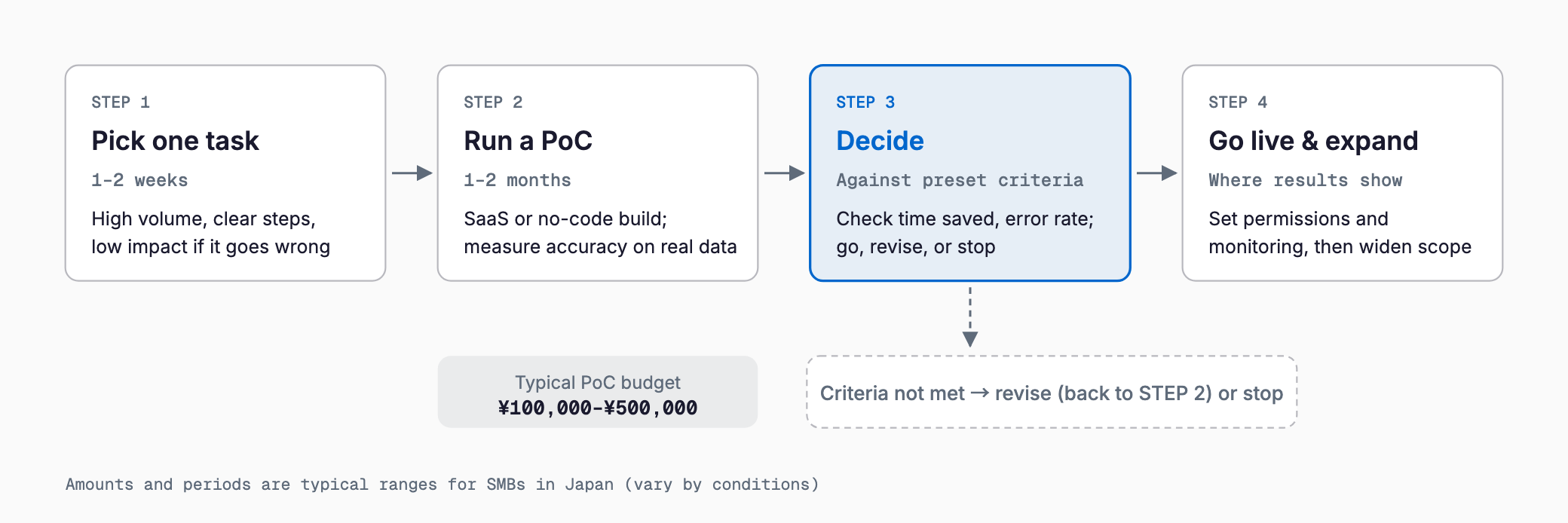
The cost and approach of a PoC are covered in PoC Cost Guide for System Development. For AI agents too, spending roughly ¥100,000–¥500,000 on a PoC to confirm that a task is a good fit before deciding on the main investment tends to lower the total. For deciding which work to hand to AI and which to keep with people, see How to Decide What to Delegate to AI.
Common failure patterns
- Trying to automate everything at once: scope expands, requirements and integration work balloon, and the project stalls
- Judging accuracy from a demo: it works on clean samples but real business data has many exceptions
- Granting overly broad permissions: letting the agent send email or make payments without limits magnifies the impact of mistakes
- Not budgeting for maintenance: a change in a connected service stops the agent, and repair costs arrive unexpectedly
- Not setting a usage cap: pay-per-use API fees exceed expectations and monthly bills become unpredictable
- Not measuring current workload: you cannot compare results or tell whether the project succeeded
- No designated owner: after launch no one watches for malfunctions or declining accuracy, and use fades
Checklist before ordering or signing
- Have you narrowed to one target task (volume, time per item, clarity of procedure)?
- Have you measured current workload and labor cost, and put the expected savings in numbers?
- Have you compared the approaches (off-the-shelf, no-code, custom) and can you explain why you chose one?
- Have you listed the systems to connect and confirmed whether APIs exist?
- Have you decided what the AI may do (draft only / execute after approval / fully automatic)?
- Is there a way to stop the agent when it malfunctions, and a way to review its activity logs?
- Have you checked how personal and confidential information is handled and where data is stored?
- Have you asked for a monthly breakdown (API fees, tool fees, maintenance), not just the initial cost?
- Can you set a spending cap or alerts on API fees?
- Have you set PoC success criteria and the criteria for proceeding or stopping?
- Have you assigned an internal owner for operations (checking malfunctions, deciding improvements)?
- Have you confirmed how data and settings are handed over when the contract ends?
Summary
As of October 2026, a rough guide for AI agent costs is ¥0–¥300,000 initially for an off-the-shelf service, ¥300,000–¥1,500,000 for a no-code build, and ¥1,500,000–¥8,000,000 or more for custom development, though these vary widely with conditions. What drives cost is the approach, the number of integrations, and the scope of delegation, not the price of the AI model itself. When reviewing quotes, check the breakdown into requirements, integration development, API fees, permissions and monitoring, and maintenance, and judge with the monthly running cost included. We recommend measuring results with a PoC limited to one task and expanding only after confirming it pays for itself.
Frequently asked questions
How much should I budget for an AI agent in the end?
As a guide for October 2026, an off-the-shelf service is about ¥0–¥300,000 up front and ¥10,000–¥150,000 per month, a no-code build about ¥300,000–¥1,500,000 up front, and custom development about ¥1,500,000–¥8,000,000 or more up front. Because the target task and integrations change this greatly, a PoC limited to one task is a realistic way to sharpen the estimate.
How is this different from subscribing to a chat AI such as ChatGPT?
A chat AI is mainly used by people asking questions and receiving answers, and its cost is easy to read as a monthly fee per user. An AI agent works through several steps and operates external tools, so integration development, permission design, and monitoring costs are added, and pay-per-use charges tend to be larger.
Does it make sense for a company with 10 to 30 employees?
It does when the target task has enough volume and clear procedures. However, for tasks with few items, the monthly running cost can exceed the savings. We recommend trying one task with an off-the-shelf service, measuring current workload and time saved, and then deciding the scale of investment.
What is the hardest part of the monthly cost to predict?
The pay-per-use API fees for the AI model. An agent calls the model many times per item, so costs rise in proportion to volume. Before signing, check whether you can set monthly caps and alerts and whether the provider will give an estimate for your expected volume, which helps prevent unexpected bills.
How much should a PoC cost?
A guide is roughly ¥100,000–¥500,000 over 1–2 months. You build a small version with an off-the-shelf service or no-code tools and measure accuracy and savings on real business data. Setting success and stop criteria at the PoC stage is important for controlling cost.
Can subsidies be used?
IT adoption and DX subsidies may be available. Eligible expenses and conditions differ by program and fiscal year; some cover only subscription fees for off-the-shelf services, and custom development may be excluded, so check the latest application guidelines before you proceed.
Related free tools (no sign-up, instant results)
Feel free to contact us
Contact Us