Raon-1 mini (KRAFTON) Requirements
28.8B MoE Fits a 24GB GPU at 4-bit (2026)
KRAFTON's Raon-1 mini preview is a 28.8B MoE with ~4.3B active. At 4-bit the weights are ~16-20GB and fit a 24GB GPU. Sizes by quantization, setup, benchmarks and comparisons. Updated Oct 2026.
Raon-1 mini preview needs roughly 16-20GB for weights at 4-bit and about 18-23GB of memory in practice, so it fits a 24GB GPU such as the RTX 3090 or 4090. It is a 28.8B-total, ~4.3B-active MoE. Using the full 262,144-token context adds KV cache and leaves little headroom on 24GB, but short-to-medium contexts fit (memory figures are estimates from file sizes and the vendor's KV-cache numbers).
Raon-1 mini preview is an Apache 2.0 open-weight model that KRAFTON's AI team released on Hugging Face on October 21, 2026. It was trained from scratch and uses KRAFTON's own linear attention. As the name says, it is a preview: the model card warns that specs and results may change before the final version, which is planned to ship with a technical report (as of October 2026).
Requirements at a glance
| Precision (format) | Weight size | Memory needed (estimate) | Example hardware |
|---|---|---|---|
| BF16 (theoretical) | ~57.6GB (28.8B x 2 bytes, est.) | 60GB+ | H100 80GB, A100 80GB |
| Official repo (MXFP8, mixed BF16/F8) | 32.7GB (actual files) | ~34-38GB | 48GB-class GPU; 32GB GPU with CPU offload (per the model card) |
| 8-bit (Q8_0 GGUF) | 30.7GB (actual file) | ~33-36GB | 48GB-class GPU or Mac; RTX 5090 32GB only at short context |
| 6-bit (Q6_K GGUF) | 25.8GB (actual file) | ~28-31GB | RTX 5090 32GB, Mac with 36GB+ |
| 5-bit (Q5_K_M GGUF) | 22.2GB (actual file) | ~24-27GB | 32GB GPU or Mac (24GB is tight) |
| 4-bit (Q4_K_M GGUF) | 19.7GB (actual file) | ~21-23GB | RTX 3090/4090 24GB (medium context), 32GB Mac |
| 4-bit (NVFP4 / MLX) | 17.6GB (actual files) | ~19-22GB | RTX 5090 32GB (official vLLM setup), 24GB-class GPU, 32GB Apple Silicon |
| 4-bit (IQ4_XS GGUF) | 16.1GB (actual file) | ~18-20GB | 24GB GPU; 16GB GPU with partial CPU offload |
If you want to check quickly whether it runs on your GPU or Mac, our free VRAM calculator (no signup) estimates required VRAM from the model, quantization and context length. Raon-1 mini is available in its model list.
Except for BF16, weight sizes are the actual Hugging Face file totals; the memory column adds KV cache and runtime headroom, so it is an estimate. KRAFTON states the 7 full-attention layers use about 8KiB of KV cache per token (BF16), which is only about 2GiB at 262,144 tokens (estimate). The linear-attention layers keep a fixed-size state, so memory grows slowly with context. There is no official GGUF below 4-bit; one community Q2K_Q4 exists, but we could not verify its size or quality. For choosing a quantization, see our GGUF quantization guide.
Model overview
| Item | Detail |
|---|---|
| Developer | KRAFTON (Korean game company); preview released Oct 21, 2026 |
| Parameters | 28.8B total (Hugging Face shows 29B) / ~4.3B active |
| Architecture | MoE (6 of 128 routed experts + 1 shared active), 25 layers |
| Attention | Hybrid: 18 linear-attention layers (Raon Delta Attention) + 7 full-attention layers (Gated MLA) |
| Context length | 262,144 tokens (native) |
| Languages | Strong in Korean, solid in English; the model card also lists Japanese, Chinese, Spanish, French and Thai |
| Features | Built-in thinking mode; tool calling (config examples for Hermes Agent, Pi, OpenCode) |
| License | Apache 2.0 (commercial use OK; hosted API under separate terms) |
| Repository | KRAFTON/Raon-1-mini-preview (quantized: -gguf / -mlx / -nvfp4 / -dflash2) |
| Official precision | BF16, F32, F8_E4M3 (Safetensors) |
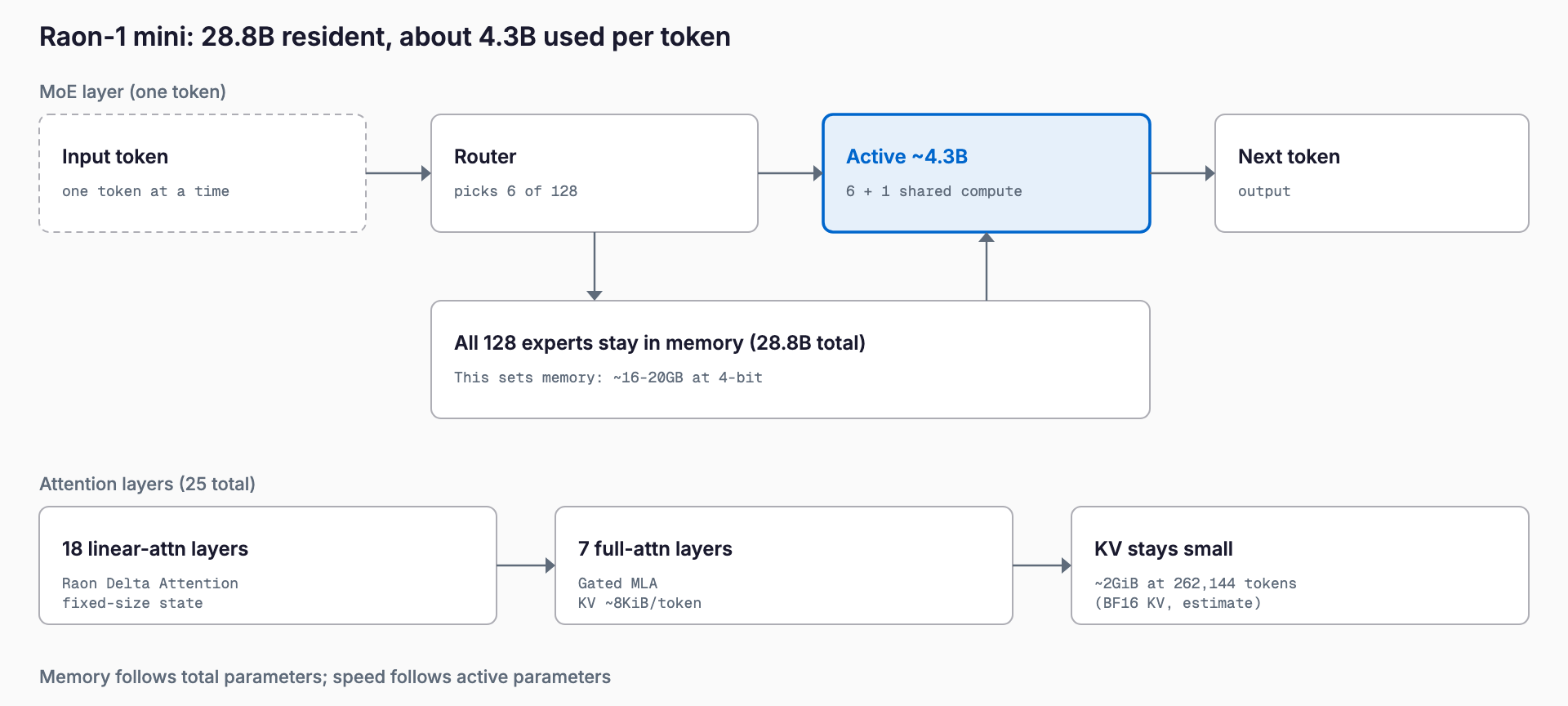
Because it is an MoE, memory is set by the 28.8B total parameters, not the 4.3B active. Active parameters only reduce per-token compute (speed); unused experts still have to sit in VRAM or RAM. We explain the same idea in our Gemma 4 requirements guide.
Benchmarks
| Benchmark | Raon-1 mini | Qwen3.6-35B-A3B | Gemma 4 26B-A4B |
|---|---|---|---|
| MMLU Pro (knowledge) | 76.5 | 85.9 | 82.9 |
| GPQA Diamond (reasoning) | 84.3 | 83.2 | 80.7 |
| AIME 2026 (math) | 93.3 | 92.9 | 87.1 |
| IFBench (instruction following) | 84.2 | 66.6 | 80.9 |
| LiveCodeBench v6 (coding) | 81.6 | 81.2 | 83.4 |
| SWE-Verified (code repair) | 70.8 | 63.2 | 61.6 |
| Terminal-Bench Lite | 47.0 | 63.3 | 52.0 |
| BFCL v4 (tool calling) | 59.8 | 64.7 | 65.8 |
| BrowseComp Plus (agentic) | 55.7 | 34.8 | 32.2 |
| AA-LCR (long context) | 67.3 | 69.3 | 67.0 |
| Chatbot Korean (internal) | 92.9 | 74.5 | 90.6 |
All numbers are KRAFTON's own, judged by gpt-5.6-luna, and independent verification is still thin. The model card also compares Qwen3.8-27B (dense) and Muse Glimmer 30B (dense); Raon's MMLU Pro is the lowest of the five (76.5 versus 82.9-85.9 for the others). It also trails the compared MoE models on Terminal-Bench Lite and BFCL v4, so it does not win across the board. Chatbot Korean is an unreleased internal benchmark. The model card asks for an access request (auto-approved), although the API showed the repo as ungated when we checked.
How well it works in Japanese
There is little evidence either way. KRAFTON's announcement focuses on Korean and English, and while the model card lists Japanese as a supported language, it publishes no Japanese benchmark. Given the lower knowledge score (MMLU Pro), test it on your own data before relying on it for Japanese factual Q&A. Korean and English work, and agentic use with tool calling, have better published backing. For Japanese-first work, compare it side by side with models that have a proven track record at this size.
How to run it (vLLM, llama.cpp, Ollama and more)
As of October 2026, both vLLM and llama.cpp require KRAFTON's forks, since upstream support is pending. For llama.cpp, build the fork and use the GGUF repo.
git clone -b raon-1-mini-preview https://github.com/krafton-ai/llama.cpp
cd llama.cpp
cmake -B build -DGGML_CUDA=ON   # drop -DGGML_CUDA=ON on Apple silicon
cmake --build build --config Release -j

./build/bin/llama-server \
  -hf KRAFTON/Raon-1-mini-preview-gguf:Q4_K_M \
  --host 127.0.0.1 --port 8000 \
  --ctx-size 32768 \
  --temp 1.0 --top-p 0.95 --top-k 20 --presence-penalty 1.5 \
  --reasoning on
The official example uses --ctx-size 262144, but on a 24GB GPU it is safer to start smaller, as above. For vLLM, use the NVFP4 checkpoint; this is the officially documented setup for an RTX 5090 (32GB). It needs CUDA Toolkit 13 (nvcc), and the first start spends about 10 minutes compiling kernels.
VLLM_USE_PRECOMPILED=1 uv pip install \
  "vllm @ git+https://github.com/krafton-ai/vllm.git@raon-1-mini-preview"

vllm serve KRAFTON/Raon-1-mini-preview-nvfp4 \
  --served-model-name Raon-1-mini-preview \
  --max-model-len 32768 --max-num-seqs 8 \
  --gpu-memory-utilization 0.85 --kv-cache-dtype fp8_e4m3 \
  --reasoning-parser raon_1 \
  --enable-auto-tool-choice --tool-call-parser raon_1
- Ollama: the model card lists ollama run hf.co/KRAFTON/Raon-1-mini-preview-gguf:Q4_K_M, but since upstream llama.cpp does not support the model yet, we could not confirm it works on stock Ollama. If it fails, use the forked llama.cpp
- LM Studio / Jan: the card advertises support but gives no settings; unverified
- Apple Silicon (MLX): use -mlx (NVFP4, 17.6GB); the tested versions are mlx 0.32.4, mlx-lm 0.32.2 and transformers 5.20.1
- Transformers: pinned to transformers 5.16.1 and accelerate 1.15.0, with trust_remote_code=True; for a 32GB GPU the card suggests the MXFP8 model with CPU offload
- Recommended sampling: temperature 1.0, top_p 0.95, top_k 20; presence_penalty 1.5 for chat and agents, 0 for coding and math; do not disable thinking
- Speculative decoding: DFlash2 (-dflash2) reports up to ~2.18x output throughput on a B300 with vLLM (hardware dependent)
How it compares with similar models
| Model | Total / active | License | 4-bit memory (estimate) |
|---|---|---|---|
| Raon-1 mini preview | 28.8B / ~4.3B | Apache 2.0 | 16.1-19.7GB files, ~18-23GB needed |
| Qwen3.6-35B-A3B | ~36B / ~3B | Apache 2.0 | ~18GB weights, ~20-22GB needed |
| Gemma 4 26B-A4B (requirements) | ~25.8B / ~4B | Apache 2.0 (per Hugging Face) | ~13GB weights, 16GB minimum guide |
| Holo4-35B-A3B | ~35B / ~3B | Apache 2.0 | ~17.5GB weights, ~20GB needed |
| Recursive Flint 40B-A2.5B | 39.8B / ~2.5B | Apache 2.0 | 23-26GB weights, 24-30GB needed |
Raon-1 mini has the largest active-parameter count here (~4.3B), needs less memory than Flint, and a bit more than Gemma 4 26B-A4B. By its own numbers it leads on GPQA, IFBench and SWE-Verified, but it is weaker on knowledge and tool calling. Since all five are Apache 2.0, the choice comes down to use case (Korean, agents, Japanese factual Q&A) rather than license.
Troubleshooting
- Stock llama.cpp or Ollama will not load it: the custom architecture (raon1_mini) is not upstream yet. Build KRAFTON's fork (branch raon-1-mini-preview)
- vLLM's first start is slow: it compiles kernels for about 10 minutes; wait for the logs rather than assuming it hung
- Out of memory: lower the context from 262,144 to something like 32,768, use an fp8 KV cache, or switch to a smaller quantization (IQ4_XS)
- Verbose or repetitive output: check presence_penalty; Transformers has no built-in presence penalty, so the model's remote code applies it
- Reasoning mixed into or missing from output: vLLM returns it in message.reasoning and llama.cpp in message.reasoning_content
- Download refused: the model card says to request access and run hf auth login (approval is automatic)
- It is a preview, so results can change: weights and specs may differ in the final release; wait for it or design for easy swapping
FAQ
Does Raon-1 mini run on a 24GB GPU?
At 4-bit (Q4_K_M 19.7GB, IQ4_XS 16.1GB) it should. Using the full 262,144-token context adds KV cache and leaves little headroom, so start at 32,768-128,000 and verify memory on your own machine (the memory figures here are estimates).
Why is it ~4.3B active when the total is about 30B?
It is a Mixture-of-Experts model: for each token the router picks 6 of 128 experts (plus 1 shared) to compute. All weights, including unused experts, still have to be held in memory, so memory is set by the total parameter count.
Can I use it commercially?
The weights are Apache 2.0, which allows commercial use. KRAFTON's hosted API and playground are under separate terms, and its training data and methods are not covered by the license.
Does it work in Japanese?
The model card lists Japanese as supported, but no Japanese benchmark is published and KRAFTON's announcement centers on Korean and English. Verify on your own data.
Can I run it with Ollama or regular llama.cpp?
As of October 2026, upstream llama.cpp does not support it yet and KRAFTON's fork must be built. The model card lists an Ollama command, but we could not confirm it on stock Ollama. vLLM also requires KRAFTON's fork.
Related free tools (no sign-up, instant results)
Feel free to contact us
Contact Us