AI-OCR Costs for SMBs: What to Check Before Going Paperless
AI-OCR costs for SMBs digitizing invoices and faxes: cloud SaaS, document-specific tools, LLM reading, custom builds, plus accuracy limits and a checklist.
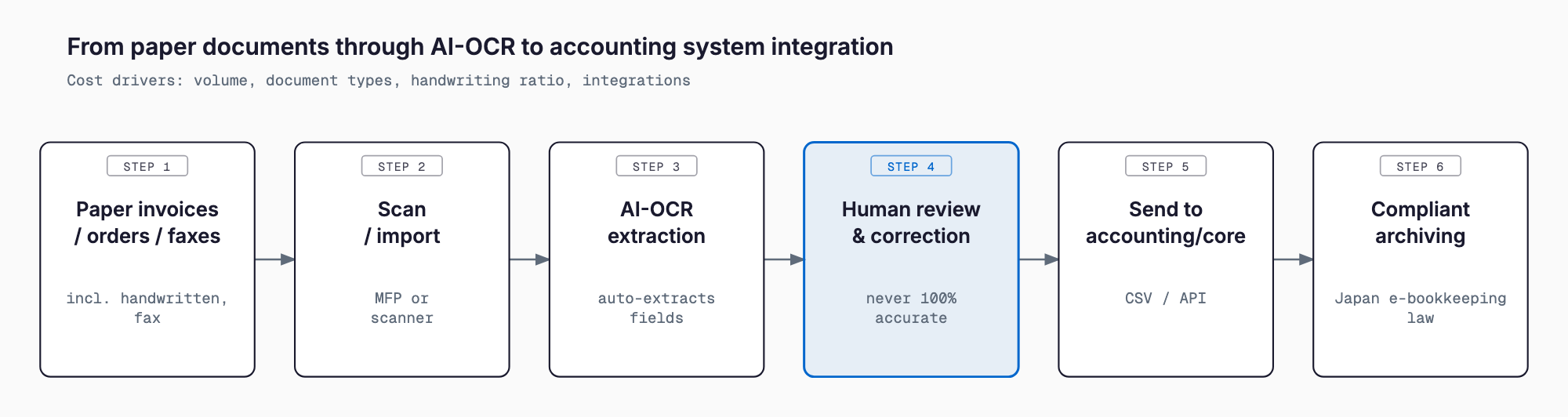
AI-OCR is technology that reads paper documents such as invoices, purchase orders, faxes, and receipts as images and uses AI (machine learning and large language models) to convert individual fields into structured text data. Traditional OCR was limited to recognizing characters at fixed positions in a fixed format, while AI-OCR differs in that it can handle documents with varying layouts and, to some extent, handwritten or faded text. Costs vary widely by approach: a general-purpose cloud AI-OCR SaaS typically runs a few thousand to tens of thousands of yen per month, a document-specific cloud service adds a per-page charge of roughly a few to tens of yen on top of a similar monthly base, reading via generative AI (an LLM) is billed per token as API usage (varying with volume and complexity), and building custom integration with an existing system runs several hundred thousand to several million yen upfront — all general 2026 market ranges, not a specific quote. Many small and midsize businesses face challenges such as manually keying in paper invoices or spending time every day digitizing orders that arrive by fax, but cases also stand out where overconfidence in accuracy or a poorly designed review process causes the rollout to break down. This article breaks down AI-OCR costs, the differences between offering types, the reality of accuracy, and what to check before choosing, in plain terms for non-IT staff.
AI-OCR vs. Traditional OCR
Traditional OCR (optical character recognition) assumes text sits at a predetermined position in a fixed format; it can reach high accuracy on a standardized document, but accuracy drops sharply once the format shifts even slightly. AI-OCR uses a machine learning model to estimate which field appears where on each document, so it can handle invoices with layouts that differ by vendor, handwritten purchase orders, and low-quality fax images reasonably well. More recently, an approach that feeds images directly into a generative AI (LLM) to extract fields has also spread; this doesn't require preparing a fixed template and tends to be more flexible, though its cost structure and accuracy tendencies differ from conventional AI-OCR services.
Cost by Offering Type
| Offering type | Overview | Upfront cost (approx.) | Monthly / usage cost (approx.) |
|---|---|---|---|
| 1. General-purpose cloud AI-OCR SaaS | An off-the-shelf service covering a broad range of documents, from business cards to receipts to invoices | 0-100,000 yen | A few thousand to tens of thousands of yen monthly (often tiered by reading volume) |
| 2. Document-specific (invoices, cards, expenses) | Specialized for a specific task such as invoice processing or expense checks, with easier integration into accounting/expense systems | 0-300,000 yen | A few thousand yen monthly base plus roughly a few to tens of yen per page |
| 3. Reading via generative AI (LLM) | Feeds images into a chat AI or LLM API to extract fields | 0 to a few hundred thousand yen (including prompt design and validation work) | Token-based usage pricing (roughly a few yen per page and up, varying with document complexity and page count) |
| 4. Custom development / integration with existing systems | Connects directly to your core system or accounting software so extracted data flows in automatically | Several hundred thousand to several million yen | Maintenance at roughly 15% of upfront cost per year |
For a small business at the stage of simply wanting to reduce the effort of entering invoices, a free or low-cost tier of a general-purpose cloud AI-OCR SaaS or a document-specific service is often enough. If you want to go further — for example, feeding extracted data straight into journal entries or accounting software as covered in AI in Accounting and Back-Office Work — a document-specific service or custom integration is worth considering. All figures above are general ranges; actual cost varies with document volume and the contracted plan.
What Drives Cost
- Monthly page volume: most services bill by usage or a volume-based tier, so the per-page cost tends to fall as volume grows
- Variety of document types: the more types of documents you need read — invoices, purchase orders, receipts, business cards — the more setup and validation work is required
- Share of handwritten text: documents mixing in handwriting tend to read less accurately than printed-only documents, raising the burden of the review step
- Number of connected systems: the more systems you connect to — accounting software, inventory management, a core system — the greater the need for, and cost of, custom development
- Designing the review process: the workflow and training cost of deciding who checks the reading results and how is easy to overlook but is a real part of the total cost of adoption
The Reality of Accuracy: It Never Reaches 100%
AI-OCR accuracy often reaches a high level on printed, standardized documents, but a certain number of reading errors still occur with handwritten text, low-quality fax images, and receipts that have faded over time. Accuracy figures published by vendors also vary a lot depending on test conditions, and there's no guarantee the same accuracy will hold for your own documents. As a result, adopting AI-OCR doesn't realistically let you eliminate the step where a person checks the reading results — at minimum, fields where a mistake matters, such as amounts, still need a human eye built into the workflow. Once you understand what RPA is, designing a workflow that pairs RPA with routine tasks like transcription and journal entry after the reading step makes it easier to compress overall working time while still keeping a review step in place.
Relationship to Japan's Electronic Bookkeeping Law and Invoice System
AI-OCR is fundamentally a technology for reading paper documents and turning them into data; it's worth noting that it doesn't automatically satisfy the preservation requirements set out in Japan's Electronic Bookkeeping Law, such as timestamping, search requirements, and keeping a history of corrections and deletions. To comply with the scanned-document preservation rules, data read by AI-OCR needs to be combined with a document management system that can store it in a way that meets those requirements. It's also worth checking, when choosing a document-specific service, whether it can correctly extract the items a qualified invoice must show under the invoice system, such as the registration number and amounts broken out by tax rate.
Common Failure Patterns
- Overtrusting accuracy and eliminating the review step entirely, so misreads causing wrong amounts or duplicate entries go unnoticed
- Signing a contract without testing accuracy on your own documents (a high share of handwriting, varied layouts, etc.) first, only to find actual accuracy lower than expected
- Still manually transcribing the extracted data into accounting or inventory systems, so only the "reading" step gets automated and the labor savings end up small
- Underestimating page volume under a usage-based plan, so the monthly bill grows well beyond the initial small-scale estimate
- Losing the know-how for template settings and exception handling when the person in charge leaves or changes roles, leaving the process to fall into disuse
A Rough Cost-Effectiveness Calculation
A simple way to think about cost-effectiveness is to compare the manual time spent before adopting AI-OCR against the "reading plus review" time after. Say you currently key in 500 invoices a month by hand, averaging two minutes per invoice: that comes to about 16.7 hours a month (500 invoices x 2 minutes / 60 minutes). If AI-OCR automates the reading itself and you shift to reviewing only the important fields, such as amounts, at roughly 30 seconds per invoice, monthly work time compresses to about 4.2 hours (500 invoices x 30 seconds / 60 minutes) — freeing up roughly 12.5 hours a month for other work. If the monthly fee for such a service falls in the range of a few thousand to tens of thousands of yen, it's relatively easy to weigh that against the value of the time saved (converted to an hourly rate). Keep in mind, though, that review time per document runs longer than this estimate for documents with a high share of handwriting. As covered in Understanding the Cost of AI Adoption, for AI-related investments, understanding the current state before adoption is especially important as the baseline for measuring the effect.
Checklist Before Choosing
| Item to check | Details |
|---|---|
| Types of documents | Have you mapped out the document types you want read — invoices, purchase orders, faxes, receipts, business cards? |
| Share of handwritten text | Do you know roughly what proportion of your documents include handwriting? |
| Ability to run a proof of concept | Can you test accuracy on your own document samples before signing a contract? |
| Expected monthly volume | Have you estimated monthly page volume, including busy and slow periods? |
| Connected systems | Is it clear which systems — accounting software, inventory management, a core system — the extracted data needs to flow into? |
| Designing the review process | Have you decided who checks the results, which fields, and how? |
| Compliance with the Electronic Bookkeeping Law | Can it be paired with document management that meets the scanned-document preservation requirements? |
| Pricing structure | Is it a flat monthly fee, usage-based, or token-based, and have you checked how the per-page rate changes as volume grows? |
FAQ
What's the difference between AI-OCR and traditional OCR?
Traditional OCR assumes text sits at a fixed position in a fixed format, so accuracy drops once the format changes. AI-OCR uses machine learning to estimate where each field sits on a given document, so it can handle invoices with differing layouts and handwritten text reasonably well.
What does AI-OCR typically cost?
A general-purpose cloud AI-OCR SaaS typically runs a few thousand to tens of thousands of yen monthly. A document-specific service adds roughly a few to tens of yen per page on top of a similar monthly base. Custom integration with an existing system runs several hundred thousand to several million yen upfront. These are general 2026 market ranges, not a specific quote.
Does adopting AI-OCR eliminate data entry work entirely?
It's unlikely to eliminate it entirely. Handwritten text and low-quality fax images cause a certain number of reading errors, so it's realistic to keep a human review step, especially for fields where a mistake matters, such as amounts.
Does AI-OCR automatically handle the Electronic Bookkeeping Law or invoice system requirements?
AI-OCR itself is a technology for reading and digitizing documents; it doesn't automatically meet the preservation requirements the Electronic Bookkeeping Law sets out, such as timestamping and search requirements. It needs to be paired with a document management system that satisfies those requirements.
Summary
AI-OCR costs typically run a few thousand to tens of thousands of yen monthly for a general-purpose cloud SaaS, a similar monthly base plus a few to tens of yen per page for a document-specific service, and several hundred thousand to several million yen upfront once custom integration is included. What matters most isn't choosing on price alone, but confirming that you can test accuracy on your own documents (handwriting share, document types, volume), design a workflow for reviewing the reading results, and pair the system with document management that satisfies the Electronic Bookkeeping Law before adopting it.
Related free tools (no sign-up, instant results)
Feel free to contact us
Contact Us