ATS Recruiting System Costs: A Small Business Guide
A cost guide to ATS pricing by hiring volume: SaaS vs. custom builds, core features, a rollout checklist, and pitfalls small business HR teams should avoid.
In short, a cloud-based applicant tracking system (ATS) typically costs anywhere from a few thousand yen to around 100,000 yen a month, and it usually starts paying for itself once a company hires more than about 5-10 people a year. Below that volume, spreadsheets can often still get the job done. This article lays out what an ATS actually covers, what it tends to cost, how it compares with spreadsheet-based hiring and with custom-built systems, and what to watch for when rolling one out.
What an applicant tracking system (ATS) actually is
An ATS is a cloud service that centralizes candidate information gathered from job boards and recruiting agencies, and handles tracking each candidate's stage in the hiring process, scheduling interviews, emailing candidates, and following up with offer recipients, all from one screen. It's more than a candidate list: most products automatically pull in applications from multiple job boards and visualize the hiring pipeline in a kanban-style view. Giving hiring managers, not just HR staff, visibility into where each candidate stands helps prevent stalled applications and missed follow-ups.
The limits of spreadsheet-based hiring
Plenty of small businesses still track applicants in Excel or Google Sheets. As hiring volume and the number of sourcing channels grow, though, a few structural problems tend to show up. First, someone has to manually copy application data from each job board, agency, referral, or the company's own careers page into a single sheet, which invites missed entries and duplicates. Second, if the person responsible forgets to update a candidate's status, follow-up stalls and the candidate drops out to a faster-moving employer. Third, with multiple interviewers editing the same sheet, version control breaks down through overwritten edits. Fourth, sharing spreadsheets containing personal data over email or chat raises the risk of a data leak. None of this is a major problem at a handful of applications a month, but the load grows sharply once a company opens several roles at once or switches to year-round hiring.
Core ATS features
- Centralized applicant data (automatically aggregated from multiple job boards)
- Pipeline status tracking (document screening, first interview, final interview, offer, visualized kanban-style)
- Interview scheduling (automated scheduling with candidates, calendar integration)
- Bulk email/SMS to candidates, with template management
- Shared interview scorecards (each interviewer's evaluation recorded in the system)
- Offer follow-up (automated offer notices and onboarding guidance)
- Hiring analytics (applications, offer rate, and cost per hire, broken down by source)
Products aimed at small businesses tend to focus narrowly on applicant tracking and pipeline visibility, while products aimed at mid-sized companies often add hiring analytics and support for managing multiple locations or roles at once. Deciding on the scope your company actually needs before comparing products helps avoid paying for features you'll never use.
Cost guidelines by hiring volume
Cost varies significantly with annual hiring volume and how many roles are open at once. The figures below are rough guidelines centered on cloud-based ATS SaaS; actual quotes will move depending on the number of job boards integrated and optional features such as aptitude test integration or referral hiring tools.
| Hiring volume | Upfront cost (approx.) | Monthly cost (approx.) | Notes |
|---|---|---|---|
| Up to ~5 hires/year | ¥0 | Free to roughly ¥10K | Free tiers or small-business pricing often applicable |
| Up to ~20 hires/year | Roughly ¥0-100K | Roughly ¥10K-50K | Cost varies with number of job board integrations and user accounts |
| 50+ hires/year | Roughly ¥100K-300K and up | Roughly ¥50K-150K and up | Setup effort grows with multiple locations and roles run at once |
| Year-round or bulk hiring (e.g. new-grad recruiting) | Roughly ¥200K-500K and up | Roughly ¥100K-300K and up | Range depends on whether aptitude test integration and analytics are included |
Many products price monthly fees as a base charge plus a per-user-account fee, so cost moves with how many HR staff and hiring managers log into the system. Some products also price by the number of job board API integrations, so it's worth getting a quote that includes every job board you actually use before comparing. Annual contracts sometimes come with a discount, so comparing annual totals rather than just the monthly figure gives a more realistic picture.
Off-the-shelf SaaS vs. custom development
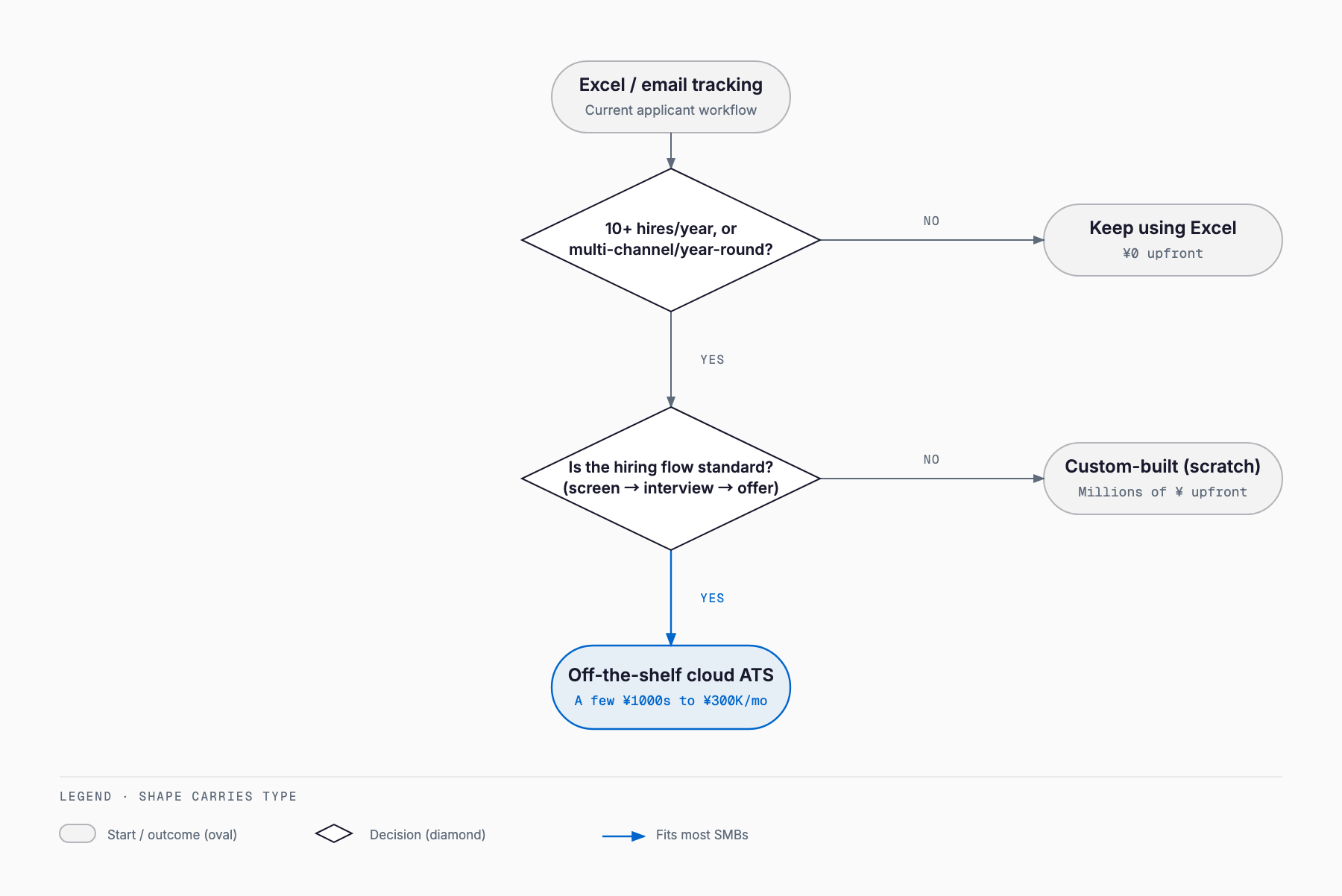
There are broadly two ways to implement an ATS: adopt an off-the-shelf cloud SaaS product, or build one from scratch tailored to your own hiring process. Here's how they compare.
| Option | Upfront cost (approx.) | Monthly cost (approx.) | Best fit | Time to launch |
|---|---|---|---|---|
| Off-the-shelf cloud SaaS | Roughly ¥0-300K | A few thousand yen to ¥300K | Most small and mid-sized companies with a standard hiring process | Days to about a month |
| Custom-built (scratch) | Millions of yen and up | Tens of thousands of yen per month in maintenance and up | Companies where a unique hiring process is business-critical, or deep integration with an existing HR system is required | Several months to over half a year |
For most small and mid-sized companies, an off-the-shelf cloud SaaS is enough. If your hiring process fits the general "screening → interviews → offer" pattern, custom development is heavy on both upfront cost and ongoing maintenance, and usually isn't worth the investment. Building your own is worth considering only for companies with an industry-specific, genuinely complex hiring process, or those that need tight API integration with an existing core system. If you do outsource development, see how to collect competitive quotes for system development for a practical approach.
How to roll one out
- Take stock: tally your current applicant-tracking method, annual application and hire counts, and which job boards you use
- Map the pain points: identify concrete problems with the current spreadsheet setup (missed entries, stalled candidates, slow information sharing)
- Define requirements: decide must-have features (job board integration, pipeline tracking, interview scheduling) plus expected user-account count and budget
- Compare services: shortlist 2-3 ATS services that fit your hiring volume and budget, taking advantage of free trials where offered
- Pilot it: try it on a single open role first to work out the pipeline settings and operating rules
- Roll out company-wide: after training interviewers and hiring managers, extend it to every open role
- Lock in operating rules: document who updates pipeline status and when, as an internal manual
Selection checklist
- Have you confirmed integration with the job boards you currently use?
- Can the hiring pipeline (interview rounds, evaluation criteria) be customized to match your actual process?
- Does the service meet your security and privacy requirements for handling candidates' personal data?
- Does the pricing structure account for changes in the number of user accounts over time?
- Have you confirmed whether data can flow into your existing payroll/HR system?
- Have you checked how usable it is from a smartphone, for interviewers checking status while out of the office?
- Have you confirmed support hours and supported languages?
- Have you tried a free trial or demo to see how it actually feels to use?
- Have you confirmed how to export your data if you cancel?
If you already run a payroll or HR system, it's worth confirming whether offer-recipient data can flow directly into onboarding. Without that link, manual re-entry tends to survive anyway. See payroll and HR system costs for a cost breakdown of that side of the stack.
Common mistakes
One common mistake is choosing an ATS purely on feature count, without first confirming it actually integrates with the job boards you use. Applications from any board that isn't integrated still have to be copied over manually, and the expected time savings never fully materialize. Another common mistake is forcing the existing hiring process onto the system as-is, which can end up adding to interviewers' workload rather than reducing it. Reviewing your current pipeline for anything that can be simplified before configuring the system tends to produce a setup that actually sticks. It's also worth checking that your careers site or job listing pages feed applications into the ATS directly; a disconnected application flow leads to lost candidates. See recruiting site production costs for more on building that entry point.
Measuring results after go-live
Without deciding upfront what "success" looks like, it's hard to judge cost-effectiveness after the fact. Useful metrics include average days from application to offer (pipeline lead time), the candidate drop-off rate due to delayed follow-up, offer rate and cost per hire by source, and time spent per interviewer on the hiring process. It's common for workload to rise temporarily in the first month or two while staff get used to the new system, so evaluating results after at least one full hiring cycle (around three months) gives a more realistic picture.
Summary
Once annual hiring volume passes roughly 5-10 people, an ATS becomes worth evaluating. Costs for a cloud SaaS product typically run from a few thousand yen to around 100,000 yen a month, and risk stays manageable by moving through inventory, pilot, and company-wide rollout stages rather than deploying to every role at once. Spreadsheets can still work at low hiring volumes, but once you switch to hiring for multiple roles at once or move to year-round hiring, it's worth confirming job board integrations and connections to existing systems, then starting small from there.
Frequently asked questions
Is it worth adopting an ATS with only a handful of applications a month?
Often yes. Even with low application volume, being able to centrally manage applications from multiple job boards and avoid missed follow-ups on candidate status is useful regardless of scale. Free or low-cost cloud ATS SaaS options let you adopt one with almost no upfront cost, so it's worth considering early, before switching to year-round hiring.
Do we need an ATS if we only use one job board?
If you use only one job board and application volume is low, spreadsheets can often keep working without major issues for now. But if you plan to add more job boards or open multiple roles at once, switching to an ATS earlier tends to avoid a more costly migration later.
How much time does an ATS actually save HR staff?
It varies, but the time spent manually copying applications from multiple sources, and checking or communicating pipeline status, is usually cut substantially. That said, actually corresponding with candidates and conducting interviews still requires a person, so time spent doesn't drop to zero.
Can an off-the-shelf ATS SaaS handle our company's own hiring process?
Most cloud ATS products let you customize pipeline stage names and the number of stages to some extent, so a general "screening → interviews → offer" flow is usually well supported. If you need to precisely replicate an industry-specific, multi-department evaluation process, though, you'll need to confirm feasibility in advance or consider custom development.
What happens to our data if we cancel an ATS subscription?
Most services let you export applicant data, often as CSV, but retention periods and export formats vary by provider. Since this data includes personal information, it's best to confirm the export method and your own internal storage/disposal rules before canceling.
Related free tools (no sign-up, instant results)
Feel free to contact us
Contact Us