Fish Audio Drama 3 Guide: Requirements, License and Usage
Fish Audio Drama 3 (Oct 2026): 35B MoE open-weight TTS. No official minimum; 48GB GPU advised. Free commercial use under $500K revenue, API cost, SGLang-Omni.
Fish Audio Drama 3 is a text-to-speech (TTS) model released by Fish Audio on October 13, 2026. It is a 35B-parameter MoE with about 3B parameters active per token, and the weights are published on Hugging Face (fishaudio/drama-3). Its standout traits are inline direction tags such as [whispering] and the ability to handle up to 16 speakers in a single generation.
The short version. (1) Hardware: there is no official minimum requirement, and every official benchmark ran on an NVIDIA H200. For self-hosting, third-party guides recommend one GPU with 48GB or more of VRAM. 24GB consumer GPUs are not the target. (2) License: Fish Audio Community License v1.0. Free for research and non-commercial use, and free for commercial use if you and your affiliates earn under US$500,000 a year. Above that, or if you offer Drama 3 to others as a TTS or API service, you need a license. (3) Price: the hosted API lists at $50 per 1M characters, with a launch price of $10 per 1M characters until November 12, 2026. (4) Usage: serve it with SGLang-Omni and POST to /v1/tts. Details follow.
This article relies only on the official blog, the Hugging Face model card and press coverage. Anything not stated officially is marked as not stated, and our own estimates are labeled as rough guidance.
What Drama 3 is: a 35B MoE TTS you can direct
Drama 3 succeeds Fish Audio's S2 line (S2 and S2.1 Pro). It is available on fish.audio, in the iOS and Android apps, and through the API. Because the weights are public, you can also run it on your own server. The technical report is arXiv 2610.18010, code lives at github.com/fishaudio/fish-speech, and docs are at docs.fish.audio.
Fish Audio raised a $52M seed round in July 2026 and reportedly has $21M in ARR and more than 8M users. A company with a commercial voice product releasing the weights of a flagship model is the heart of this news. But as covered below, it is open-weight, not open source.
What it can do: direction, multiple speakers, voice cloning
- Direction: put a bracketed instruction at the start of a line, in any language. A bracket mid-line changes delivery from that point on
- Non-verbal cues: tags like [shaky breath], [small laugh], [whispering], [sighs] and [laughs]
- Paired tags: <emphasis>…</emphasis> and <whisper>…</whisper> for selected words
- Multi-speaker: tags from <|speaker:0|> to <|speaker:15|> allow up to 16 characters in one text, so a whole scene comes out in one pass
- Long text: automatically chunked and streamable
- Voice cloning: reference audio plus its transcript
- Editing by continuation: pass previous_takes to continue from an earlier take
Audio inpainting (interactive editing) is in invite-only testing and the editing API is listed as "coming soon". Nothing says it is generally available yet, so avoid designing around it.
The model is announced with 83 languages, but the pages we checked do not show an official language list. The official blog shows a Japanese direction example, yet you should check the official language list and listen to real output before relying on Japanese quality.
Specs: architecture and speed
| Item | Detail |
|---|---|
| Total parameters | 35B (the Hugging Face page lists 36B) |
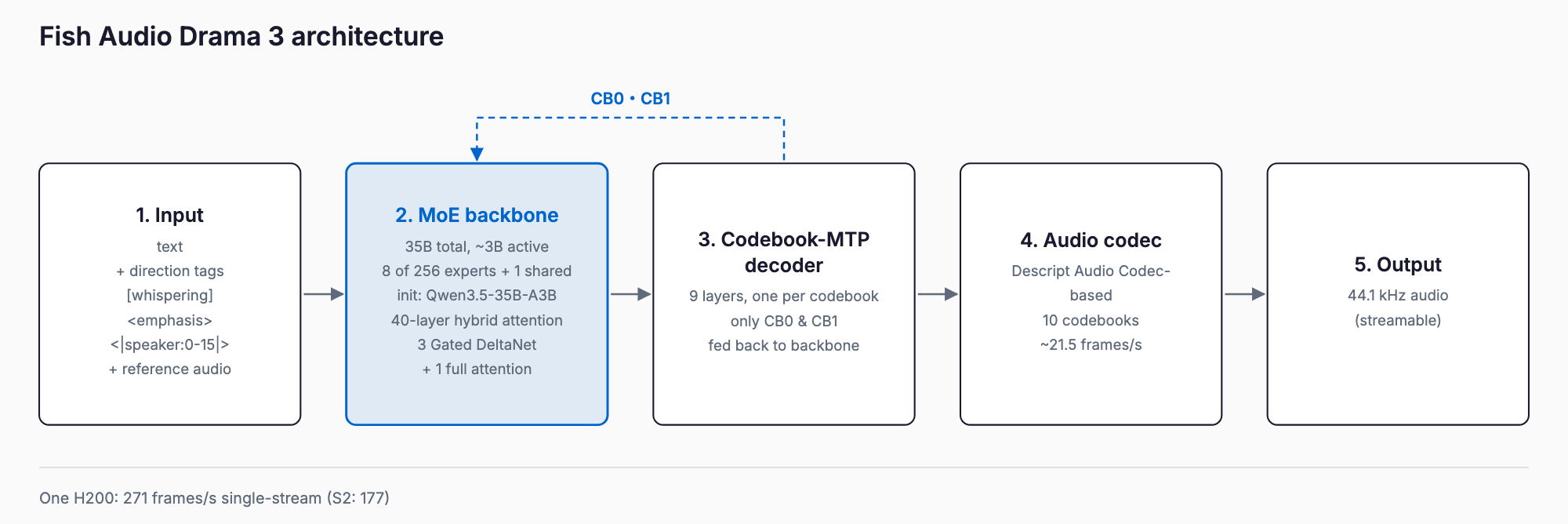
| Structure | MoE: 8 of 256 routed experts plus 1 shared, about 3B active per token |
| Backbone | Initialized from the Qwen3.5-35B-A3B language model |
| Attention | Hybrid: 40 layers in blocks of 3 Gated DeltaNet layers plus 1 gated full-attention layer |
| Decoder | Codebook-MTP (9 layers, one per acoustic codebook), replacing S2's Fast AR |
| Tokenizer | Same as S2: Descript Audio Codec based, 44.1 kHz, 10 codebooks, about 21.5 frames/s, fully causal |
| Weights | safetensors; MoE experts in FP8 (F8_E4M3), the rest in BF16 |
| Training | 3 pre-training stages, instruction fine-tuning, RL with a learned human-preference reward model (GRPO without KL penalty) |
Starting from a Qwen3.5-35B-A3B language model will feel familiar to anyone running local LLMs; see our piece on running Qwen3.5 27B/35B locally. Speech adds codebook generation and a vocoder, so memory estimates differ from a plain LLM.
On one H200, single-stream decoding runs at 271 frames/s for Drama 3 versus 177 for S2. The model card streaming benchmark on one H200:
| Concurrency | Frames/s | Time to first audio (p50) | RTF |
|---|---|---|---|
| 1 | 166.7 | 88.9 ms | 0.131 |
| 16 | 927.6 | 210.1 ms | 0.373 |
| 64 | 1,687.3 | 450.9 ms | 0.801 |
An RTF below 1 means generation is faster than playback. Even at 64 streams RTF stays at 0.801. At 256 streams, moving the vocoder to a second GPU gave 4,160 frames/s and 2,146 ms to first audio, versus 2,422 frames/s and 3,403 ms on a single GPU.
Quality: pronunciation robustness
On Artificial Analysis's Pronunciation Robustness test (English), Drama 3 scored 93.2%, ranking first ahead of ElevenLabs Eleven v4 and v4 Turbo, per reports. Fish S2.1 Pro scored 88.1%.
| Category | Drama 3 | Fish S2.1 Pro |
|---|---|---|
| Brands, places, technical terms | 95.9 | 87.3 |
| Context-dependent words | 95.3 | 86.1 |
| Shorthand (numbers, dates, units) | 93.6 | 92.7 |
| Exact sequences (codes, paths, emails) | 86.3 | 79.4 |
It is also reported as the top open-weights model on the Artificial Analysis TTS leaderboard. Note this is an English test and says nothing direct about Japanese. For a Japanese-focused open model, compare Irodori-TTS-v4-Large.
Requirements: no official minimum
This is the most misunderstood point. Drama 3 has no official minimum requirements. All official benchmarks ran on an NVIDIA H200, and operation or speed on other GPUs is not guaranteed.
Third-party guides recommend one GPU with 48GB or more of VRAM (RTX 6000 Ada, L40S, A6000 48GB class, H100, H200) for FP8 self-hosting. With about 35B parameters mostly in FP8, the weights alone come to roughly the mid-30GB range, and KV cache plus vocoder add more. The table below is our rough guidance, not an official figure.
| GPU class | Guidance | Notes |
|---|---|---|
| H200 / H100 | Official benchmark hardware (H200); ample headroom | For high-concurrency production |
| 48GB class (L40S, RTX 6000 Ada, A6000) | Rough lower bound | Third-party recommendation; keep concurrency low |
| 24GB (RTX 4090, etc.) | Not the target | No official quantization |
| 32GB (RTX 5090) | Not the target | Weights unlikely to fit |
| Mac | Not stated officially | Unverified |
There is no official GGUF or consumer-grade quantization at launch. Hugging Face lists community quantized variants, but their quality is unverified. Treat it as a server-GPU model, not a casual desktop one. For lightweight use, the hosted API or a smaller model is the practical choice.
License: can you use it commercially?
The weights ship under the Fish Audio Community License v1.0. It is an open-weight license, not open source in the OSI sense.
- Research and non-commercial: free
- Commercial, small: free if you and your affiliates have under US$500,000 in annual revenue
- Commercial, large: at US$500,000 or more, you need a license from Fish Audio
- Offering it as a service: regardless of revenue, providing Drama 3 to others as a TTS, voice-cloning or inference service or API requires a license (business@fish.audio)
- Prohibited: cloning a real person's voice without consent
One catch: the Hugging Face license tag reads fish-audio-research-license, and S2 remains under the Fish Audio Research License, so the label may be a mix-up. Read the full LICENSE file in the repository before any commercial decision. The line between "using it behind your own product" and "selling it to others as an API" is easy to misread, so involve legal review.
Pricing: hosted API and apps
The hosted API uses the same endpoint as S2.1 Pro, https://api.fish.audio/v1/tts. Set the header model: drama-3 and put tags directly in text.
| Item | Price |
|---|---|
| API list price | $50 per 1M characters |
| Launch price (Oct 13 to Nov 12, 2026) | $10 per 1M characters (80% off) |
| Apps | Drama 3 uses the same credits as S2.1 Pro; new Plus/Pro/Max plans are 50% off until Nov 12 |
At the launch price, a 10,000-character script costs about $0.10 ($10 / 1M characters x 10,000); at list price about $0.50. This is plain character math, and how retries or silence are billed is not stated. Self-hosting carries fixed GPU costs, so at low monthly volumes the API is likely cheaper.
How to use it: SGLang-Omni and API calls
The official self-hosting route is SGLang-Omni. A vLLM procedure was not mentioned in the sources we checked.
git clone https://github.com/sgl-project/sglang-omni.git && cd sglang-omni
uv pip install --prerelease=allow -v -e ".[fishaudio]"
sgl-omni serve --model-path fishaudio/drama-3 --port 8000
The server listens on port 8000 at /v1/tts. POST JSON containing text, references (a list of audio_path and text pairs), and optionally previous_takes. The example below combines multiple speakers and direction (paths and text are placeholders).
curl -X POST http://localhost:8000/v1/tts \
  -H "Content-Type: application/json" \
  -d '{
    "text": "<|speaker:0|>[whispering] I have some important news today.\n<|speaker:1|>[small laugh] Oh, what is it?",
    "references": [
      {"audio_path": "/path/to/ref_a.wav", "text": "Transcript of the reference audio"}
    ]
  }' --output out.wav
With the hosted API only the endpoint and header change; tags work the same way.
curl -X POST https://api.fish.audio/v1/tts \
  -H "Authorization: Bearer $FISH_API_KEY" \
  -H "Content-Type: application/json" \
  -H "model: drama-3" \
  -d '{"text": "[sighs] Finally done.<emphasis>really</emphasis>long."}' \
  --output out.mp3
Three tips:
- Keep directions short and at the line start: begin with a single word such as [whispering], listen, then add more
- Use paired tags for emphasis: wrapping only the needed words in <emphasis> breaks less often than stacking global directions
- Pin speakers by number: map each speaker number to one reference voice to keep consistency across the script
Cloning needs reference audio and an accurate transcript. If you use someone else's voice, their consent is required.
How it differs from other TTS
Competitor rows stick to known attributes (open or closed, self-hostable) and carry no price or performance numbers.
| Model | Release | Self-host | Notes |
|---|---|---|---|
| Fish Audio Drama 3 | Open weights (Community License) | Yes (48GB-class GPU as guidance) | 35B MoE, direction tags, up to 16 speakers, 83 languages |
| Fish S2 / S2.1 Pro | S2 under Research License; S2.1 Pro via API | S2 yes | Predecessor; S2.1 Pro scored 88.1% on the pronunciation test |
| ElevenLabs Eleven v4 | Closed | No (API only) | Reported to rank behind Drama 3 on the pronunciation test |
| Irodori-TTS-v4-Large | Open | Yes | 3.29B Japanese TTS; see this article |
| xAI Grok TTS | Closed | No (API only) | See our Grok TTS guide |
A simple rule: for natural Japanese on lighter hardware, a Japanese-focused open model; for multi-speaker scenes and direction with a server GPU available, Drama 3; to avoid infrastructure, an API. For trying local speech synthesis more casually, something like VoiceStudio is another route.
Things to watch
- Check Japanese quality by ear: the headline score is an English pronunciation test; reading, accent and direction-following in Japanese need separate checks
- Leave hardware headroom: with no official minimum, 48GB may still stall at high concurrency or long text; load-test it
- Settle the license boundary first: sort out the revenue threshold and the service-provision clause internally before adoption
- Voice rights: cloning requires consent; keep it in writing for staff or partners
- Do not count on editing: inpainting is invite-only and the editing API is not out
- Pricing is temporary: $10 per 1M characters ends November 12, 2026; budget at the $50 list price
- It is new: bugs and spec changes are likely right after launch, so leave an evaluation period before production
FAQ
Can Fish Audio Drama 3 be used commercially?
With conditions. Under the Fish Audio Community License v1.0, commercial use is free if you and your affiliates have under US$500,000 in annual revenue. Above that, or if you offer Drama 3 to others as a TTS, voice-cloning or inference service or API, you need a license from Fish Audio (business@fish.audio). The Hugging Face license tag differs in name, so read the full LICENSE file.
What are the Drama 3 requirements? Does it run on an RTX 4090?
There is no official minimum, and all official benchmarks ran on an NVIDIA H200. Third-party guides recommend one GPU with 48GB or more of VRAM (L40S, RTX 6000 Ada, A6000 48GB, H100, H200). With weights mostly in FP8 and roughly in the mid-30GB range, a 24GB RTX 4090 is not the target, and no official quantized build exists at launch.
Does Drama 3 support Japanese?
It is announced with 83 languages, and the official blog shows a Japanese direction example. However, the pages we checked show no official language list, and the high benchmark score is for English. Check the official list and listen to your own text before using it in Japanese.
How much does the API cost?
List price is $50 per 1M characters. From October 13 to November 12, 2026 a launch price of $10 per 1M characters (80% off) applies. The endpoint is https://api.fish.audio/v1/tts with the header model: drama-3. In the apps, Drama 3 uses the same credits as S2.1 Pro.
Summary
Fish Audio Drama 3 is an open-weight 35B MoE TTS that handles direction tags and up to 16 speakers in one generation. It is reported to lead an English pronunciation benchmark and holds RTF 0.801 at 64 streams on an H200. But there is no official minimum requirement, self-hosting points to 48GB-class server GPUs rather than desktop PCs, and while commercial use is free under US$500,000 in annual revenue, serving it to others needs a separate agreement.
A sensible order: test Japanese quality through the hosted API while the launch price lasts, then consider GPUs and the license boundary for self-hosting. Information is likely to change soon after launch, so confirm current terms in the official docs and model card.
Feel free to contact us
Contact Us