Graphify Explained
Turn a Codebase, Docs and PDFs into a Knowledge Graph for Coding Agents (vs Vector RAG, Serena, OpenViking, Hindsight) [2026]
Graphify is an open-source tool that turns code, docs, SQL schemas and PDFs into a queryable knowledge graph for 20+ coding agents. Code parsing is local, no LLM needed. Updated Oct 2026.
Graphify (Graphify-Labs/graphify) is an open-source Python tool that turns a codebase, plus its docs, SQL schemas, configs and PDFs, into a queryable knowledge graph that coding agents such as Claude Code, Cursor and Codex can query through a skill, a CLI or MCP. The verdict: it is a graph-based alternative to vector search for the problem of agents re-grepping a large repo and misreading its structure, and the practical point is that code parsing runs locally with no LLM.
The repository sits at roughly 135k GitHub stars as of October 2026, which makes it one of the most-watched agent tooling projects. Everything below comes from the official README: how it works, install, pricing, and how it differs from the alternatives.
What is Graphify?
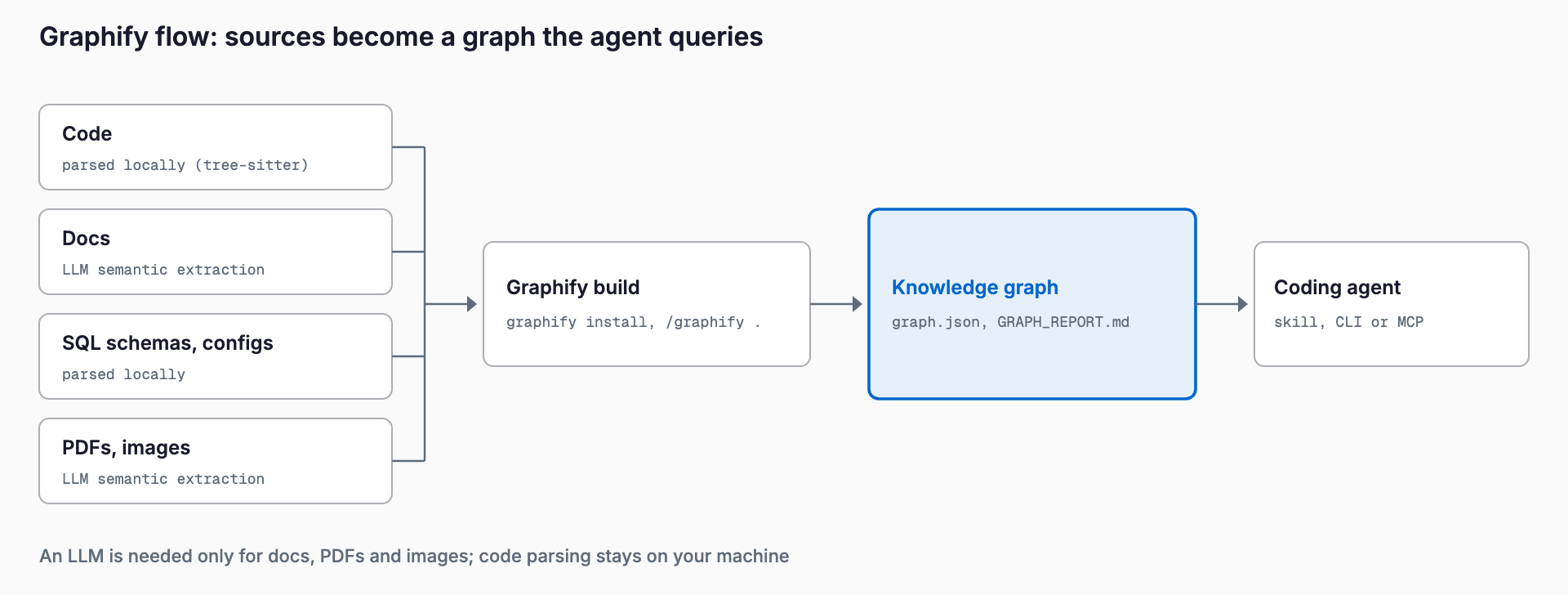
Graphify parses source code with tree-sitter and turns functions, classes, calls and imports into nodes and edges. Docs, PDFs and images go through a semantic pass that uses your agent's model (or a configured API key) and are merged into the same graph. Each edge is tagged EXTRACTED (explicit in the source) or INFERRED (resolved by Graphify), so you can tell how strong the evidence is.
| Item | Details |
|---|---|
| Publisher | Graphify-Labs (GitHub: Graphify-Labs/graphify) |
| License | Ships both Apache-2.0 and MIT license files (some secondary sources say MIT only, so check the repo before use) |
| Language / requirements | Python 3.10+. uv recommended; pipx and pip also work |
| Inputs | About 40 programming languages (tree-sitter), docs, PDFs, images, audio/video (local transcription with faster-whisper), SQL schemas, configs, Terraform/HCL, docx and xlsx |
| Output | graph.html, GRAPH_REPORT.md and graph.json under graphify-out/ |
| Storage | JSON files by default. No vector store or embeddings. Optional push to Neo4j or FalkorDB |
| Clustering | Leiden (falls back to networkx Louvain without the leiden extra) |
| Query interfaces | Skill (/graphify), CLI (query, path, explain), MCP stdio server, direct reads of graph.json |
| Supported agents | 20+ including Claude Code, Cursor, Codex, Gemini CLI, GitHub Copilot CLI, VS Code Copilot Chat, Aider, OpenClaw, Kiro, Amp, OpenCode, Kilo Code, plus a generic Agent Skills target |
| Pricing | Core is free. The hosted Graphify Cloud lists only a 14-day free trial in the README; paid pricing is not disclosed |
What it can do
| Feature | Details |
|---|---|
| Code graph | Deterministic tree-sitter parsing. No LLM, and code stays on your machine |
| Docs, PDFs, images | Semantic extraction with your agent's model or an API key, linked to code nodes |
| Design rationale | # NOTE: and # WHY: comments and ADR/RFC citations become nodes linked to code |
| Path and explain queries | query (question), path (route between two nodes), explain (one node) |
| Incremental updates | --update rebuilds only what changed; graphify hook install wires it into Git |
| Visualization and report | Interactive graph.html and a GRAPH_REPORT.md summary |
| Merging graphs | graphify merge-graphs combines graphs from several repositories |
| Fully local mode | GRAPHIFY_BACKEND=none disables LLM backends; ollama keeps semantic extraction local too |
Install and pricing
uv tool install graphifyy      # or: pipx install graphifyy / pip install graphifyy
graphify install               # project-scoped: graphify install --project
Note that the PyPI package name is graphifyy (two y's). PDF, Office, video, MCP, SQL and Leiden support come as extras (pdf, office, video, mcp, sql, leiden, all). The core is free; the LLM-based semantic pass costs whatever your agent's model or API key costs. The hosted Graphify Cloud advertises an always-on graph, monorepo and cross-repo support, code review and Sentry/Jira connectors, and the README claims an 80% cut in token spend. We found no independent verification, so treat that number with caution.
How to use it (shortest path)
- 1. Install the CLI with uv tool install graphifyy, then run graphify install to register the skill with your agent
- 2. Open your agent at the project root and run /graphify . to build the graph ($graphify in Codex)
- 3. Read graphify-out/GRAPH_REPORT.md and graph.html for the overall picture and communities
- 4. From then on, query with /graphify query, path and explain; after code changes, run --update to refresh only the diff
/graphify .
/graphify query "what connects auth to the database?"
/graphify path "UserService" "DatabasePool"
/graphify explain "RateLimiter"
/graphify ./docs --update
graphify hook install
How it differs from other tools
| Tool | What it stores or searches | Structure | LLM needed? | Best for |
|---|---|---|---|---|
| Graphify | Relationships across code, docs, schemas and PDFs (calls, dependencies, design rationale) | Knowledge graph (JSON, optional Neo4j) | Not for code; yes for docs and PDFs | Tracing "how does A connect to B" in a large repo |
| Plain vector RAG | Chunks of docs or code, by embedding similarity | Vector DB | Embedding model | Fuzzy-wording doc search, FAQs |
| OpenViking | Agent context (memory, resources, skills) managed hierarchically | Context database | Depends on usage | Managing an agent's whole context in one place |
| Hindsight | Memories learned from conversations and work | Agent memory | Used to extract memories | Carrying lessons from past sessions forward |
| Serena (MCP) | Symbol-level search, editing and refactoring (LSP-based, 40+ languages) | Language server, not a graph | No | Precise definition/reference lookup and edits; GPL-3.0-or-later (parts MIT) |
| Sourcegraph | Org-wide code search and code intelligence | Search index | Varies by feature | Cross-repository search, mostly hosted and commercial |
| akitaonrails/ai-memory | Session-to-session handoff (where work stopped, what failed, what remains) | Git-backed markdown wiki plus SQLite index (Rust, MIT) | Not by default | Continuing work across different agent CLIs |
It helps to think in layers. Graphify is the structural map of the codebase, ai-memory and Hindsight handle work memory and handoff, OpenViking holds the broader context, and Serena does precise symbol-level lookup and edits. ai-memory does not analyze code relationships; it is a separate layer for session handoff, so it complements Graphify rather than competing with it. For a small repo, Serena or plain grep is often enough; Graphify pays off once you need to follow cross-cutting dependencies and design intent.
Caveats and poor fits
- The semantic pass for docs, PDFs and images uses an LLM, so check where content goes (your agent's model or API key) before feeding in confidential documents. Use GRAPHIFY_BACKEND=ollama or none to avoid external calls
- The "80% fewer tokens" figure is a Graphify Cloud claim with no third-party verification. Measure it on your own repo
- The published benchmarks (LOCOMO recall@10 0.497, LongMemEval-S QA 76%, etc.) are mostly memory and QA metrics, not a guarantee of better coding results
- INFERRED edges can be wrong. Verify important decisions against EXTRACTED evidence or the actual code
- With this many stars come many open issues and PRs (several hundred each as of October 2026), so commands and behavior may change often. Pin the version
- Query logs are written to ~/.cache/graphify-queries.log; set GRAPHIFY_QUERY_LOG_DISABLE=1 to turn that off
- For projects of a few dozen files, building a graph is usually not worth the effort
For related reading on agent context and memory, see OpenViking (a context database for agents), Hindsight (agent memory) and archify (drawing architecture diagrams with an agent skill); together they make the division of labor between these tools easier to see.
FAQ
Is Graphify free?
The open-source core is free and installs with uv, pipx or pip. If you use your agent's model or an API key for the semantic pass over docs and PDFs, that usage is billed separately. The hosted Graphify Cloud shows a 14-day free trial in the README; paid pricing is not disclosed.
Does my code get sent to an external LLM?
Per the official description, code is parsed locally with tree-sitter and no LLM is involved. An LLM is used only for semantic extraction from docs, PDFs and images. Set GRAPHIFY_BACKEND=none to disable LLM backends, or ollama to keep that step local too.
Which coding agents does it work with?
More than 20, including Claude Code, Cursor, Codex, Gemini CLI, GitHub Copilot CLI, VS Code Copilot Chat, Aider, OpenClaw, Kiro, Amp, OpenCode and Kilo Code, plus a generic Agent Skills target. An MCP stdio server is available through the mcp extra.
Can it replace vector RAG?
They do different jobs. Graphify uses no embeddings or vector store and is good at following relationships such as calls, dependencies and design rationale. Vector RAG is better for fuzzy-wording document search, so the two complement each other rather than replace one another.
How is it different from Serena or Sourcegraph?
Serena is a symbol-level search and editing toolkit built on language servers, and Sourcegraph is an org-wide code search platform. Neither builds a single graph that merges code with docs and PDFs. Graphify does, and lets agents trace relationships across them.
Can I use it with ai-memory or Hindsight?
Yes, they sit at different layers. Graphify is the structural map of the codebase, ai-memory (Rust) hands work off between sessions, and Hindsight keeps memories the agent has learned. Pick per layer instead of expecting one tool to cover everything.
Feel free to contact us
Contact Us