Meta Muse Spark 1.3: Benchmarks and the 12-21x Price Gap
Meta's Muse Spark 1.3 hits DeepSWE 75.4, Terminal-Bench 88.8. Standard ($1.25/$4.25) vs Contributor ($0.10/$0.20) shows a 12-21x gap paid in training data.
On September 2, 2026, Meta released a new model, Muse Spark 1.3, as a same-day drop-in across Muse Code and the Meta Model API. It ships with a 1M-token context window. A deeper max reasoning mode remains a limited preview pending additional safety review. On coding benchmarks it shows clear gains over the previous 1.2 generation, scoring 75.4 on DeepSWE v1.1 and 88.8 on Terminal-Bench 2.1 (tied with GPT-5.6 Sol).
But the numbers aren't the real story here. Meta's pricing splits Muse Spark 1.3 into a "Standard" and a "Contributor" tier, with input tokens 12x cheaper and cached input over 75x cheaper on the Contributor side — and the difference isn't paid in cash, it's paid by handing over your prompts and outputs for Meta's own use. Cheap tokens come with a reason attached. This piece lays out, fact by fact, which tier an engineering team should actually pick.
What changed in Muse Spark 1.3
According to Meta's own announcement, Muse Spark 1.3 was trained to handle longer-horizon tasks that require ongoing collaboration with users and management of multiple workflows, and it can pull in context from a variety of sources on its own when pursuing open-ended goals. It's also tuned to ask for help when it hits ambiguity and to seek confirmation before making significant changes. In Meta's own engineer-led comparisons against 1.2, the model used roughly 20% fewer tool calls and about 25% fewer tokens — the claim being fewer round-trips and less token spend to finish comparable work.
Alongside the standard reasoning mode covered by the public benchmarks, Meta has previewed a deeper "max reasoning" mode, but that is explicitly slated for a later rollout once additional safety review wraps up — it isn't available as of September 2026. Rollout pacing also varies by region, and availability in the EU and elsewhere may lag behind the initial release.
Where it lands on the benchmarks
Lining up the published benchmark scores against GPT-5.6 Sol and Claude Opus 5, Muse Spark 1.3 either leads or ties on coding tasks, and pulls well ahead on long-context retrieval (MRCR), especially in the 512K-1M token range. On agentic tasks, however — GDPVal-AA v2 and OSWorld 2.0 — it trails Claude Opus 5 slightly. The picture that emerges from the public data is a model that's strong on coding and long context, but not the clear leader on general-purpose agentic work.
| Benchmark | Muse Spark 1.3 | GPT-5.6 Sol | Claude Opus 5 |
|---|---|---|---|
| DeepSWE v1.1 | 75.4 | 73.0 | 74.0 |
| SWEAtlas CodeBase QnA | 59.4 | 53.5 | 52.7 |
| Terminal-Bench 2.1 | 88.8 | 88.8 (tied) | 86.7 |
| MRCR 256K-512K | 98.5 | 91.5 | — |
| MRCR 512K-1M | 98.1 | 73.8 | — |
On the agentic benchmarks, published figures show GDPVal-AA v2 at 1754 for Muse Spark 1.3, 1710 for GPT-5.6 Sol and 1824 for Claude Opus 5, and OSWorld 2.0 at 66.9, 62.7 and 68.3 respectively — a modest edge for Opus 5. There's still a gap when it comes to autonomously carrying out long, open-ended tasks end to end. For more on long-context, agentic model design, see our coverage of Claude Fable 5.1 and Mythos 5.1.
Pricing and how to read the Contributor tier
Here's the Meta Model API pricing for Muse Spark 1.3:
| Tier | Input (per 1M tokens) | Output (per 1M tokens) | Cached input (per 1M tokens) |
|---|---|---|---|
| Standard | $1.25 | $4.25 | $0.15 |
| Contributor | $0.10 | $0.20 | $0.002 |
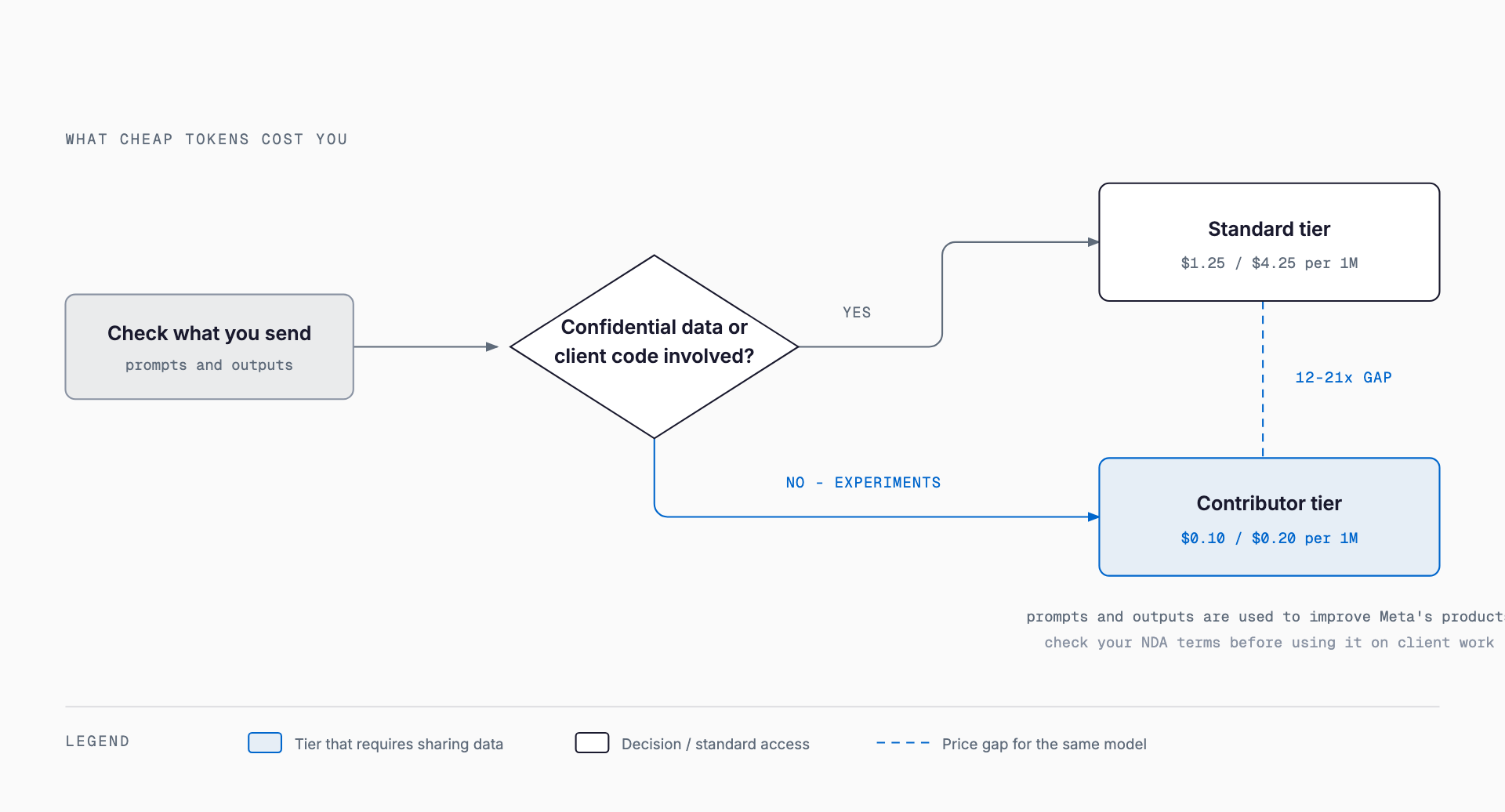
At roughly 1/12.5 the input price of Standard, and about 1/75 on cached input, the Contributor tier is remarkably cheap. But the condition attached is explicit: it requires consent for Meta to use your submitted prompts and generated outputs to improve its products, including model training, and it comes with tighter rate limits than Standard. In other words, the payment for "cheap tokens" isn't cash — it's your own code and data.
That framing makes the decision fairly clean. For business code, customer data, or contract-development work under NDA — anywhere disclosure to a third party could be a contractual or legal problem — Standard is the sensible default. For a Japanese firm doing contract development or acting as a systems integrator handling a client's proprietary source code or specifications, using the Contributor tier carries real risk of breaching confidentiality obligations owed to that client. Conversely, for personal learning, open-source experimentation, or internal proof-of-concept work where exposure carries no real downside, the Contributor tier's cost efficiency is a genuinely attractive option. Note that none of this is legal advice — actual contractual permissibility should be confirmed against your own agreements and counsel.
One more practical caveat: Muse Spark 1.3 keeps its reasoning traces private. Unlike models such as Claude's, where an extended-thinking process can be inspected, there's no way to see the intermediate reasoning steps, and developers have flagged this as making it harder to debug an agent when its behavior diverges from what was intended. Before shipping to production, it's worth having a separate plan for isolating unexpected outputs.
How to access it
Beyond direct access through the Meta Model API, Muse Spark 1.3 is also available via OpenRouter. Its OpenRouter model IDs differ by tier: meta/muse-spark-1.3 for Standard and meta/muse-spark-1.3-contributor for Contributor — separate endpoints despite the shared name, so anyone migrating configuration from 1.2 should double-check the model ID rather than assume it carries over. The model is also integrated into Muse Code as of the same release date.
How it compares to other models
Among the models developers weigh for coding and agentic work, Muse Spark 1.3's strengths are its 1M-token context and long-context retrieval accuracy, and it leads by a narrow margin on several coding benchmarks. On general-purpose agentic capability, though, Claude Opus 5 holds a modest edge, keeping the Opus line in the running for complex, multi-step workflows. If low cost and fast responses matter more than peak capability, it's worth comparing against a lighter model like Gemini 3.8 Flash. For teams that want everything to stay local, the local deployment requirements for Muse Glimmer 30B are also worth a look.
Things to watch
- The max reasoning mode remains a limited, safety-review-gated preview; only the standard mode is generally available today
- The Contributor tier requires handing over your data, making it a poor fit for confidential or customer information
- Reasoning traces are not exposed, so plan for a separate way to debug unexpected agent behavior
- Regional rollout timing varies, and availability in the EU and elsewhere may lag
- Pricing and benchmark figures can change with future updates — verify current values against Meta's official documentation before a production rollout
FAQ
Can anyone use the Muse Spark 1.3 Contributor tier?
Yes, via the Meta Model API or OpenRouter, but it requires consent for Meta to use your prompts and outputs for product improvement and model training, and it comes with tighter rate limits than Standard.
Is it okay to use the Contributor tier for contract development work under NDA?
Sending a client's source code or confidential information through it risks breaching confidentiality obligations. This isn't legal advice — confirm against your own contracts and counsel, but if in doubt, Standard is the safer default.
When will the max variant become available?
As of September 2026 it remains a limited preview pending additional safety review, with no official date for general availability.
Should I choose this over Claude Opus 5 or GPT-5.6 Sol?
If coding and long-context retrieval are the priority, Muse Spark 1.3 is a strong candidate. But published data shows Claude Opus 5 with a modest edge on general agentic capability, so the right choice depends on the specific use case.
Feel free to contact us
Contact Us