Ollaya: Run Jev-Style Decision Models Locally (Ollama-Like)
Ollaya is an open-source local runtime for decision models: state and typed questions in, calibrated probabilities out in ms, via Ollama-style pull/run/serve.
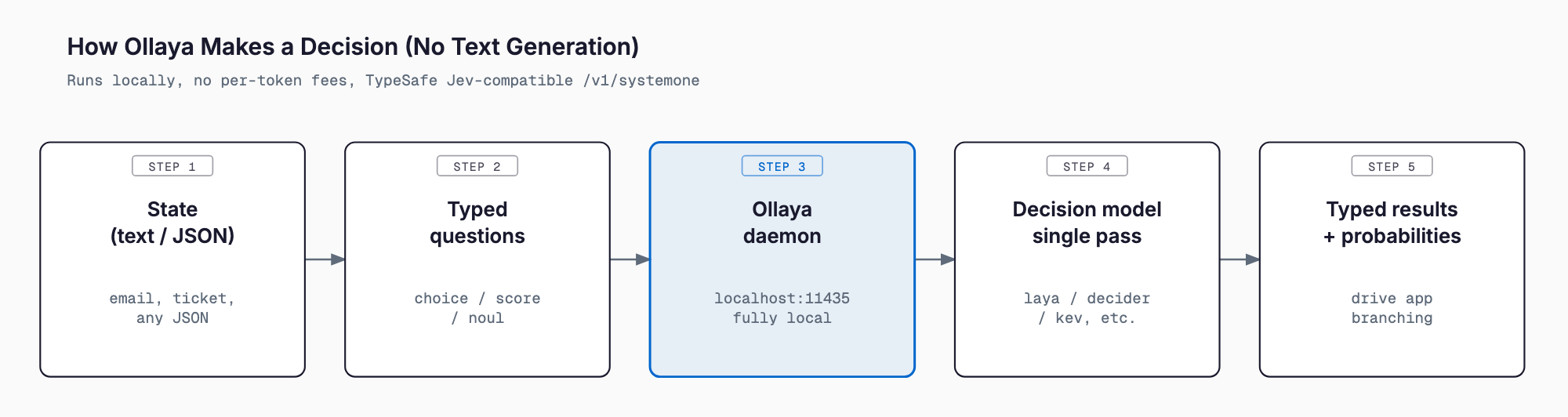
Ollaya is an open-source local runtime for decision models — not LLM chat, but models that take a state (text, an email, a ticket, or any JSON) plus typed questions (choice, score, or noul — a yes/no probability) and return calibrated probabilities in a single forward pass, in milliseconds. Its CLI and daemon mirror Ollama's UX almost exactly: pull a model by name, then run or serve it locally. Ollaya hit the Hacker News front page around September 25-26, 2026 (462 points, 117 comments), largely because it offers a local, drop-in way to run the kind of decision model TypeSafe AI's hosted Jev "System One" API introduced on September 15, 2026.
What Ollaya Can Do
A decision model doesn't generate text. It takes a state and typed questions and returns only probabilities (or score distributions) for each — essentially a smart if-statement. That makes Ollaya useful for:
- Support ticket triage — judge refund intent, urgency, and churn risk in one call
- Email and ticket routing — score priority and sentiment to route to the right queue
- LLM guardrails — check inputs and outputs for risky intent or policy violations before or after generation
- Smart if-statements in workflows — replace regex or rule-based branching with a calibrated, probability-backed decision
Install, Pricing, and Requirements
Ollaya is open source under Apache 2.0 (per-model licenses vary) and free to use, with no per-token fees.
| Item | Details | |
|---|---|---|
| License / pricing | Apache 2.0 (model licenses vary); free, open source, no token fees | |
| Install (Linux/macOS) | curl -fsSL https://ollaya.dev/install.sh piped to sh | |
| Install (Windows) | `irm https://ollaya.dev/install.ps1 \ | iex` (PowerShell) |
| Install (Docker) | docker run -d --gpus=all -p 11435:11435 ghcr.io/ollaya-dev/ollaya:cuda | |
| Supported OS | macOS Apple Silicon 14+, Windows 10/11 x64, Linux x86-64/ARM64, WSL2 | |
| GPU | NVIDIA CUDA 13+ / driver R580+ (installer auto-adds the CUDA runtime), Apple GPU via MLX, CPU fallback available | |
| Default port | 11435 (Ollama uses 11434) |
Quickstart
The setup flow mirrors Ollama closely. After installing, start the local daemon with ollaya serve and pull a model with something like ollaya pull laya. To try it out, run ollaya run laya --preset triage "I was charged twice for my subscription this month and want a refund." — a single call returns intent refund 1.00, is_urgent no 0.88, frustration 1.76/3 0.36, refund_requested yes 0.90, and churn_risk no 0.61. From an application, call the HTTP API directly (POST /api/decide, or the Jev-compatible POST /v1/systemone), or point TypeSafe's official SDK (confirmed working at 0.7.1) at Ollaya by setting TYPESAFE_BASE_URL=http://localhost:11435. For Claude Code, Claude Desktop, or Cursor, add it as an MCP server with claude mcp add ollaya -- ollaya mcp so an agent can call decision models directly. Manage models and the server with ollaya list (pulled models), ollaya ps (running models), ollaya show (details), and ollaya stop / ollaya rm. Behavior can be tuned via OLLAYA_HOST, OLLAYA_MODELS, OLLAYA_KEEP_ALIVE, OLLAYA_DEVICE, and OLLAYA_API_KEY.
Supported Models
| Model | Base | Size | Notes |
|---|---|---|---|
| laya | Router | - | Auto-detects English vs. other languages and routes accordingly |
| laya:en | ModernBERT-large | 421M | 8-10ms for five questions on an RTX 4090 (vs. 236-276ms for hosted APIs per Ollaya's own numbers) |
| laya:multilingual | mmBERT-base | 322M | Covers 100+ languages |
| decider | Qwen3.5-based | 0.75B/1.9B (2B default) | Scores 0.591 on Ollaya's own "typed-decisions" benchmark |
| kev | Qwen3.5 LoRA | 0.76B/4.2B/7.9B | kev:9b scores 0.722, the highest of the listed models |
| nli | DeBERTa-v3-large | ~396M/435M | Zero-shot NLI |
| gliclass | DeBERTa-v3-large | 439M | Zero-shot classification |
| qwen3guard | Qwen3.5-based | 0.6B | Safety checks |
| decision | - | 0.75B | 16k context |
| von | - | 395M | 8k context |
| winnow | Gemma 4 (GGUF) | - | Runs via llama.cpp |
How Ollaya Compares
Ollaya sits between local LLM runtimes and TypeSafe's hosted decision-model API — it's neither.
| Tool | What it returns | Where it runs | Jev-compatible API | Pricing |
|---|---|---|---|---|
| Ollaya | Decision models (probabilities in ms) | Local | Yes (/v1/systemone) | Free, open source |
| Ollama | LLM chat / generation | Local | No | Free, open source |
| llama.cpp | LLM inference engine (GGUF) | Local | No | Free, open source |
| LM Studio | Desktop GUI for local LLM chat | Local | No | Free (some paid tiers) |
| TypeSafe Jev (hosted) | Decision models (the original) | Cloud | Native | $0.042/M input, output free |
| LLM structured output / JSON mode | Forces JSON-shaped output from a general LLM | Local or cloud | No | Depends on the LLM used (token billing) |
Worth noting: Ollaya is not an official TypeSafe AI product — it's a third-party open-source project that happens to implement a wire-compatible API against the hosted System One endpoint TypeSafe Jev announced on September 15, 2026. LLM structured output/JSON mode is sometimes used for similar tasks, but that approach forces a large generative model into a fixed output shape, whereas Ollaya's small, purpose-built models return probabilities in a single forward pass — an order of magnitude or more cheaper and faster.
Who It's For (and Who It Isn't)
- Good fit: teams triaging support tickets or routing email at volume who want fast, cheap, typed judgments repeated many times over
- Good fit: developers who want to bolt a probability-based guardrail onto an LLM agent's inputs or outputs
- Good fit: teams already using TypeSafe Jev who want to run it offline, self-hosted, or at close to zero cost
- Not a fit: use cases centered on generating or summarizing free text — Ollaya returns probabilities, not prose
- Not a fit: low-volume, low-frequency workloads where calling a hosted API is simpler than running local infrastructure
- Not a fit: teams that need a proven, long-maintained project — Ollaya only became widely known in September 2026
FAQ
How is Ollaya different from Ollama?
Ollama runs LLMs locally for chat and generation, returning generated text. Ollaya borrows Ollama's CLI and daemon UX, but runs decision models that take a state plus typed questions and return probabilities — it doesn't generate text at all. It also defaults to a different port (11435 vs. Ollama's 11434).
Does it support Japanese or other non-English languages?
Yes, via laya:multilingual (built on mmBERT-base), which covers 100+ languages; the router model laya picks between it and the English-only laya:en automatically based on the input. As of September 26, 2026, we could not find published benchmark numbers for Japanese specifically, so it's worth validating accuracy on your own data before relying on it.
Do I need a GPU?
No — a CPU fallback is available. GPU acceleration (NVIDIA with CUDA 13+/driver R580+, or Apple Silicon via MLX) is what gets you the millisecond-scale latency the project advertises (e.g., 8-10ms for five questions); expect CPU-only runs to be slower.
Is Ollaya an official TypeSafe product?
No. It's published under the ollaya-dev organization as a third-party open-source project, not by TypeSafe AI. It implements an API wire-compatible with TypeSafe Jev's hosted System One endpoint (announced September 15, 2026, priced at $0.042/M input tokens with free output), so pointing TypeSafe's official SDK at a local Ollaya server is enough to switch.
Is it ready for production?
It's licensed under Apache 2.0 (check individual model licenses separately), so commercial use isn't restricted. But it only reached the Hacker News front page around September 25-26, 2026, and had roughly 275 GitHub stars at the time of writing — it's an early-stage project. Validate accuracy, latency, and operational behavior on your own workload before relying on it in production.
Summary
Ollaya keeps Ollama's familiar CLI experience but points it at a different kind of model: one that returns calibrated probabilities from a state and typed questions, instead of generating text. Because it exposes an endpoint wire-compatible with TypeSafe Jev's hosted API, it's a plausible option for teams that want to self-host support-ticket triage or workflow branching logic instead of depending on an external API. For more on the API this project mirrors, see TypeSafe Jev: The System One Decision Model Explained and the TypeSafe Jev Practical Guide.
Related free tools (no sign-up, instant results)
Feel free to contact us
Contact Us