GPT-Live-1 API: $0.05/min Full-Duplex Voice, Pricing & Setup
GPT-Live-1 is OpenAI's full-duplex voice model, released Sep 10, 2026, billed $0.05/min on a dedicated Live endpoint, with 87% tool accuracy and 0.8s latency.
GPT-Live-1 is OpenAI's full-duplex voice model, released to the API on September 10, 2026. It can listen while speaking, reacting to interruptions and backchannel cues the way a human conversation does. It runs exclusively on a dedicated Live endpoint (v1/live/sessions) — a separate service from the Realtime API, Chat Completions, or Responses API. Pricing is $0.05/minute, billed per second, with no free tier. In short: for use cases where natural, interruption-tolerant voice conversation matters — phone support, voice reception, live agents — GPT-Live-1 is currently the strongest option, especially where tool-calling accuracy matters too.
What it can do
Input and output are limited to audio and text; there is no image or video support. The knowledge cutoff is July 31, 2025. It supports streaming responses, function calling, and delegating work to a backend, but does not support structured outputs or fine-tuning. It runs on the same underlying model that powers ChatGPT Voice, and Yelp has already deployed it for phone reservations.
- 12 new voices spanning a wider range of accents, dialects, and languages
- Full-duplex (simultaneous two-way) audio lets it react to interruptions instantly
- Function calling and backend task delegation are supported natively
- If a user interrupts, delegated backend work is not automatically cancelled — task state persists
Pricing and limits
Billing is $0.05 per minute, calculated per second. This covers the Live model's own audio processing; token costs for whichever backend model it calls, plus any tool usage, are billed separately. There is no free tier.
| Item | Detail |
|---|---|
| Price | $0.05/min, billed per second |
| Free tier | None |
| Backend / tool costs | Billed separately |
| Concurrent sessions | 25-500, depending on usage tier |
| Input/output | Audio and text (no image or video) |
| Knowledge cutoff | July 31, 2025 |
Cost example: a 3-minute call costs $0.15 for the voice portion alone ($0.05 x 3 min), with backend token costs adding a few more cents to tens of cents. For a call center handling 1,000 calls a month at an average of 3 minutes each, the voice portion alone works out to roughly $150/month ($0.05 x 3 min x 1,000 calls), with backend and tool usage billed on top.
How to get started (shortest path)
1. Start a session on the dedicated Live endpoint, v1/live/sessions — distinct from the Realtime API or Responses API endpoints
2. Pick a connection method — WebRTC for browsers, WebSockets for server-to-server, or telephony/SIP for phone agents
3. Choose how backend work is delegated — either OpenAI's built-in managed Responses delegation, or client-side delegation to your own models, agents, or services
4. Design around durable task state, since a user's interruption does not automatically cancel in-flight backend work
5. Optionally pair it with the Codex SDK to pass conversation context directly into a Codex thread, letting a voice instruction continue as a development task
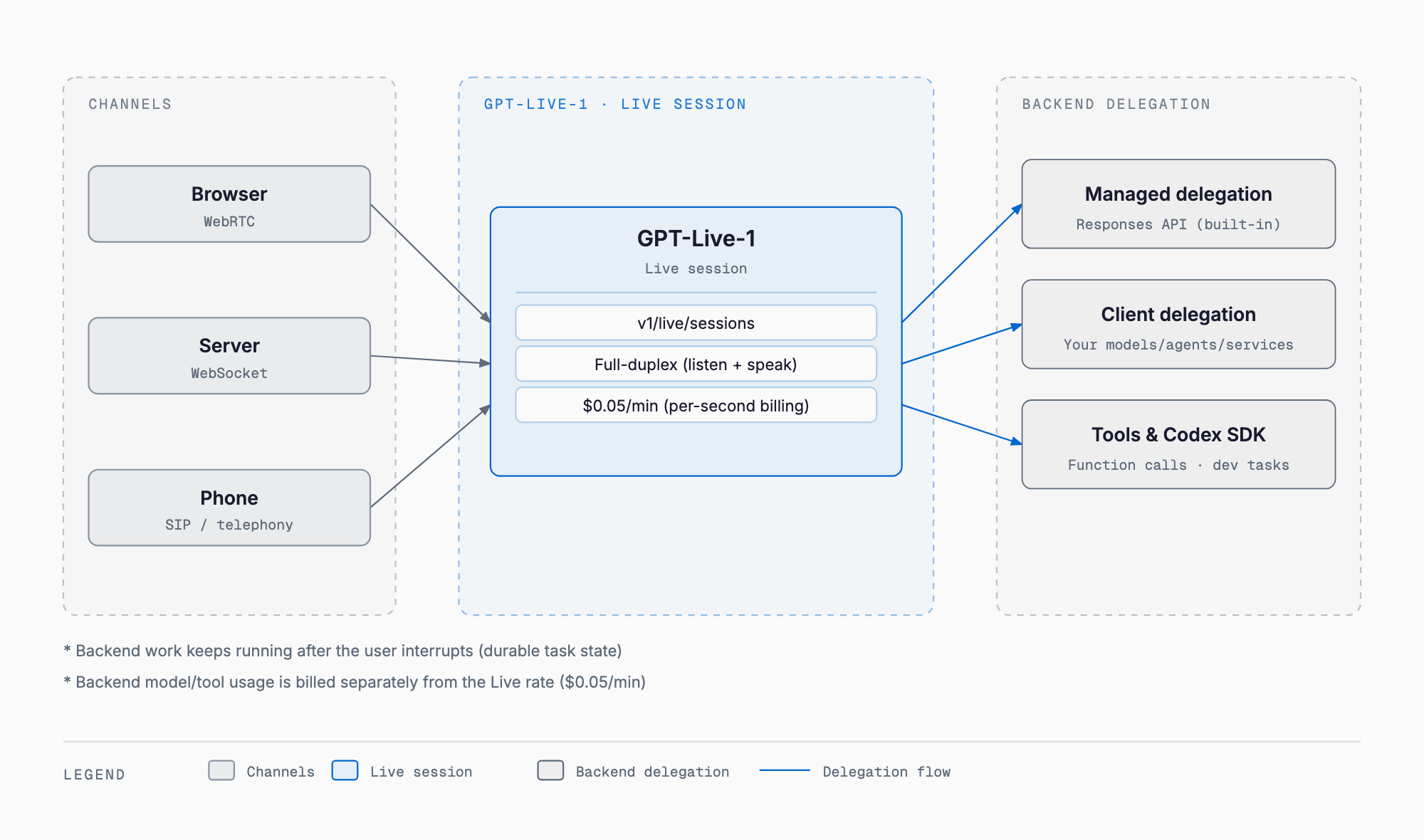
For how to design the backend delegation and session management, see our OpenAI Agents API guide, which covers sessions and sandboxing in more depth.
Comparison with other voice models
| Model | Delivery | Full-duplex | Turn-taking latency | Tool-calling accuracy |
|---|---|---|---|---|
| GPT-Live-1 | OpenAI API ($0.05/min) | Yes (80.1%) | 0.8s | 87% |
| GPT-Realtime-2.1 | OpenAI API | Limited (45.4%) | 1.4s | 60% |
| GPT-Realtime-2 (earlier gen.) | OpenAI API | No | Not published | Not published |
| NVIDIA PersonaPlex | Open-source, runs locally | Yes | Depends on deployment | Depends on deployment |
Against GPT-Realtime-2.1, GPT-Live-1's published benchmarks show full-duplex interactivity at 80.1% vs 45.4%, turn-taking latency of 0.8s vs 1.4s, tool-calling accuracy of 87% vs 60%, and a banking voice support pass rate of 32% vs 12.4%. Paired with GPT-6 Astra, it reaches 83.6% Tau3 task completion and 90% response quality. Compared to the earlier GPT-Realtime-2 models, full-duplex support and interruption handling are now the clear differentiators. If you need to keep data on-premises or avoid per-minute API billing, our NVIDIA PersonaPlex guide covers a local, open-source alternative; if you want a managed service with the latest benchmark performance, GPT-Live-1 is the stronger pick.
Use cases and cautions
- Phone reservations and reception: connect over telephony/SIP to build a phone agent; interruption tolerance matters most here (Yelp's phone reservation use is a live example)
- First-line customer support: suited to routine intake; however, the banking voice-support pass rate is still only 32% (vs 12.4% before), so design complex or high-risk cases around human escalation
- Development assistant agents: pairing with the Codex SDK lets a spoken instruction carry straight into a development task
- Cautions: no image or video input, so it is unsuited to conversations that need shared visual material; the July 31, 2025 knowledge cutoff means current information needs to come through tool calls or search; with no free tier and per-second billing, designs with long idle time can get expensive
Is GPT-Live-1 the successor to the Realtime API?
No, it's a separate service. GPT-Live-1 runs on the dedicated Live endpoint (v1/live/sessions), distinct from the Realtime API, Chat Completions, and Responses API.
Is there a free tier?
No. Billing is $0.05/minute, per second, with backend model and tool usage billed separately.
How many concurrent sessions can I run?
Between 25 and 500, depending on your usage tier. Check the limit for your tier before designing a large-scale phone system.
Does backend processing stop if the user interrupts the call?
No. Task state is durable, and a user interruption does not automatically cancel backend work in progress.
Should I choose GPT-Live-1 or NVIDIA PersonaPlex?
If you need to keep data local or avoid per-minute API costs, PersonaPlex, which runs locally, is a candidate. If you want a managed service with the latest benchmark performance, GPT-Live-1 is the stronger option.
Feel free to contact us
Contact Us