Paperclip AI: Open-Source Agent Team Manager (2026)
Paperclip is a free, open-source (MIT) self-hosted app that orchestrates teams of AI agents such as OpenClaw, Claude Code, Codex, and Cursor with an org chart, budgets, and approval gates. Updated Sep 2026.
Paperclip is a free, open-source (MIT), self-hosted app that organizes multiple AI agents — OpenClaw, Claude Code, Codex, Cursor, and more — into a single "company," complete with an org chart, budgets, and human approval gates. It's a Node.js server with a React UI that looks like a task manager on the surface, but underneath runs org charts, budgets, governance, and goal alignment.
It's built by paperclipai, a GitHub organization founded on March 2, 2026. As of this writing (September 28, 2026), the repository has roughly 91,765 stars and 15,816 forks, and it ranked #2 on GitHub's weekly trending list with +7,364 stars in a single week (#3 was Hindsight, an agent memory layer). The latest release is v2026.916.1, shipped 2026-09-21. This article covers Paperclip's main features, installation, basic usage, and how it compares to existing tools, based only on the official README and GitHub repository.
What Is Paperclip? "If OpenClaw Is an Employee, Paperclip Is the Company"
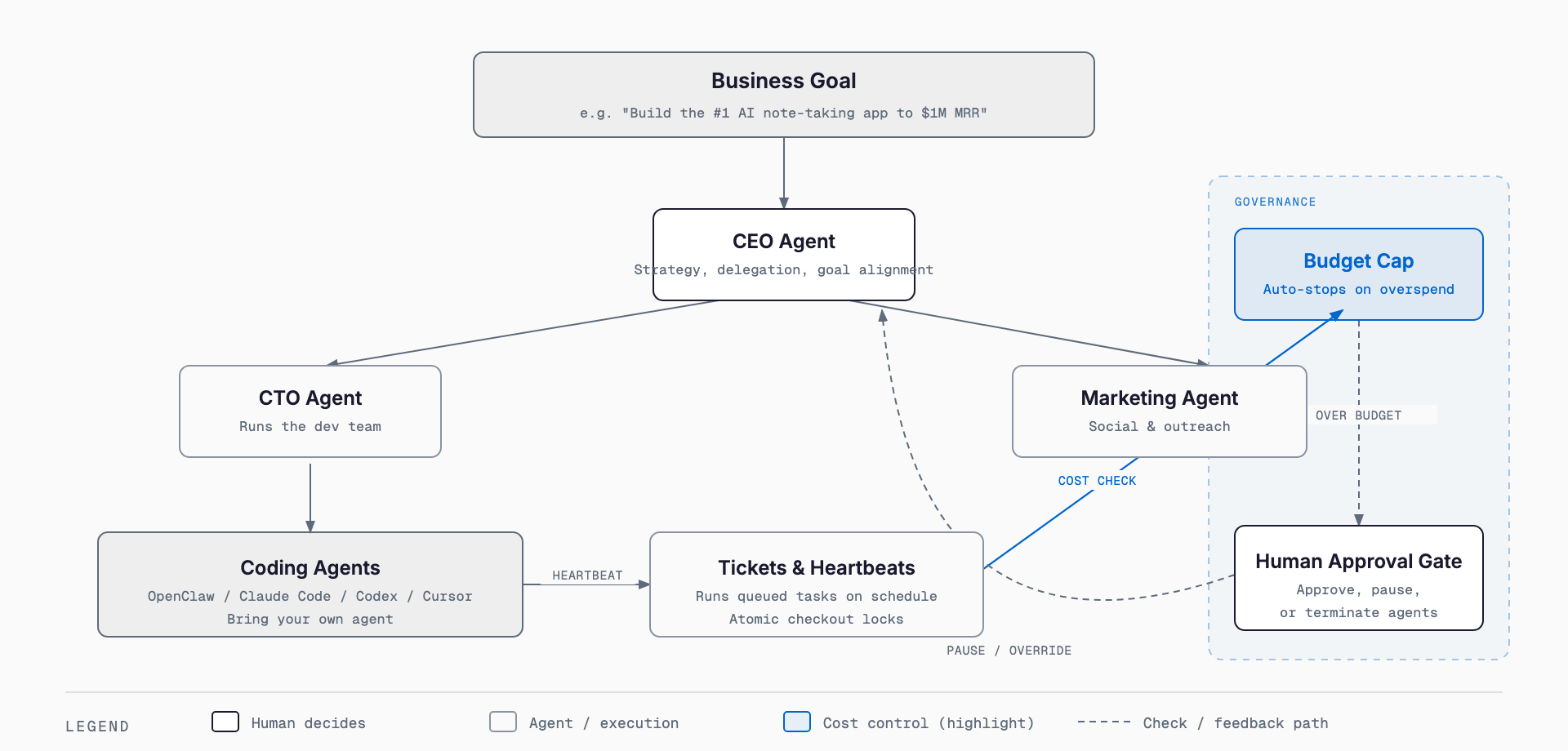
The README frames Paperclip's position with the line: "If OpenClaw is an employee, Paperclip is the company." It isn't a tool to make one agent smarter — it's a control plane for running many agents, across any provider or runtime, as a single organization. The basic flow is described in three steps.
| Step | What happens | Example |
|---|---|---|
| 01 Define the goal | State a business goal as text | "Build the #1 AI note-taking app to $1M MRR" |
| 02 Hire the team | Assign any bot or provider to a role: CEO, CTO, engineer, designer, marketer | Claude Code, Codex, Cursor, OpenClaw, bash/HTTP bots, etc. |
| 03 Approve and run | Review the strategy, set budgets, hit go, and monitor from the dashboard | The organization starts working |
What It Can Do — The Four Pillars
The README argues that four things have to work for an organization of AI agents to actually produce: the tasks, the org, the training, and the infrastructure. Paperclip is built around exactly those four pillars.
| Pillar | Built for | What it covers |
|---|---|---|
| Agentic Task Manager — declare intent, agents work, you verify | Everyone, daily | Tasks, approvals & review gates; proactive agent coworkers; auditable routines & workflows; verify from diffs, screenshots & tests |
| Org Chart for Agents — roles, permissions & boundaries | Managers | Mixed human + agent org chart; responsibilities, delegation, specialization; governance over who can do what; scoped secrets & company boundaries |
| Agent Employee Training — design, train & evaluate AI employees | Enablers | Skill Studio & shared org-wide skills; evals & saved test runs; active learning loops & quality metrics; performance reviews for agents |
| Agentic OS — the infrastructure that makes the work run | IT & platform | Cross-provider runtime; sandboxing, integrations & MCP servers; SSO, GRC, RBAC & cost controls; data privacy and internal trace collection |
Key Features
| Feature | What it does |
|---|---|
| Bring Your Own Agent | Any agent, any runtime, one org chart. If it can receive a heartbeat, it's hired |
| Goal Alignment | Every task traces back to the organization mission, so agents know what to do and why |
| Heartbeats | Agents wake on a schedule, check work, and act; delegation flows up and down the org chart |
| Cost Control | Monthly budgets per agent; when they hit the limit, they stop |
| Multi-Organization | One deployment, many organizations, with complete data isolation |
| Ticket System | Every conversation traced, every decision explained, with full tool-call tracing and an immutable audit log |
| Governance | Approve hires, override strategy, pause or terminate any agent at any time |
| Org Chart | Hierarchies, roles, and reporting lines — agents get a boss, a title, and a job description |
| Mobile Ready | Monitor and manage autonomous businesses from anywhere |
Three points the README calls out specifically: atomic execution (task checkout and budget enforcement are atomic, so there's no double-work and no runaway spend), persistent agent state (agents resume the same task context across heartbeats instead of restarting from scratch), and governance with rollback (approval gates are enforced, config changes are revisioned, and bad changes can be rolled back safely).
Installation and Pricing
| Item | Detail |
|---|---|
| Developer | paperclipai (GitHub org, founded 2026-03-02) |
| License / price | MIT, open source, free. No Paperclip account required for self-hosting |
| Implementation | Node.js server + React UI |
| Requirements | Node.js 24.11+, pnpm 9.15+ (for manual setup) |
| Database | An embedded PostgreSQL database is created automatically — no setup required; external object storage providers are also supported |
| Latest version | v2026.916.1 (2026-09-21) — a patch fixing the chat composer's send button |
| Homepage | paperclip.ing (docs at docs.paperclip.ing) |
The official installer is the recommended path — download the checksum-verified shell script and run it.
curl -fsSLO https://paperclip.ing/install.sh
curl -fsSLO https://paperclip.ing/install.sh.sha256
sha256sum -c install.sh.sha256   # macOS: shasum -a 256 -c install.sh.sha256
bash install.sh
The installer ensures Node.js 24.11+ is available, installs a managed Paperclip CLI under ~/.paperclip/cli, and starts interactive onboarding; it can also run as a background service on supported Linux and macOS systems. To try it without a permanent install, use the npx onboarding command.
npx --registry https://registry.npmjs.org paperclipai onboard --yesFor an isolated instance already initialized with a CEO agent, use test-drive. It stays in the foreground, never installs a service or creates a first task, and only opens the browser once setup succeeds.
ANTHROPIC_API_KEY=... npx paperclipai test-drive
OPENAI_API_KEY=... npx paperclipai test-drive --harness codex
OPENROUTER_API_KEY=... npx paperclipai test-drive \
  --harness opencode \
  --model openrouter/anthropic/claude-sonnet-4.5
For a manual setup, clone the repository and run pnpm install && pnpm dev. This starts the API server at http://localhost:3100, with an embedded PostgreSQL database created automatically.
git clone https://github.com/paperclipai/paperclip.git
cd paperclip
pnpm install
pnpm dev
How to Use It — The Shortest Path
- Declare a goal: write down what you want to achieve, as text
- Hire agents: assign Claude Code, Codex, Cursor, OpenClaw, or any agent you like to roles such as CEO, CTO, or engineer (bring your own agent)
- Approve the strategy: review what the CEO agent proposes and set budget caps
- Hit go: agents wake on their heartbeat schedule and work through ticketed tasks
- Monitor from the dashboard or your phone: check diffs, screenshots, and test results, pausing or approving as needed
Recurring work — customer support, social posts, reports — can be automated with Routines, triggered by cron, webhook, or API calls, so nothing needs a manual kickoff each time. Plugins let you extend Paperclip with new tools and UI without forking it. For related agent-infrastructure background, see the Claude Code Complete Guide 2026 and the MCP roadmap breakdown.
How It Differs From Existing Tools
| Paperclip | Orca | CrewAI | OpenClaw | |
|---|---|---|---|---|
| Positioning | A control plane that runs a "company" of multiple agents | An ADE that runs coding agents in parallel git worktrees within one repo | A Python framework for defining multi-agent orchestration in code | An autonomous AI agent itself (the "employee") |
| Unit of work | An organization (many projects, many agents) | Tasks within a single code repository | A crew of role-based agents | A single agent |
| Focus | Org chart, budgets, approval gates, governance | Worktree isolation, diff review, in-app browser | Coding the coordination logic between agents | Executing individual tasks and conversations |
| License / price | MIT, free (self-hosted) | MIT, free (desktop app) | MIT, free library (paid Enterprise tier exists) | MIT (Copyright OpenClaw Foundation), free to run. Runs locally; cost depends on your connected LLM provider's API usage |
| Best fit | Coordinating many agents to run a business, with a human overseeing | Trying one coding task with several agents in parallel | Developers who want to define agent roles and flow in code | Individuals or small teams delegating work to a single agent |
Orca is a development environment (ADE) that runs multiple coding agents like Claude Code and Codex in parallel git worktrees — it has no heartbeats, budgets, or approval gates like Paperclip. See the full Orca guide for a tool focused on parallel review of a single coding task. CrewAI is a Python framework for coding the coordination and role logic between agents; it doesn't ship a human approval gate or org-chart UI the way Paperclip does out of the box. OpenClaw is an autonomous AI agent itself — in the README's own metaphor, closer to "the employee Paperclip hires." See What Is OpenClaw? for its basics.
Things to Watch For, and Who It's For
- Paperclip doesn't run agents itself — contracts, API keys, and authentication for Claude Code, Codex, OpenClaw, and any other agent are your own responsibility (bring your own agent)
- The README itself says "if you have one agent, you probably don't need Paperclip. If you have twenty, you definitely do" — it can be overkill for light, single-agent use
- It explicitly states it is not a workflow builder, prompt manager, or code review tool, so drag-and-drop pipelines and the review process itself are out of scope
- Company Portability lets you export/import an entire organization (agents, skills, projects, routines, issues), but check its secret-scrubbing and collision-handling behavior before relying on it
- Runaway-cost protections exist (budget auto-stop, atomic checkout), but final billing should always be confirmed in each agent provider's own console
It suits individuals or teams already running several AI agents who have lost track of what each one is doing, can't predict cost, or want a real approval process. If you're only using a single coding agent, a lighter tool like Orca above may be a better fit.
FAQ
Is Paperclip free to use?
The app itself is open source under MIT and can be self-hosted without a Paperclip account. However, the agents you hire — Claude Code, Codex, and so on — still need their own subscriptions or API keys, arranged separately.
Which agents can it work with?
The official README lists OpenClaw, Claude Code, Codex, and Cursor, plus bots reachable via bash or HTTP/webhook, summarizing it as: if it can receive a heartbeat, it's hired.
Do I need to set up a database myself?
No. Running pnpm dev automatically creates an embedded PostgreSQL database.
Is it worth it for individual use?
The README says if you only use one agent, you probably don't need Paperclip — but it's built for situations like having 20 Claude Code terminals open and losing track of what each is doing. Whether it's worth it depends on how many agents you run and how hard they are to manage.
Can it prevent runaway costs?
You can set a monthly budget per agent, and agents stop automatically once they hit the limit. According to the README, task checkout and budget enforcement are atomic, which is designed to prevent double-work and the overspend that comes with it.
Summary
Rather than making a single agent smarter, Paperclip is a control plane for running multiple agents as an organization — goal-setting, delegation, execution, budgets, and human approval gates all live in one dashboard, aimed at the chaos of manually managing twenty-plus agent sessions.
That said, contracts and authentication for the agents themselves remain your responsibility, and it can be overkill for single-agent use. Trying a small organization with the test-drive command first, then tightening budget and approval rules as you scale, looks like the reasonable path to a full rollout.
Sources
Feel free to contact us
Contact Us