Are Post-Delivery Bugs Fixed Free? Liability & Warranty
Is a bug after delivery fixed free? It depends on nonconformity liability and warranty. Covers the 2020 reform, what counts as a defect, and terms to check.
After a system is delivered, you may find defects: a screen that misbehaves, a calculation that comes out wrong. The first question most business owners ask is whether the developer will fix it for free or whether it will cost extra. The answer depends on two things: "nonconformity liability" (契約不適合責任) in a contract for work under Japanese civil law, and the warranty period written in your contract. This article explains, for non-IT readers, what changed in the 2020 Civil Code reform, which problems are usually fixed free of charge and which are not, how a warranty period differs from a maintenance contract, and what to check in the contract. Because defects are first caught during acceptance testing, we also cover how the two relate.
The short answer: it depends on the contract type and whether it is a "nonconformity"
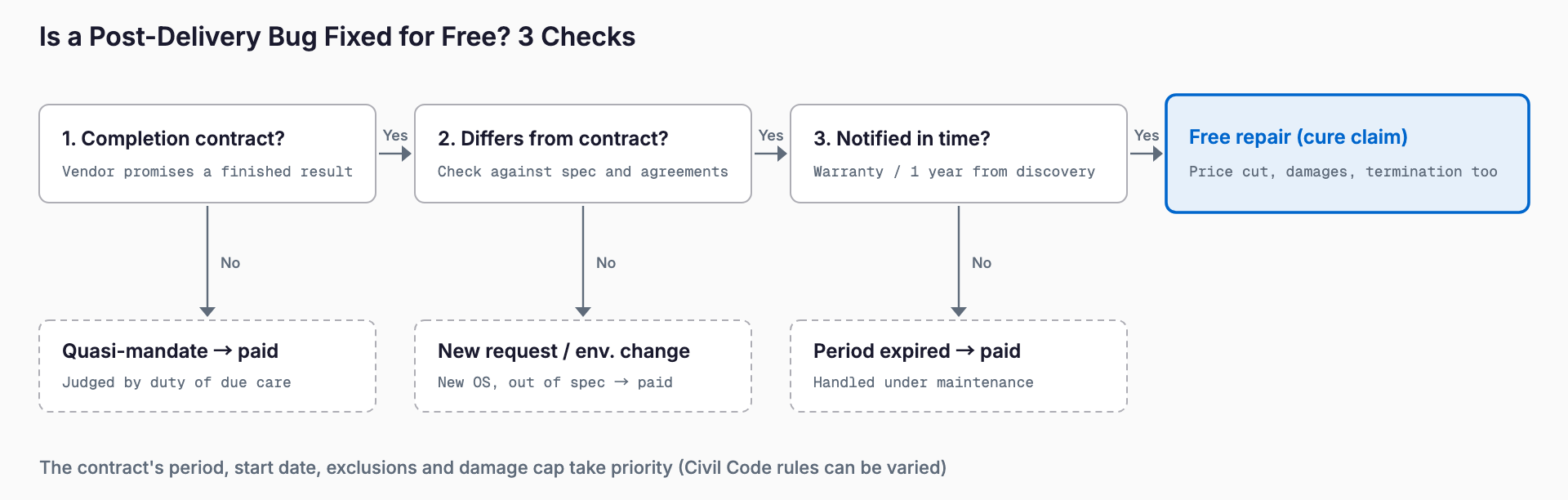
Whether a post-delivery bug is fixed for free is mainly decided by three points: (1) whether the contract is a contract for work (請負) or a quasi-mandate (準委任), (2) whether the problem is a failure to conform to the contract, and (3) whether it falls within the warranty period and outside the contract's exclusions. "There is a bug" alone does not automatically mean a free fix. Conversely, even if the contract is silent, the Civil Code may still give you remedies. Keeping these three viewpoints in mind makes it easier to read your contract and your deliverables calmly.
"Defect liability" became "nonconformity liability"
The Civil Code reform that took effect on April 1, 2020 replaced the old "defect liability" (瑕疵担保責任) with "nonconformity liability" (契約不適合責任). It was not merely a rename. Previously the question was whether there was a "hidden defect." Now the standard is whether what was delivered conforms to the contract in type, quality, and quantity. In other words, the test is not whether a flaw is visible, but whether it matches what was promised. In software projects the promise is usually found in the requirements document or specification, so well-maintained documents matter a great deal.
| Item | Before (defect liability) | After (nonconformity liability) |
|---|---|---|
| Test | Is there a hidden defect? | Does it conform to the contract? |
| Main remedies for the buyer/client | Repair, damages, rescission | Cure (repair), price reduction, damages, rescission |
| Time limit in contracts for work | Action needed within one year of delivery (or completion) | Notify the contractor within one year of learning of the nonconformity (Civil Code Art. 637) |
| Nature | Seen as a statutory liability | Based on the contract content (can be modified by agreement) |
As the table shows, in a contract for work the client generally preserves its rights by notifying the contractor within one year of learning of the nonconformity. That year is a deadline for giving notice, not a deadline for finishing the repair. The time limit is generally said not to apply if the contractor knew of the nonconformity at delivery, or was grossly negligent in not knowing. After notice, the rights themselves are usually described as subject to the ordinary statute of limitations for claims: five years from when you learn of them, or ten years from when they could first be exercised.
Four remedies available to the client
When there is a nonconformity, the client is generally said to have the following four options. Which one is actually available depends on the circumstances, so the conditions and order should be checked.
- Request for cure (repair): ask the contractor to fix the problem. In software this means bug fixes or rework
- Price reduction: in principle, you first ask for a cure and may ask for a reduction if it is not made within a reasonable period
- Damages: compensation for losses caused by the defect. This generally requires a reason attributable to the contractor
- Rescission: ending the contract when the defect is serious and the purpose of the contract cannot be achieved. Minor nonconformities are unlikely to qualify
In practice, the usual path is to ask for a fix first rather than jump to a price reduction or rescission. Rebuilding software takes time and money, so both sides typically discuss the scope and deadline of the fix.
The period can be changed by contract: watch for "months after acceptance"
The Civil Code period (notice within one year of learning of the problem) is generally considered a default rule that the parties can change by agreement. That is why software contracts usually state a period such as "within six months after acceptance is completed" or "within one year of delivery." Two things deserve attention: a short period, and the starting point, whether it is the delivery date or the acceptance date, which changes the time you actually have. If you start using a system months after acceptance, a defect in a feature used only once a year, such as year-end processing, may not surface within the warranty period. Compare the contract period against your own business calendar.
Contracts for work and quasi-mandates treat responsibility differently
Nonconformity liability is typically at issue in a contract for work (請負), where the contractor promises to complete a result. A quasi-mandate (準委任) is a promise to perform services, not to deliver a finished product. A liability of the same form is therefore less likely to arise; instead the question is whether the contractor exercised the care expected of a professional (the duty of care of a prudent manager). Lab-type and agile development are often contracted as quasi-mandates, so a free bug fix is not guaranteed. To tell which you have, look beyond the contract title to how payment works (per deliverable, or by effort or monthly fee) and whether completion is an obligation. See contract for work vs. quasi-mandate for details.
What counts as a nonconformity, and what does not
The most common point of confusion in practice is where to draw the line. The basic idea is whether the result differs from what the contract or specification promised. The following are general guidelines, and the final judgment depends on the contract and circumstances.
| Case | Likely treated as nonconformity? | Note |
|---|---|---|
| Does not work as specified (wrong calculation, wrong screen flow) | Likely | Typical case for a free repair |
| A feature in the specification is missing | Likely | Best caught during acceptance |
| A request not in the specification, or a feature you "assumed" would exist | Unlikely | Often treated as paid additional work |
| Support for a new OS or browser released after delivery | Unlikely | Check whether maintenance or a separate quote covers it |
| Problems caused by a change in an external service (payments, maps, APIs) | Unlikely | Provider changes are usually outside the contractor's responsibility |
| User error or incorrect data entry | Unlikely | If training was inadequate, there may be room to discuss |
| Defects caused by specifications or materials the client specified | Unlikely | Remedies can be limited when the client's instructions were the cause |
| Insufficient performance (slow under expected load) | Depends | Turns on whether performance requirements were stated in numbers |
Disputes tend to arise over "obvious behavior that was not in the specification" and over performance. A request made only verbally is hard to prove later as part of the promise. Recording requests in email or meeting minutes often decides whether a free fix is possible. For how to tell these from extra work, and how to avoid cost disputes, see patterns that trigger extra costs.
A warranty period and a maintenance contract are different things
A warranty period does not mean you are covered forever. It is an agreement that fixes for deliverables that do not match the contract will be done free of charge for a set time. A maintenance contract, by contrast, is an ongoing, fee-based arrangement that covers not only defect repair but also inquiries, monitoring, minor changes, and update support. The two are easily confused, so the table below compares them.
| Item | Warranty period (free warranty) | Maintenance contract |
|---|---|---|
| Purpose | Correct deliverables that do not match the contract | Keep the system running and provide ongoing support |
| Cost | Free (included in the development fee) | Paid, monthly or annual |
| Typical period (guideline) | Often 3 months to about 1 year after acceptance | Often renewed in one-year terms |
| Scope | Mismatch with the specification (defects) | Inquiries, monitoring, minor fixes, updates, as defined in the contract |
| Commonly excluded | New OS support, added requests, user-caused issues | Large feature additions, work outside the contract scope |
| When it ends | Later fixes are generally paid | Support stops unless renewed |
If a defect is found after the warranty period, a shortened contractual period generally takes precedence even if the Civil Code period would still be running. It is also wise to decide before the warranty ends whether to sign a maintenance contract, so you are not caught unprepared afterward. For what to check in a maintenance agreement, see maintenance contract checkpoints.
Seven points to check in the contract
Clauses on nonconformity liability and warranty are often grouped under headings such as "Nonconformity Liability," "Warranty," "Defects," "Damages," and "Exclusions." Before signing, check the following.
- Period and starting point: from the acceptance date or the delivery date, and for how long (3 months, 6 months, 1 year)
- Notice method: in writing, by email, or through a form; whether notice within the period is enough or the fix must be completed in it
- Remedy: whether free repair is the baseline, and whether replacement or price reduction is mentioned
- Exclusions: when the contractor is not liable (client instructions, third-party services, user fault, force majeure)
- Damages cap: often limited to the contract price; whether lost profits are included
- Scope of liability: how defects caused by third-party libraries, open-source software, or cloud services are treated
- Recurrence: whether the same defect returning is covered free, and how regressions caused by a fix are handled
The damages cap is easy to overlook. Even if a defect causes large business losses, compensation may be limited to the development fee. For systems that run core operations, check this cap in advance, along with fallback procedures such as manual workarounds.
Six steps when you find a bug after delivery
Before contacting the contractor in frustration, organize the facts as follows. It is especially important to leave a record that you gave notice within the period.
1. Record the symptoms: when, who, which screen, what action, what result. Keep screenshots or video
2. Write down the steps to reproduce: confirm it happens again and list the steps
3. Assess the impact: does it stop operations, is there a workaround, how urgent is it
4. Give notice in writing or by email: do not rely on phone calls alone; use the method specified in the contract and leave a record
5. Check the period and scope in the contract: within the warranty, not excluded, and when the period started
6. Discuss and agree: confirm in writing the scope, deadline, cost responsibility, and prevention of recurrence
The contractor may also respond that the behavior matches the specification and is not a defect. In that case, ask where the specification or meeting minutes say so, and if the views still differ, consider getting an opinion from an independent expert.
Typical cost of fixes after the warranty period
Fixes made after the warranty period, or fixes that are not nonconformities, are generally paid work. Costs vary widely by system size, structure, and content, but they are commonly described roughly as follows. These are guidelines only; confirm actual amounts in a quote.
- Minor fixes (wording, display adjustments, small bug fixes): roughly tens of thousands to a little over 100,000 yen
- Mid-size changes (screen revisions, added reports, data integration adjustments): from several hundred thousand yen as a guide
- Maintenance contract (with a fixed allowance of support and minor fixes): commonly tens of thousands to over 100,000 yen per month
- Urgent response (night or holiday outage recovery): may carry a surcharge
Whether to pay per fix by quote or sign a flat-rate maintenance contract depends on how often you need changes and how badly downtime would hurt your business. If changes are frequent, maintenance can end up cheaper. It is reassuring to ask about the pricing approach before a fix is actually needed.
Frequently asked questions
Will a bug found six months after delivery be fixed free of charge?
If the warranty period in the contract is longer than six months and the bug differs from the specification (a nonconformity), it may be covered free of charge. A shortened contractual period generally takes precedence. Check the period and starting point, and if you are within the period, send written notice promptly.
What is the difference between defect liability and nonconformity liability?
The April 2020 Civil Code reform reorganized defect liability as nonconformity liability. The standard moved from "is there a hidden defect" to "does it conform to the contract," and the remedies of cure, price reduction, damages, and rescission were clarified. For contracts for work, the time limit became notice within one year of learning of the nonconformity.
What if the contract does not mention a warranty period?
The Civil Code rules, such as notice within one year of learning of the nonconformity in a contract for work, would generally be the baseline. However, exclusions or period clauses may appear elsewhere, so review the whole contract and related documents, and consult a lawyer if anything is unclear.
Are bugs fixed free of charge under a quasi-mandate (lab-type) contract?
A quasi-mandate does not promise a completed deliverable, so nonconformity liability of the contract-for-work kind generally does not arise. The questions become whether bug fixing is within the contracted scope and whether the contractor exercised due care. If you expect free fixes, write that into the contract.
Is support for a new OS or browser covered free of charge?
Support for environments that appeared after delivery does not contradict the contract as of delivery, so it is rarely treated as a nonconformity and is usually paid work. If a maintenance contract includes version-upgrade support, or the contract specifies the supported environment, it may be covered within that scope.
What can I do if the vendor refuses a free fix?
First, get the reason in writing (matches the specification, period expired, excluded) and compare it with the contract, specification, and meeting minutes. If you still cannot agree, options include an independent technical review or consulting a lawyer or a dispute resolution body. Organizing your records early is key.
Summary and notes
Whether a post-delivery bug is fixed free of charge can be sorted by three questions: the contract type (work or quasi-mandate), whether it is a nonconformity, and whether it is within the warranty period and exclusions. The 2020 reform turned defect liability into nonconformity liability, and for contracts for work the baseline is notice within one year of learning of the problem. Since the period can be changed by contract, the written terms come first in practice. Before signing, check the period and its starting point, the notice method, exclusions, and the damages cap, and keep specifications in writing. For pre-delivery checks, see also how to run acceptance.
Note: this article provides general information and is not legal advice. For the interpretation of a specific contract or an actual dispute, please consult a lawyer or other qualified professional.
Related free tools (no sign-up, instant results)
Feel free to contact us
Contact Us