Atria Dawn Preview Requirements: 744B MoE VRAM & GPUs
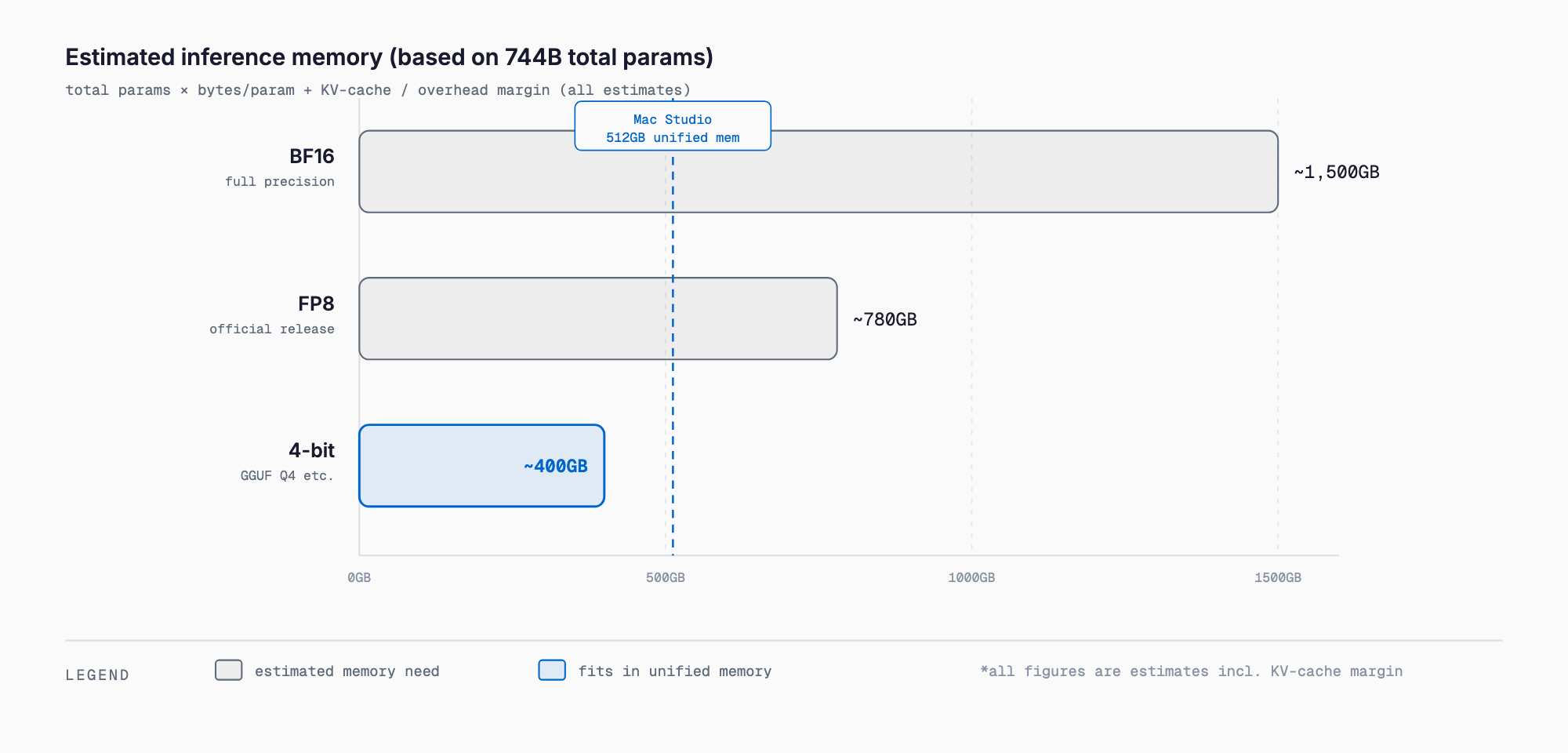
Atria Dawn Preview needs an estimated ~400GB at 4-bit, ~780GB at FP8, or ~1,500GB at BF16. A rundown of this 744B MoE model's specs, vendor-reported benchmarks, API options, and comparison with other open MoE models.
The short answer: running Atria Dawn Preview locally takes roughly 400GB (4-bit) to 1,500GB (BF16 full precision) of memory, depending on quantization. It is a 744B-total-parameter MoE (Mixture of Experts) model, and the official release ships two checkpoints — a BF16 full-precision one and an FP8-quantized one. Neither fits on a single consumer gaming PC; you need a multi-GPU server or a workstation-class machine with a very large pool of unified memory.
All figures below are estimates. The formula is "total parameters × bytes/param + KV-cache/overhead margin," using bytes/param of BF16=2, FP8=1, and 4-bit (INT4/GGUF Q4-style)=0.5, with an added margin for context cache and inference-time activations. Because this is a MoE model, the active parameters used to compute any single token are far fewer than the total, but which experts get selected depends on the input, so in practice nearly all expert weights must stay resident in memory. That means VRAM/RAM sizing should be based on total parameters, not active parameters.
Spec quick-reference (estimated)
| Precision | Estimated memory (total) | Example GPU configs | Fits a Mac Studio 512GB (unified memory)? |
|---|---|---|---|
| BF16 (full precision, official) | ~1,500GB | H100 80GB x19-20 / H200 141GB x11 / B200-class x9 | No (far exceeds capacity) |
| FP8 (official) | ~780GB | H100 80GB x10 / H200 141GB x6 / B200-class x5 | No (exceeds capacity) |
| 4-bit (INT4/GGUF Q4-style, community conversion assumed) | ~400GB | H100 80GB x5-6 / H200 141GB x3 / B200-class x3 | Possibly, depending on conditions (little headroom once KV-cache is counted) |
Officially only BF16 and FP8 are distributed; no lightweight 4-bit-class checkpoint has been found from the official source as of this writing (September 22, 2026). Community conversions to formats like GGUF may appear later, but for now treat the 4-bit figure as an estimate.
What Atria Dawn Preview is
Atria Dawn Preview is a preview model released on September 11, 2026 by Shanghai Artificial Intelligence Laboratory, purpose-built for agentic use cases — research and engineering workflows. It is a 744B-total-parameter MoE foundation model, reportedly built by applying additional agentic post-training (reinforcement learning for tool use and task execution) on top of GLM-5.2, which Zhipu AI (Z.ai) released in June 2026. Rather than single-turn Q&A, it is designed around a full task-completion loop: analyzing a problem, using tools, implementing code, running experiments, analyzing results, and recovering from failures.
The weights went live on GitHub and Hugging Face on September 11, 2026 (the FP8 checkpoint followed on September 12), while the technical report (arXiv:2609.15818) was posted on September 14 — meaning the weights and API preceded the technical report by a few days. The paper is titled "Atria Dawn: The Dawn of Agentic Superintelligence" and lists more than 143 authors.
Basic information
| Item | Value |
|---|---|
| Developer | Shanghai Artificial Intelligence Laboratory |
| Base model | GLM-5.2 (Zhipu AI / Z.ai, 744B MoE) with agentic post-training |
| Total parameters | 744B |
| Active parameters | Not officially disclosed (unofficial figures disagree, so not treated as confirmed here) |
| Context length | 256K tokens |
| License | MIT (confirmed on both GitHub and Hugging Face) |
| Released checkpoints | BF16 (full precision) and FP8-quantized |
| Inference engine support | Officially supports SGLang (v0.5.13.post1+) and vLLM (v0.23.0+) |
| API | International: api.atria-asi.ai / China: discovery.intern-ai.org.cn (OpenAI-compatible) |
| Weights release date | September 11, 2026 (FP8 on September 12) |
| Technical report | arXiv:2609.15818 (submitted September 14, 2026; v2 on September 17) |
Benchmarks (all vendor-reported)
The figures below come from Shanghai AI Laboratory's own technical report. All are self-reported (vendor-reported) benchmarks, not independently verified by a third party. The report claims the top score on 5 of 16 listed benchmarks.
| Benchmark | Score | Note |
|---|---|---|
| SWE-bench Pro | 59.6% | Software engineering capability |
| AutomationBench | 53.8 | Claimed top score |
| BrowseComp | 92.5 | Claimed top score |
| DeepSearchQA | 96.0 | Claimed top score |
| BFCL v4 | 77.0 | Claimed top score (tool-calling) |
| CyberGym | 86.5 | Claimed top score (cybersecurity) |
| MLE-bench Lite | 86.2 | ML engineering related |
The technical report also describes a case study of 769 task records in which human raters judged roughly one-third of the AI-assisted completions as infeasible without AI support — offered as evidence that the model can contribute at the project level of human-AI collaboration, not just single-task execution. This too is the developer's own self-assessment.
Intended use cases — Discovery / Creation / Delivery / Cybersecurity
- Discovery: research-oriented tasks such as literature review and evidence retrieval
- Creation: implementing software, apps, and machine learning systems
- Delivery: producing documents and presentation materials
- Cybersecurity: analyzing and remediating vulnerabilities
API vs. self-hosting
Shanghai AI Laboratory offers two hosted, OpenAI-compatible APIs — international (api.atria-asi.ai) and China (discovery.intern-ai.org.cn). However, API pricing is not officially disclosed as of this writing, and it is unclear whether a free tier or specific per-token rates exist. For an initial evaluation phase, using the API is the practical choice.
For self-hosting, SGLang (v0.5.13.post1+) and vLLM (v0.23.0+) are officially supported. But as noted above, BF16 requires roughly 1,500GB and even FP8 requires roughly 780GB, so a multi-node cluster of H100/H200-class GPUs is the baseline requirement. Self-hosting pays off mainly when data sovereignty or latency requirements are strict and sustained high-volume usage is expected.
Comparison with other major open-weight MoE models
Comparing Atria Dawn Preview against other large open-weight MoE models released around the same time helps place it in context. Figures below are limited to those confirmed via each model's official sources or this site's existing articles; anything unconfirmed is marked accordingly.
| Model | Total params | Active params | Context length | License | Estimated 4-bit memory |
|---|---|---|---|---|---|
| Atria Dawn Preview | 744B | Not officially disclosed | 256K | MIT | ~400GB |
| GLM-5.2 | 753B | Not disclosed (per this site's article) | Per article | MIT | ~430GB |
| Kimi K3 | 2.8T | ~50B-class (reported figures vary) | 1,048,576 (1M) | Modified-MIT-style (verify the distributed LICENSE) | ~1.4TB at MXFP4 (roughly 8-bit-equivalent weights) |
| DeepSeek V4-Pro | 1.6T | 49B | 1M | MIT | ~920GB |
| DeepSeek V4-Flash | 284B | 13B | 1M | MIT | ~160GB |
Since Atria Dawn is a GLM-5.2 derivative, its total parameter count and estimated memory footprint sit close to GLM-5.2's. Compared with DeepSeek V4 or Kimi K3, its total parameter count is smaller, but these models differ in active-parameter design and context-length targets, so this is not a simple better/worse ranking. Note also that Kimi K3's official distribution uses MXFP4, a different quantization scheme from the "4-bit" figures for the other models.
Cautions — read this as a "Preview" release
- It is a preview release: as the name states, this is a preview, and architecture or benchmark numbers may change in a final release
- Benchmarks are self-reported: every figure cited here comes from the developer's own technical report, not independent third-party verification
- Active parameter count undisclosed: a design detail that matters for a MoE model, yet official materials omit it and unofficial sources disagree
- Quantized options are limited: only BF16 and FP8 are officially released; no community 4-bit conversion was found as of this writing
- API pricing undisclosed: without a cost estimate for sustained use, committing to a large self-hosting investment may be premature
FAQ
Who built Atria Dawn Preview?
Shanghai Artificial Intelligence Laboratory (the organization behind the InternLM model family) released this agent-focused preview model on September 11, 2026. It is a 744B-total-parameter MoE foundation model, built through additional agentic post-training on top of Zhipu AI (Z.ai)'s GLM-5.2.
Why size memory by total parameters instead of active parameters for a MoE model?
A Mixture-of-Experts model only computes with a subset of experts per token, so its active-parameter count determines compute cost, not memory footprint. Because the router can select any expert on any token, essentially all expert weights must stay resident in memory. So while inference speed tracks active parameters, VRAM/RAM sizing should be based on the total parameter count.
Is the active parameter count for Atria Dawn Preview officially disclosed?
As of this writing (September 22, 2026), neither the Hugging Face model card nor the GitHub README states an active-parameter figure — it is not officially disclosed. Unofficial roundup sites report inconsistent estimates (roughly 18B in some, 37-40B in others), so this article treats it as unconfirmed rather than citing a specific number.
How reliable is the reported 59.6% SWE-bench Pro score?
That figure comes from Shanghai AI Laboratory's own technical report (arXiv:2609.15818) — a vendor-reported benchmark, not an independent third-party evaluation. Given this is explicitly a "Preview" release, treat the number as a reference point that may change in a final release.
Can it run on an Apple Silicon machine like a Mac Studio?
A 4-bit quantization (roughly 400GB estimated) could plausibly fit inside a 512GB unified-memory Mac Studio configuration. FP8 (roughly 780GB estimated) and BF16 (roughly 1,500GB estimated) would not fit in 512GB. All figures are estimates; real-world usage must also account for OS/other-process memory and KV-cache growth with longer context.
Should I use the API or self-host?
API pricing for Atria Dawn Preview is not officially disclosed as of this writing. Self-hosting a model that needs hundreds of gigabytes to 1.5TB of memory carries a heavy upfront and operational cost, so a practical path is to evaluate it first via the hosted international/China APIs or third-party hosting that supports SGLang/vLLM, then consider self-hosting once sustained usage is confirmed.
Summary
Atria Dawn Preview is a 744B-total-parameter MoE foundation model, a preview release from Shanghai AI Laboratory built through agentic post-training on top of GLM-5.2. Running it locally takes roughly 400GB at 4-bit quantization, roughly 780GB at the officially released FP8, and roughly 1,500GB at BF16 full precision — all estimates, but all requiring substantial compute. Every benchmark figure cited is self-reported, and the model should be evaluated with its "preview" status in mind. For comparison with other large open-weight MoE models released around the same time, see this site's articles on GLM-5.2, Kimi K3, DeepSeek V4, and GLM-5.3. Help with building a large-model evaluation environment or broader AI adoption is available through AI consulting; reach out via contact.
Related free tools (no sign-up, instant results)
Feel free to contact us
Contact Us