Claude Opus 5.5: $4/$20 Pricing, Benchmarks & Changes (2026)
Anthropic released Claude Opus 5.5 on Sep 22, 2026: $4/$20 per 1M tokens (20% below Opus 5), 30%+ faster. Updated Sep 2026: pricing, benchmarks, API changes.
Anthropic released Claude Opus 5.5 on September 22, 2026. The model ID is claude-opus-5-5 (Bedrock: anthropic.claude-opus-5-5). Pricing drops to $4 input / $20 output per 1M tokens, a 20% cut from Opus 5's $5/$25, and Anthropic says output is over 30% faster with roughly 40% lower cost on typical workloads. Terminal-Bench 4.0 hits 66.4% (+14.1pt vs. Opus 5) and OSWorld 2.0 hits 81.8% (+7.8pt), with the biggest gains landing on coding and long-running agentic benchmarks.
What changed
Five things that matter:
1. A price cut alongside a capability jump — $4 input / $20 output is 20% below Opus 5's $5/$25. Cache reads drop to $0.20 (−60% vs. Opus 5)
2. The default effort level changes to medium — Opus 5 defaulted to high; Opus 5.5 defaults to medium, and Anthropic says medium effort matches or exceeds Opus 5 at high on coding and knowledge work
3. Adaptive thinking is always on and cannot be disabled — the model automatically tunes reasoning depth internally, but the thinking: disabled setting itself is no longer accepted
4. Knowledge cutoff is June 2026, with a 1M-token input context and 128K max output (up to 300K via the Batch API with a beta header)
5. Anthropic positions it as performing "at the level of Claude Fable 5.1 on most work" — reaching near-Fable-5.1 capability at less than half Fable 5.1's price ($10/$50)
This piece follows the Claude Opus 5 deep dive, GPT-6 Astra pricing and benchmarks, and Claude Fable 5.1 / Mythos 5.1, and is based on day-one primary sources.
Release overview
| Item | Detail |
|---|---|
| Release date | September 22, 2026 |
| Model ID | claude-opus-5-5 (Bedrock: anthropic.claude-opus-5-5) |
| Developer | Anthropic |
| Knowledge cutoff | June 2026 |
| Context window | 1M tokens (input) |
| Max output | 128K tokens (synchronous) / 300K tokens (Batch API with beta header) |
| Default effort level | medium (Opus 5 was high) |
| Thinking | Always on (adaptive thinking), cannot be disabled |
| Channels | Claude API, Amazon Bedrock, Google Cloud Vertex AI, Microsoft Foundry, Claude apps, Claude Code |
Pricing
Rates per 1M tokens are as follows.
| Item | Opus 5.5 | Opus 5 (prior) |
|---|---|---|
| Input | $4 | $5 |
| Output | $20 | $25 |
| Cache read | $0.20 (−60%) | $0.50 |
| Cache write (5min) | $5 | — |
| Cache write (1h) | $8 | — |
| Batch API | $2 / $10 | — |
| Fast mode | $8 / $40 | — |
Anthropic says output is over 30% faster and typical workloads run roughly 40% cheaper overall — a figure that combines the 20% rate cut with a reduction in the tokens actually needed to finish a task. For reference, Claude Fable 5.1, announced the same day, is priced at $10/$50 — more than double Opus 5.5's rate.
Benchmarks
Anthropic's published figures show the largest gains on coding and long-running agentic benchmarks.
| Benchmark | Opus 5.5 | vs. Opus 5 | Best other model |
|---|---|---|---|
| Terminal-Bench 4.0 | 66.4% | +14.1pt | GPT-6 Astra 57.9% |
| FrontierCode v1.1 | 54.4% | +6.4pt | GPT-6 Astra 53.3% |
| CursorBench 4.0 | 57.8% | +11.2pt | Fable 5.1 51.8% |
| GDPval-AA v2.1 | 1846 Elo | +138 | Fable 5.1 1735 |
| AutomationBench | 40.0% | +13.1pt | GPT-6 Astra 41.4% (Astra leads) |
| Humanity's Last Exam (with tools) | 67.7% | +4.1pt | Fable 5.1 65.6% |
| Terminal-Bench-Science | 58.7% | +29.7pt | GPT-6 Astra 64.6% (Astra leads) |
| OSWorld 2.0 | 81.8% | +7.8pt | Fable 5.1 80.7% |
| Artificial Analysis Intelligence Index | 58 (#1 overall) | — | — |
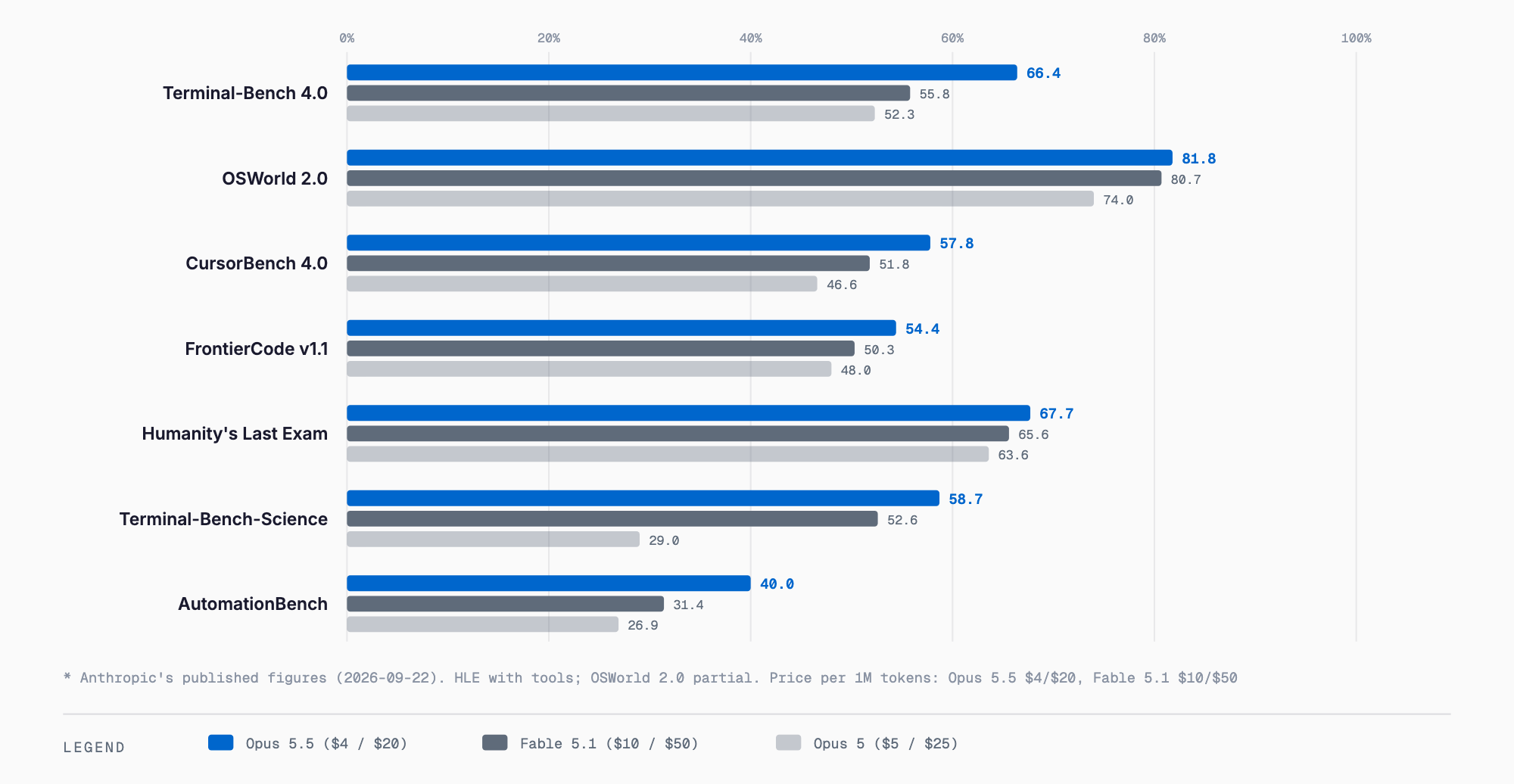
The largest raw gains are on Terminal-Bench-Science (+29.7pt) and Terminal-Bench 4.0 (+14.1pt), both benchmarks that involve operating a live execution environment over long task horizons. That said, GPT-6 Astra outscores Opus 5.5 on both AutomationBench and Terminal-Bench-Science, so Opus 5.5 is not uniformly ahead on every metric. The Artificial Analysis Intelligence Index puts it at 58, ranked #1 across models, even as individual benchmarks still show domain-by-domain trade-offs.
Opus 5 / Fable 5.1 / GPT-6 Astra / GPT-6 Sol comparison
Lined up against the current field, GPT-6 Astra's pricing ($10/$50) is covered in GPT-6 Astra pricing and benchmarks. The same day, OpenAI also announced GPT-6 Sol ($2/$10) and GPT-6 Luna ($0.10/$0.50).
| Model | Input / Output ($/1M) | Position |
|---|---|---|
| Claude Opus 5.5 | $4 / $20 | Fable 5.1-level performance at under half the price |
| Claude Opus 5 (prior) | $5 / $25 | Now legacy, still available |
| Claude Fable 5.1 | $10 / $50 | Retains the frontier top tier |
| GPT-6 Astra | $10 / $50 | OpenAI's flagship reasoning model |
| GPT-6 Sol | $2 / $10 | Cheaper mid-tier model (announced same day) |
| GPT-6 Luna | $0.10 / $0.50 | Lightweight, low-cost model (announced same day) |
Anthropic frames Opus 5.5 as performing "at the level of Fable 5.1 on most work." Given the price is under half of Fable 5.1's, testing whether workloads currently on Fable 5.1 can move to Opus 5.5 is a high-priority cost optimization to evaluate.
How to use it
As with other Claude models, the API just needs model set to claude-opus-5-5. Reasoning effort is controlled with the effort parameter, and if you omit it, the default is now medium (Opus 5 defaulted to high).
import anthropic

client = anthropic.Anthropic()

response = client.messages.create(
    model="claude-opus-5-5",
    max_tokens=4096,
    effort="medium",  # default when omitted; high / low also available
    messages=[
        {"role": "user", "content": "Fix the failing tests in this repository"}
    ],
)
print(response.content)
In Claude Code, selecting claude-opus-5-5 as the model is enough to slot it into an existing workflow. Raising effort to high reportedly beats Opus 5's high-effort performance in many cases, but since adaptive thinking is always on and cannot be disabled, any existing code that passed thinking: disabled will need to be updated before it runs.
Migration notes
Opus 5.5 ships several breaking changes to actual API behavior. Check the following before migrating existing code.
- thinking: disabled or a manual thinking budget now returns a 400 — replace it with adaptive thinking plus an effort level
- Forced tool use (tool_choice: "any" or "tool") now returns a 400 — use strict tool schemas or structured outputs instead
- Thinking blocks are bound to conversation state — replaying a conversation that includes prior thinking blocks after changing the system prompt or tool definitions returns a 400
- The computer use tool version has been updated — the old computer_20251124 version is rejected; update to the current version
- Changing effort mid-session invalidates the prompt cache — designs that switch effort levels frequently will see lower cache hit rates
- Because thinking is always on, output token budgets trend upward — even with lower per-token rates, estimate real spend including thinking tokens
Opus 5 becomes legacy but remains available. Sonnet 5.5 and Haiku 5.5 are planned "in the coming weeks", so migration for the smaller tiers is still ahead as of this writing.
Which one to choose
- If you were already on Opus 5: switching to Opus 5.5 is the reasonable default for most cases. Pricing is lower, and medium effort reportedly beats Opus 5's high effort, so you gain on both cost and speed
- If you were on Fable 5.1: given Anthropic's "level of Fable 5.1 on most work" framing and a price under half of Fable 5.1's, it's worth testing whether your workloads can move to Opus 5.5. Areas where Astra leads (AutomationBench, Terminal-Bench-Science) and Fable 5.1's hardest workloads still warrant individual verification
- If you use computer-use or browser-automation tooling: migration requires the updated computer use tool version, so check release notes before switching
- If your code relies on thinking: disabled or forced tool use: audit for these before migrating and replace them with adaptive thinking plus strict tool schemas first
FAQ
What does Claude Opus 5.5 cost?
API pricing is $4 per million input tokens and $20 per million output tokens, a 20% cut from Opus 5's $5/$25. Cache reads drop to $0.20 (−60% vs. Opus 5), Batch API is $2/$10, and Fast mode is $8/$40.
Can Opus 5.5 replace Fable 5.1?
Anthropic positions it as performing at the level of Fable 5.1 on most work, at under half Fable 5.1's price ($10/$50). However, GPT-6 Astra outscores Opus 5.5 on AutomationBench and Terminal-Bench-Science, so it isn't ahead on every benchmark — test it on your own workloads before switching.
What do I need to change when migrating existing code?
At minimum four things: (1) any thinking: disabled or manual thinking budget setting, which now returns a 400; (2) forced tool use via tool_choice: any/tool, which also 400s; (3) any flow that replays old thinking blocks after changing the system prompt or tools; and (4) old computer use tool version strings. Also account for prompt cache invalidation if you switch effort levels mid-session.
Did the default effort level change?
Yes. Opus 5 defaulted to high; Opus 5.5 defaults to medium. Anthropic says medium effort matches or exceeds Opus 5's high-effort performance on coding and knowledge work.
Is Opus 5 going away?
No, Opus 5 remains available as a legacy model. New implementations should target Opus 5.5 (claude-opus-5-5) going forward. Sonnet 5.5 and Haiku 5.5 are expected to follow in the coming weeks.
Feel free to contact us
Contact Us