GPT-6 Astra Explained: Pricing, Benchmarks, 1M Context
OpenAI announced GPT-6 Astra on Sept 3, 2026: $10 input, $50 output per 1M tokens, roughly 1.05M tokens of context. This guide covers pricing and benchmarks.
On September 3, 2026, OpenAI announced its flagship reasoning model, GPT-6 Astra (API model ID: gpt-6-astra). It is a single dense reasoning model with five configurable reasoning-effort levels and multimodal input (text and images) producing text output. Context length is roughly 1.05M tokens (sources vary between 1M and 1.1M), maximum output is 128K tokens, and the knowledge cutoff is April 30, 2026. Pricing is $10 input and $50 output per 1M tokens — about 2.5x the per-token price of the prior GPT-5.6 Sol, covered in GPT-5.6's price cut and Luna/Terra — making it the most expensive model OpenAI has sold through its public API.
What changed from GPT-5.6 Sol
OpenAI positions GPT-6 Astra as "a specialized frontier model, not a replacement for cheaper models across every use case." The main changes from GPT-5.6 Sol are the five-tier reasoning-effort setting, expanded context (roughly 1.05M tokens), and substantial benchmark gains on math, science, and agentic coding tasks. At the same time, per-token pricing has risen to roughly 2.5x Sol's, signaling a design intent to reserve Astra for tasks whose difficulty justifies the cost rather than deploying it universally. Compared with competitors such as Claude Fable 5.1 / Mythos 5.1 and Gemini 3.8 Flash, Astra prioritizes depth in specific domains over general-purpose versatility.
Pricing
According to OpenAI's announcement materials, GPT-6 Astra is priced as follows (yen figures at roughly 150 yen per dollar). Batch processing is half the standard rate, while Fast mode, which prioritizes response speed, costs double.
| Item | Rate ($/1M tokens) | Approx. yen (1 USD ≈ 150 JPY) |
|---|---|---|
| Input | $10 | ≈¥1,500 |
| Cached input | $1 | ≈¥150 |
| Output | $50 | ≈¥7,500 |
| Batch (half price) | $5 in / $25 out | ≈¥750 / ≈¥3,750 |
| Fast mode (2x) | $20 in / $100 out | ≈¥3,000 / ≈¥15,000 |
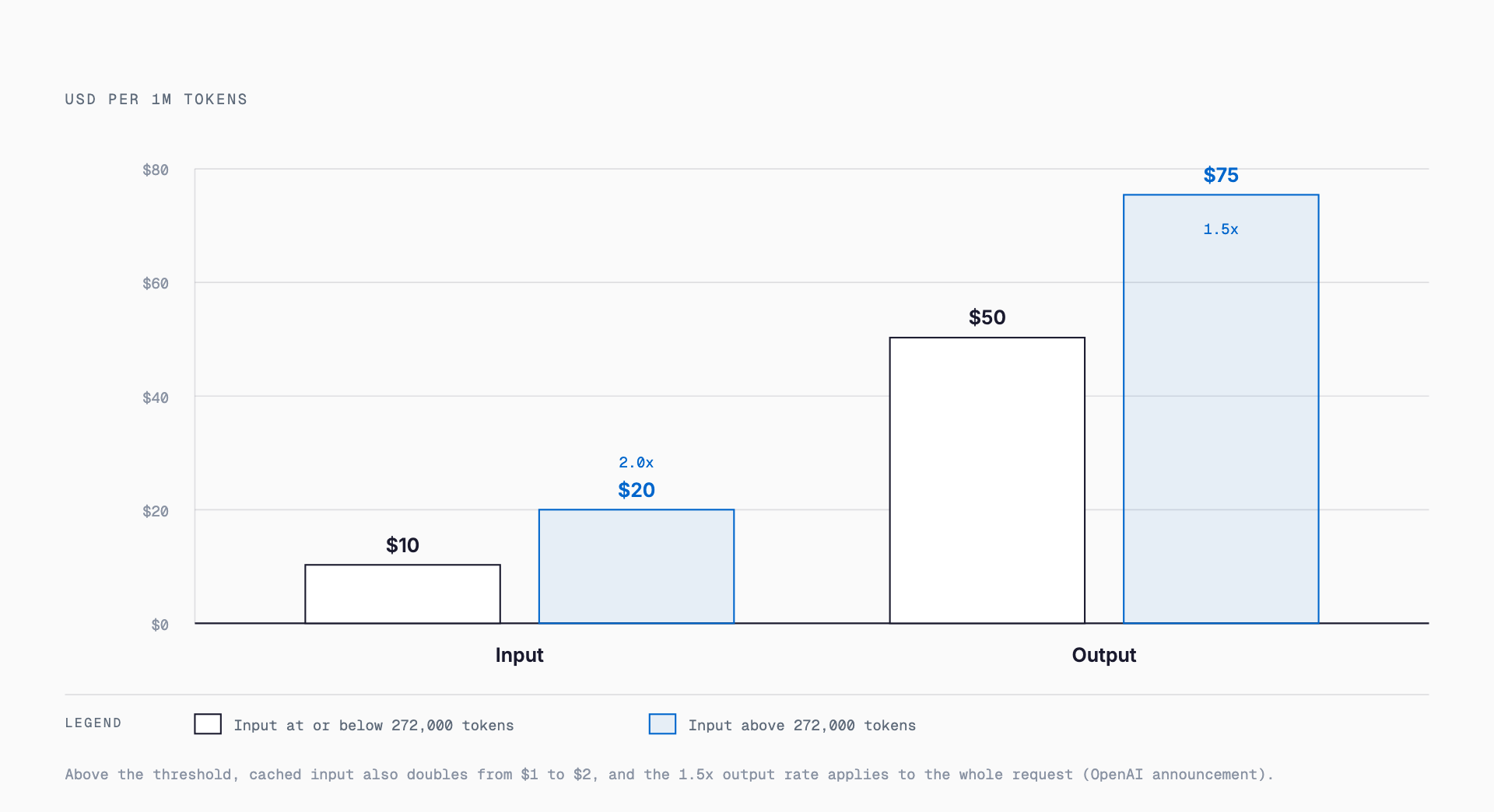
One important detail is the pricing cliff that kicks in above 272,000 input tokens: past that threshold, input and cached-input rates double, and the output rate rises 1.5x across the whole request. For long-context use cases, whether a prompt crosses the 272K boundary can substantially change the bill, so it is worth estimating total prompt tokens in advance.
Benchmarks
Based on OpenAI's announcement materials, the key benchmark results are as follows.
| Benchmark | Result |
|---|---|
| FrontierMath Tier 4 v2 | 97.6% |
| GPQA Diamond | 96% |
| DeepSWE v1.1 | 74.1% |
| OSWorld 2.0 | 72.6% (vs. Sol's 65.7%) |
| SRE-Bench (public reverse-engineering tasks) | 88% |
| ARC-AGI-3 | 62.7%–99.9% (scaffold-dependent) |
| OpenAI MRCR v2 (8-needle, 256K–512K range) | 100% |
| OpenAI MRCR v2 (8-needle, 512K–1M range) | 96.3% |
The wide 62.7%–99.9% swing on ARC-AGI-3 reflects how strongly results depend on the external scaffold used to drive the task (the search strategy and retry logic wrapped around the model), not the model's raw capability alone, so a single number should not be read as a definitive performance verdict. On long-context retrieval, MRCR v2 hits 100% in the 256K–512K range but slips slightly to 96.3% in the 512K–1M range — a modest accuracy drop as the used context grows that is worth keeping in mind when relying on the full million-token window in practice.
Where it's available
GPT-6 Astra is rolling out gradually to ChatGPT Pro, Enterprise, and Business Premium plans, with Plus availability to follow. Via the API, it is available under the model ID gpt-6-astra, so migrating existing integrations is a matter of pointing them at the new model name.
When to use it
- When Astra makes sense: high-difficulty math and scientific reasoning (FrontierMath, GPQA Diamond), complex agentic coding tasks (the DeepSWE family), and specialized tasks with low tolerance for error, such as security research
- When a cheaper model is enough: routine text generation, summarization, simple Q&A, and lightweight coding assistance where Sol-era or lower-tier models already deliver sufficient accuracy
- Long-context caution: prompts exceeding 272K tokens trigger the pricing cliff, so before packing large document sets into a single request, consider splitting the input or leaning on cached input to control cost
- Practical cost management: route asynchronous tasks that tolerate batch processing to the half-price batch tier, and reserve the 2x Fast-mode premium only for use cases where real-time responsiveness is truly required
For the lower-cost GPT-6 Sol / Luna released on September 22 and the same-week Grok 4.7, see "GPT-6 Sol vs Luna vs Grok 4.7: Pricing and Benchmark Comparison".
Constraints and caveats
GPT-6 Astra's cybersecurity-related capabilities have been rated Critical, and OpenAI has put oversight controls in place that can pause or halt tasks. Teams deploying it should account for the possibility that these controls may restrict responses at unexpected moments. On some general-purpose benchmarks it also trails Claude Fable 5.1 / Mythos 5.1, and it falls behind competing models on certain coding metrics as well. OpenAI itself frames Astra as "a specialized frontier model, not a replacement for cheaper models across every use case," so adoption should be scoped to the tasks it is actually suited for.
Frequently asked questions
How much does GPT-6 Astra cost?
According to OpenAI's announcement materials, it costs $10 input, $1 cached input, and $50 output per 1M tokens. Batch processing is half price, and Fast mode costs double.
What changes above 272K tokens?
Requests exceeding 272,000 input tokens hit a pricing cliff: input and cached-input rates double, and the output rate rises 1.5x across the whole request.
How long is the context window?
Announcement materials put it at roughly 1.05M tokens, with sources ranging from 1M to 1.1M. Maximum output is 128K tokens.
Which plans can I use it on?
It is rolling out gradually to ChatGPT Pro, Enterprise, and Business Premium plans, with Plus to follow. Via the API it is available under the model ID gpt-6-astra.
What changed from GPT-5.6 Sol?
The main changes are five-tier reasoning effort, expanded context length, and stronger benchmark results on math, science, and agentic coding — though per-token pricing rose to roughly 2.5x Sol's.
Feel free to contact us
Contact Us