Prisma ORM Today: Rust-Free v7 and the Prisma 8 RC
As of Sept. 2026, prisma@latest is 8.0.0-rc.13; stable prev is 7.10.0. Prisma 7 dropped Rust for a TypeScript compiler, shrinking bundles, speeding queries.
Prisma ORM is an open-source ORM (Apache-2.0) for TypeScript and Node.js. You define your data model in a schema.prisma file, then generate a type-safe client (Prisma Client) to work with major databases such as PostgreSQL, MySQL, SQLite, SQL Server, MongoDB, and CockroachDB; it also includes Prisma Migrate for migrations and Prisma Studio as a GUI. As of npm dist-tags on September 5, 2026, prisma@latest is 8.0.0-rc.13 (a release candidate), while prev is 7.10.0, the latest stable release in the 7.x line (released August 26, 2026) — meaning the 7.x line remains the current stable option for production.
How It Works: Prisma 7's Rust-Free Architecture
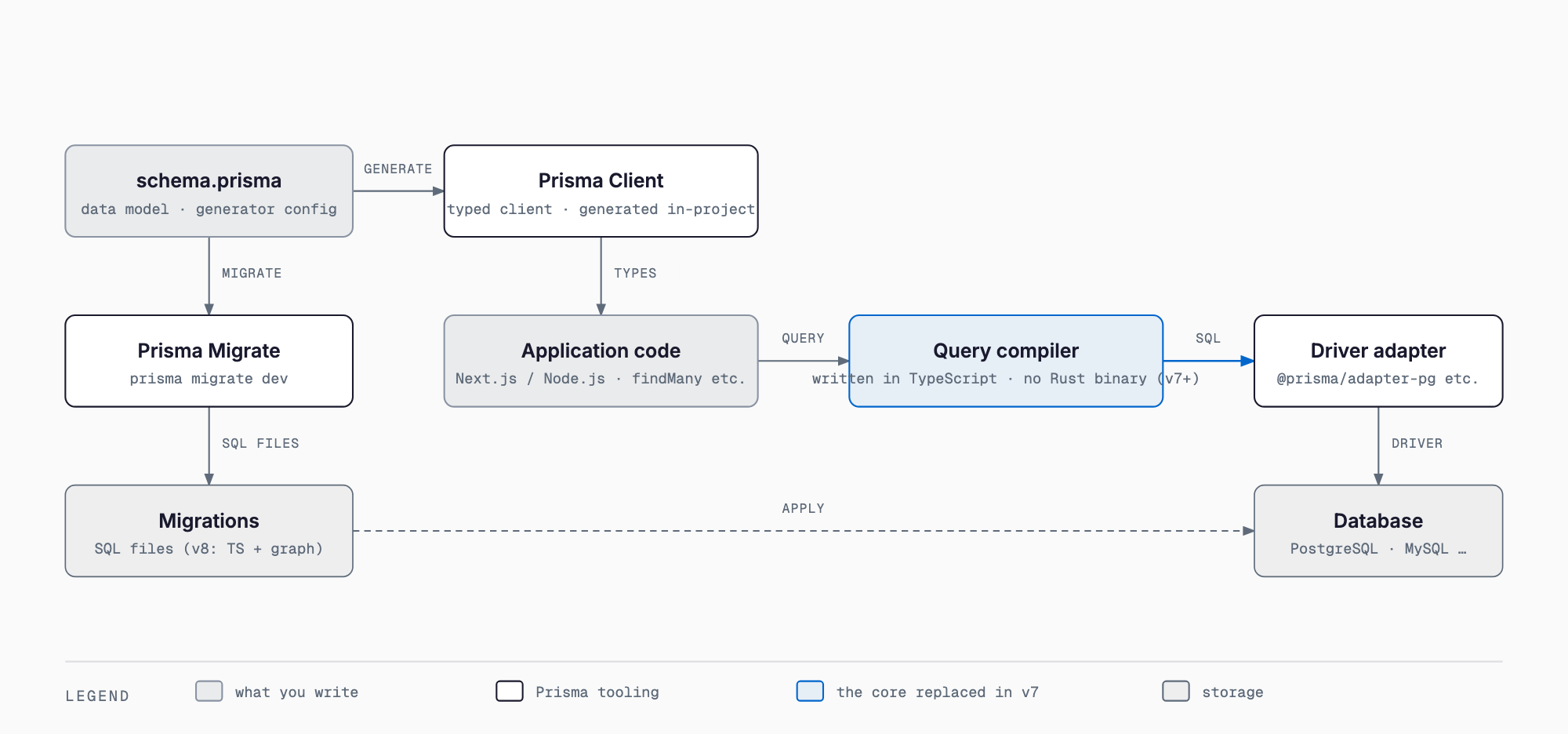
Through Prisma 6, a Rust-built 'query engine' binary shipped alongside Prisma Client and ran as a separate process to bridge the client and the database. Prisma 7, released November 19, 2025, replaces that Rust query engine with a TypeScript-based 'query compiler' (a Rust-free client). The stated motivation is that the communication layer between the JS runtime and the Rust binary was a source of overhead, and that requiring Rust skills raised the bar for community contributions. The flow now runs: define models in schema.prisma → generate the client with prisma generate → application code calls Prisma Client → the TypeScript query compiler builds the query → the query reaches the database through a driver adapter (e.g., @prisma/adapter-pg). Migrations still work the same way as before: Prisma Migrate generates SQL from the diff in schema.prisma and applies it to the database. Because the query compiler now runs in the same JS runtime as the application instead of a separate Rust process, the inter-process communication overhead goes away.
Prisma 7's Numbers and Breaking Changes
Prisma's official announcement (the Prisma 7.0.0 announcement blog) cites the following improvements.
| Metric | Improvement |
|---|---|
| Bundle size | About 90% smaller (reported as roughly 14MB to about 1.6MB) |
| Query execution | Up to 3x faster |
| Type checking | 70% faster |
| Types needed for schema evaluation | About 98% fewer |
| Types needed for query evaluation | About 45% fewer (in collaboration with ArkType author David Blass) |
| CPU/memory usage | Reduced |
Alongside these gains, five breaking changes ship with Prisma 7. If you're upgrading an existing project from the 6.x line, it's worth reviewing this list beforehand.
- The generated Prisma Client now outputs into a directory inside your project instead of node_modules
- A new configuration file, prisma.config.ts, is required
- The generator block must specify provider = "prisma-client"
- The schema file location must be declared explicitly
- Database connections go through a driver adapter (e.g., @prisma/adapter-pg for PostgreSQL)
A minimal schema.prisma looks like this.
generator client {
  provider = "prisma-client"
}

datasource db {
  provider = "postgresql"
  url      = env("DATABASE_URL")
}

model User {
  id    Int     @id @default(autoincrement())
  email String  @unique
  name  String?
}
The commands to generate the client and apply migrations are as follows.
npx prisma generate
npx prisma migrate dev
If you use Prisma Postgres, npm create db provisions a database instantly. Since it speaks the standard Postgres protocol, it stays compatible with existing tools such as Cloudflare Hyperdrive and TablePlus.
What Changes in Prisma 8
Prisma 8, at release candidate 8.0.0-rc.13 as of September 2026, is built around a full move to a TypeScript runtime. Schemas can now be written in TypeScript in addition to the traditional .prisma format. The central concept is the 'data contract': a lightweight build step generates a deterministic JSON contract and TypeScript types from the schema, designed to be machine-readable so AI agents and tools can inspect it easily. The query API becomes a composable DSL, where each query compiles at runtime into a verifiable plan with no hidden client methods. Migrations move to a graph-based model: each migration records a from/to hash, the migrations in a repository form a graph, and the database searches that graph for a path from its current state to the target state. This is meant to auto-resolve migration conflicts across branches and let partial failures be retried safely. Both schema migrations and data migrations are written in TypeScript and validated against the data contract. The architecture follows a 'minimal core plus public SPI' design, where even PostgreSQL support itself is implemented as an extension. PostgreSQL and MongoDB get first-class support first, followed by SQLite, then MySQL. Prisma Studio gains migration-history and schema-diff visualization. All of this is still release-candidate, early-access design, so the specifics may still change.
Prisma vs Drizzle ORM vs TypeORM vs Kysely
The TypeScript database tooling landscape includes several options, each with a distinct personality. If you want SQL-close ergonomics, a lightweight query builder like the one covered in the Cloudflare stack web development guide (Drizzle x D1) is often the candidate, and it's frequently discussed for its fit with edge environments such as Cloudflare D1. A general comparison looks like this.
| Aspect | Prisma | Drizzle ORM | TypeORM | Kysely |
|---|---|---|---|---|
| How types work | Types generated from schema | Inferred from schema written in TS | Inferred from decorators/classes | The query builder itself is type-safe |
| Schema definition | Its own schema language (.prisma; TS also possible in v8) | Defined directly in TypeScript code | Decorated classes | No dedicated schema definition |
| Migrations | Prisma Migrate included | Drizzle Kit included | Built in (supports both Active Record and Data Mapper) | No built-in migrations; needs a separate tool |
| Edge fitness | Improved in v7 via smaller bundles and no Rust binary | Lightweight, often cited as a good fit for edge (e.g., Cloudflare D1) | Long track record on traditional server environments | Lightweight and used at the edge too (e.g., Better Auth's D1 connections) |
| Personality | Model-oriented, generated client | SQL-close query builder | Long-standing decorator/class-based ORM | A type-safe SQL query builder, not an ORM |
If you're building around SQLite for edge deployment, it's also worth weighing libSQL-based options such as the ones covered in our explainer on Turso (edge SQLite). There's no single right answer — if you value the type-generation experience, migrations, a GUI tool, and ecosystem depth, Prisma's strengths come through.
Movement on the Prisma Platform
On the platform side, Prisma also made the following moves in July and August 2026, based on its official changelog.
- Prisma Compute reached GA (August 28, 2026); it can run production apps, with 1 million requests per month on the free plan
- Object Store buckets added (July 24, 2026, S3-compatible)
- The Supabase integration extension @prisma/orm-extension-supabase was expanded (July 17, 2026, with row-level security support)
- Prisma 8 added support for expression and partial indexes (August 2, 2026)
Making the Call: What Kind of Project Fits
For team development that values type safety, especially projects with a Next.js or Node.js backend, Prisma's schema-driven development experience and migration management remain a strong option. At the same time, Prisma 8 is still at release-candidate, early-access stage as of September 2026, so treating it as production-ready would be premature; the 7.x line (7.10.0) is the current stable choice for production. If you're upgrading an existing project from 6.x to 7.x, review the official upgrade guide (Prisma's official docs) first, since there are several breaking changes — the client output location, prisma.config.ts, and driver-adapter connections among them — and verify everything in a development environment before applying it to production.
Where This Fits for SMBs and Contract Development
For contract-development projects built for long-term maintenance, having a single source of truth — the schema file — generate types for both the database and the application tends to reduce misunderstandings as engineers rotate on and off a project and requirements keep growing. Because migration history stays in the repository, it also becomes easier to track schema differences across environments (development, staging, production), which is practically useful for the multi-environment setups many SMB systems run. If the graph-based migrations envisioned for Prisma 8 reach production readiness, resolving conflicts during branch-based, parallel schema work could get easier still. For now, though, that's a release-candidate feature, and real projects are better served by evaluating against the stable 7.x line.
FAQ
Is Prisma 8 ready for production?
As of September 5, 2026, prisma@latest is 8.0.0-rc.13, a release candidate. The current stable line for production is 7.x (prev = 7.10.0, released August 26, 2026), so choosing 7.x is the realistic option for production use today.
What's the benefit of going Rust-free?
Prisma 7 replaced its Rust-built query engine binary with a TypeScript query compiler. Officially cited gains include roughly 90% smaller bundle size, up to 3x faster query execution, and 70% faster type checking, along with reduced CPU and memory usage.
Should I pick Drizzle or Prisma?
As a general rule, choose Drizzle ORM if you want SQL-close ergonomics, a lightweight footprint, and a good fit with edge environments. Choose Prisma if you value a schema-driven type-generation experience, migrations, and ecosystem depth including the Prisma Studio GUI. It depends on your runtime and team preferences.
What should I watch for when upgrading from 6.x to 7.x?
The five main breaking changes are: the generated Prisma Client now outputs inside your project instead of node_modules; a new prisma.config.ts file is required; the generator block needs provider = \"prisma-client\"; the schema file location must be declared explicitly; and database connections go through a driver adapter. Review the official docs and verify in a dev environment before applying to production.
Summary
As of September 2026, Prisma ORM has two lines running in parallel: the 7.x line (stable at 7.10.0) and the 8.x line (release candidate 8.0.0-rc.13). Prisma 7 replaced its Rust query engine with a TypeScript query compiler, and Prisma officially reports large gains in bundle size, query execution speed, and type-checking speed as a result. Prisma 8 lays out a more ambitious design — a full move to a TypeScript runtime, data contracts, and graph-based migrations — but it remains release-candidate, early-access work today. For production adoption, a step-by-step approach makes sense: review and apply Prisma 7's breaking changes first, then keep an eye on how Prisma 8 develops from here.
Related free tools (no sign-up, instant results)
Feel free to contact us
Contact Us