Store Loyalty & Membership App Development Costs (2026)
Store loyalty and membership app costs across LINE mini apps, packaged store services, and custom builds, plus feature cost drivers and running costs.
A store loyalty and membership app replaces a paper stamp or point card with a smartphone app so restaurants, salons, and retail stores can award loyalty points, send coupons, and use push notifications to bring customers back. Costs vary enormously depending on the approach, ranging from zero upfront to over 10 million yen. As a general 2026 market range rather than a specific quote, using an existing service such as a LINE mini app or LINE Official Account's shop card feature typically costs 0 to a few tens of thousands of yen upfront plus a few thousand to a few tens of thousands of yen monthly; a packaged store app service runs about 100,000-500,000 yen upfront and 10,000-50,000 yen monthly; and a fully custom build runs 3,000,000-10,000,000 yen or more. Many store owners struggle with paper point cards that customers forget to bring or that make it impossible to measure promotional effectiveness, but going digital does not automatically fix this — choosing the wrong approach can backfire into an app nobody downloads, used even less than the paper card was. This article breaks down store app costs, how individual features affect price, ongoing running costs, and selection criteria, in plain terms for non-IT staff. For general app development costs, see mobile app development costs, and for how this differs from building a membership site, see membership site cost.
Cost by approach
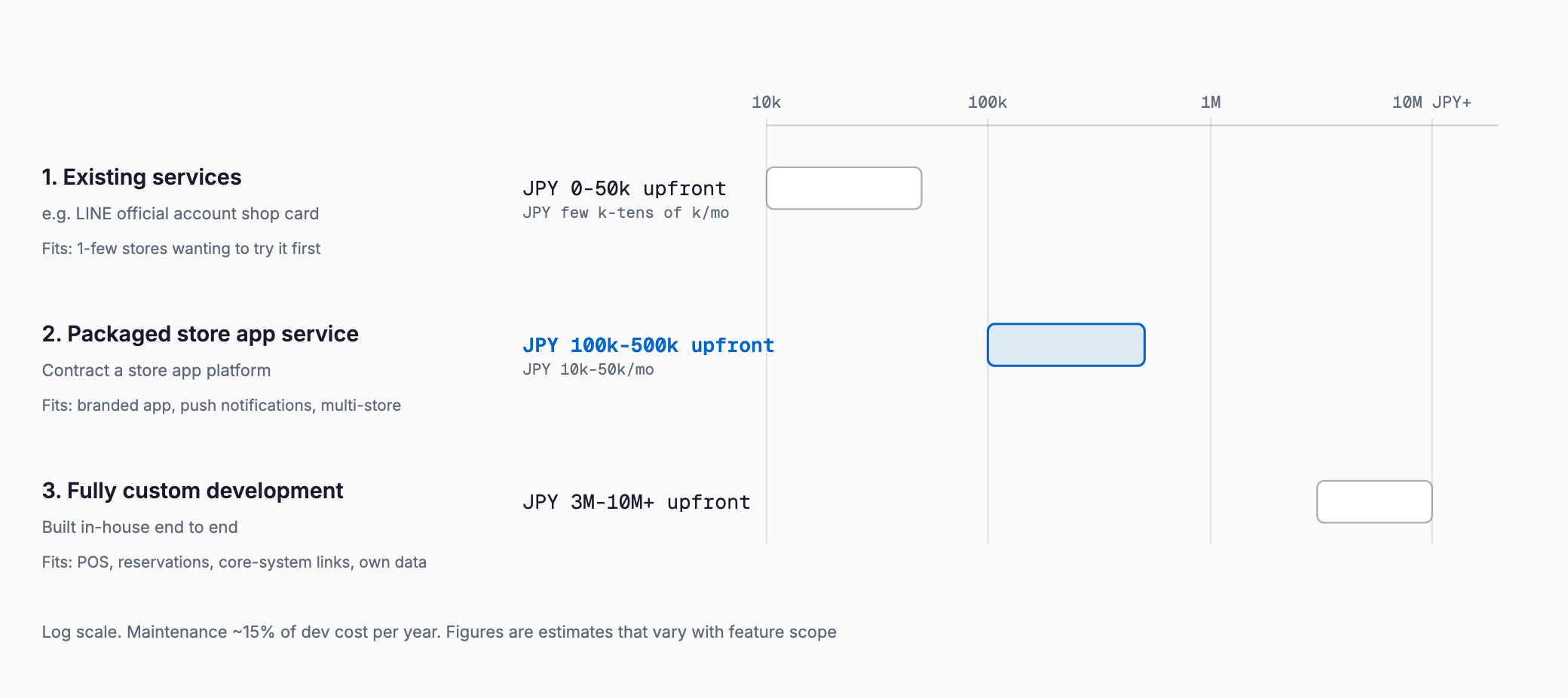
| Approach | Overview | Upfront cost (approx.) | Monthly cost (approx.) |
|---|---|---|---|
| 1. Existing service (LINE mini app, LINE Official Account shop card, etc.) | Use a standard LINE feature or dedicated SaaS as-is, with only design and settings work | 0 to a few tens of thousands of yen | A few thousand to a few tens of thousands of yen (some plans charge per message sent) |
| 2. Packaged store app service | Customize a dedicated store-app package product for your needs | 100,000-500,000 yen | 10,000-50,000 yen |
| 3. Full custom development | Built from scratch including POS integration, multi-store management, and a proprietary point design | 3,000,000-10,000,000 yen or more, potentially higher at scale | Maintenance at roughly 15% of build cost per year |
For business types with frequent visits and low per-visit spend, such as cafes or quick salon services, an existing service like a LINE mini app is often enough on its own. The need for a packaged or fully custom build grows as requirements shift toward finely tuned point rules, custom coupon conditions, or centralized data across multiple stores. The general logic for choosing between approaches is also covered in mobile app development costs.
How individual features affect cost
| Feature | Overview | Cost impact |
|---|---|---|
| Point awarding | Automatically adds points based on visits or purchase amount | Included as standard in most services; minimal cost impact |
| Membership QR code | Scanned at the register for identification and point linking | Supported by most existing services, but integration with a proprietary register often adds cost |
| Coupons | Automatic coupon delivery based on conditions like birthday or visit count | More complex conditional logic increases effort for packaged and custom builds |
| Push notifications | Direct notifications for new products or coupons via app or LINE | Often billed per message sent, so this directly affects monthly cost |
| POS integration | Syncs purchase data from the register system to award points automatically | Depends heavily on the POS vendor's specs; existing services often cannot support this, making the cost impact large |
| Reservation integration | Connects with a salon or clinic's reservation system | Depends on whether the reservation system offers an API; unsupported combinations require custom development |
| Multi-store management | Lets headquarters manage member data and promotions across stores centrally | Cost impact grows with the number of stores due to permission design and data aggregation work |
What drives cost most is not the number of features itself, but how much can be covered by an existing service's standard functionality. POS integration, reservation integration, and multi-store management are the three features least likely to be included as standard, and once any of them becomes a must-have, it's time to look beyond an off-the-shelf service. For member data design, see membership site cost, and for the broader picture of managing visit data as part of customer relationships, see CRM system costs.
Running costs that are easy to overlook
- Apple Developer Program: 99 USD per year (required to distribute on the App Store under your own company name; often unnecessary with an existing service distributed under the provider's own name)
- Google Play registration fee: 25 USD (one-time, required for Android distribution; similarly often unnecessary with an existing service)
- Server costs: Packaged and fully custom builds incur separate monthly cloud server costs that scale with member count and notification volume
- Maintenance: A rough guideline is 15% of the development cost per year, covering OS update support, bug fixes, and security patching
- OS update support: Annual iOS and Android version updates require verification and adjustments; neglecting this risks the app failing to launch
- Content creation and operations: Writing coupon and notification copy and managing the send schedule is an ongoing internal operational cost separate from the system cost itself
Decision criteria for choosing an approach
- Member count: An existing service is often enough up to a few hundred members; beyond a few thousand, a packaged or custom build tends to win on aggregation and delivery performance
- Visit frequency: Businesses with frequent visits get more value from push notifications and point design, making the investment easier to justify
- Whether POS integration is needed: Whether automatic sync with an existing POS system is a must-have largely determines whether an existing service is sufficient
- Whether you need to own the data: Whether you want to hold and analyze member data yourself, versus leaving it on the service provider's platform, changes the options available (check this against your privacy policy)
- Plans for multi-store expansion: If multi-store expansion is expected, designing for centralized headquarters management from the start avoids a costly rebuild later
Pre-order checklist
- What is the target member count and expected visit frequency?
- Is integration with an existing POS or reservation system essential, or can you operate without it?
- Do you want to own member data yourself, or is leaving it with the service provider acceptable?
- Do you need centralized headquarters management across multiple stores, or is per-store operation sufficient?
- How complex do coupon and point conditions need to be?
- What push notification frequency do you expect, and what monthly cost does that imply?
- Who handles the account and cost for the Apple Developer Program and Google Play registration fee?
- Is your customer base already comfortable using LINE, or will a dedicated app download be a barrier?
- Do you have a transition plan from paper point cards, such as a parallel-use period or incentives to switch?
Common failure patterns
Store app rollouts tend to fail in a few common ways. First, building a fully custom app but under-promoting it in-store leads to a low download rate, and the app ends up used less than the paper point card it replaced — a common problem among older customers or infrequent visitors. A LINE mini app that requires no separate download, or a transition period where the paper card remains valid alongside the app, can address this. Second, sending push notifications too frequently causes customers to mute notifications or uninstall the app entirely, losing the customer touchpoint it was meant to build. Segmenting notifications by visit frequency or coupon usage, and deciding on a sending cadence in advance, helps avoid this. Third, POS integration is often considered only after signing a contract, only to discover the chosen service doesn't support the store's POS system, resulting in duplicate manual data entry. Whether POS integration is required should be confirmed before signing any contract.
Comparison summary by approach
| Aspect | Existing service fits when | Packaged or custom build fits when |
|---|---|---|
| Member count | A few hundred to about a thousand | Several thousand or more, across multiple stores |
| POS/reservation integration | Not needed, or manual operation is acceptable | Automatic integration with an existing system is essential |
| Customer base | High LINE usage, reluctant to download another app | Comfortable downloading a dedicated app, values brand experience |
| Investment approach | Keep upfront cost low and start small | Ready to invest in multi-store expansion or custom features |
What does it typically cost to build a point card app?
Using an existing service such as a LINE mini app or LINE Official Account shop card typically runs 0 to a few tens of thousands of yen upfront and a few thousand to a few tens of thousands of yen monthly. A packaged store app service runs roughly 100,000-500,000 yen upfront and 10,000-50,000 yen monthly. A fully custom build runs 3,000,000 yen or more. These are general 2026 market ranges, not a specific quote.
Should I choose a LINE mini app or a dedicated app?
If your customer base already uses LINE heavily and may resist downloading another app, a LINE mini app tends to fit better. If you need POS integration, multi-store management, or a custom point design, a packaged or fully custom dedicated app is worth considering.
I'm worried customers won't download the app. How can I address that?
Low download rates are one of the most common store app failures. Options include choosing a download-free approach like a LINE mini app, running a transition period where the paper card stays valid alongside the app, and offering an incentive for the first download.
How much should I budget for maintenance after launch?
A rough guideline is about 15% of the development cost per year, covering OS update support, bug fixes, and security patching. On top of that, factor in the Apple Developer Program (99 USD per year) and separate server costs.
Summary
A store loyalty and membership app typically costs 0 to a few tens of thousands of yen upfront and a few thousand to a few tens of thousands of yen monthly when built on an existing service like a LINE mini app; about 100,000-500,000 yen upfront and 10,000-50,000 yen monthly for a packaged store app service; and 3,000,000 yen or more for a fully custom build. What matters most is not choosing the cheapest option, but first working out member count, visit frequency, whether POS integration is needed, and whether you need to own your own data before settling on an approach. Beyond launch, building in a transition plan from paper cards and a deliberate push notification cadence is what turns the app into something customers actually use.
Related free tools (no sign-up, instant results)
Feel free to contact us
Contact Us