StyleX Explained: Meta's Build-Time Atomic CSS-in-JS Library
StyleX is Meta's open-source styling library. A Babel plugin converts styles into atomic CSS at build time, outputting static CSS with no runtime cost.
What Is StyleX
StyleX is a styling library developed and open-sourced by Meta (formerly Facebook). Its concept is to combine the expressiveness and type safety of CSS-in-JS with the performance of static CSS. It runs as a Babel plugin at build time and performs no runtime style injection.
How It Works: Atomic CSS at Build Time
StyleX operates as a Babel plugin at build time. It statically extracts style declarations from your source code and converts every unique combination of a property and its value into a single 'atomic CSS class.' This conversion happens globally across the entire codebase, so the same property-value combination is deduplicated into the same class no matter how many times it is used, and the result is emitted as static CSS files. Because there is no runtime style injection, there is no runtime overhead.
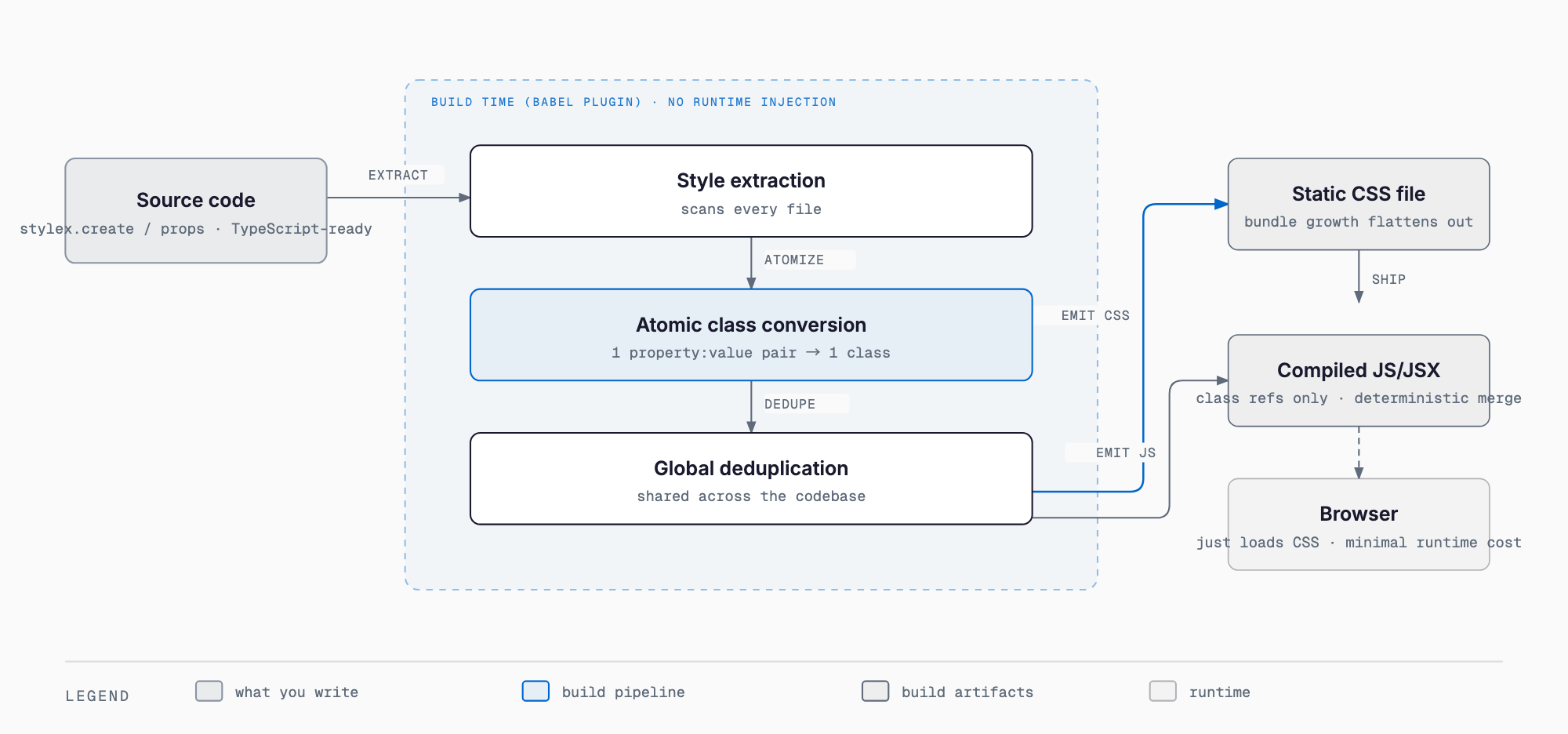
This mechanism has two effects. First, the CSS bundle does not keep growing indefinitely as code is added, since new components reuse existing property-value combinations rather than generating new CSS classes, so the total amount of CSS tends to plateau. Second, merging is deterministic and free of specificity conflicts: when multiple styles are merged, StyleX guarantees that the style applied last in the code always wins, avoiding 'styles that don't apply' caused by CSS specificity calculations.
Core API
StyleX's basic API centers on two functions: stylex.create() and stylex.props(). You start by defining styles as an object.
const styles = stylex.create({
  root: { width: '100%', maxWidth: 800 }
});
Defined styles are applied to elements with stylex.props(). Conditional style selection and map-based selection can be written in plain JavaScript.
<div {...stylex.props(
  styles.root,
  isActive && styles.active,
  colorStyles[color]
)} />
Values like design tokens are defined as type-safe CSS custom properties with stylex.defineVars(). By convention, these definitions live in a dedicated .stylex.js (or .stylex.ts) file, which is reserved solely for variable definitions, must use named exports, and requires a default value for every entry. Media query conditions can be written directly inside the variable values.
const DARK = '@media (prefers-color-scheme: dark)';
export const colors = stylex.defineVars({
  primaryText: { default: 'black', [DARK]: 'white' },
});
To provide an alternative set of values for defined variables, you switch themes with stylex.createTheme(). Note that StyleX styles are premised on being statically resolvable at compile time, and embedding runtime dynamic values directly is not recommended.
Comparison With Other Styling Approaches
StyleX differs from Tailwind CSS, runtime CSS-in-JS, and CSS Modules in both where you write styles and what gets output. A general comparison looks like this (see also the TanStack Router, Tailwind, and Vite setup guide for how Tailwind CSS is used in practice).
| Aspect | StyleX | Tailwind CSS | Runtime CSS-in-JS (styled-components/Emotion, etc.) | CSS Modules |
|---|---|---|---|---|
| Where you write | JS objects (stylex.create) | Utility classes listed in HTML class attributes | Template literals or objects in JS/TS | Regular CSS files |
| Output | Statically converted to atomic CSS at build time | Atomic CSS generated at build time | Styles injected at runtime | Scoped CSS (no atomization) |
| Runtime cost | None (static CSS) | None (static CSS) | Present (runtime injection overhead) | None |
| Type safety | Yes (checked via JS/TS types) | No (string class names) | Depends on the library | No |
| Learning curve | Requires learning the JS object convention and API | Requires memorizing utility class names | Close to familiar CSS-in-JS syntax | Close to regular CSS, low learning cost |
Adoption and 2026 Developments
StyleX is Meta's standard styling system, used across major products including Facebook, Instagram, WhatsApp, Messenger, and Threads. Outside Meta, companies such as Figma and Snowflake have also disclosed using it. In late 2025, the official StyleX site itself was relaunched using Waku, a minimal React framework with React Server Components support, and the team announced that 2026 will focus on ergonomic improvements, new features, and development tooling.
Supported Environments
StyleX works with React, Preact, Solid, lit-html, Angular, and JS frameworks in general, and supports major bundlers and build tools including Webpack, Rspack, Esbuild, Vite, and Next.js (see also this guide to web development with Vercel and React/Next.js).
- React, Preact, Solid, lit-html, Angular, and similar: supported out of the box
- Svelte, Vue: require additional configuration
- Bundlers/build tools: Webpack, Rspack, Esbuild, Vite, and Next.js are supported
Constraints and Fit
The main constraint of StyleX is the premise that styles must be written in a form that can be statically resolved at compile time. Embedding runtime dynamic values directly into styles is not recommended, and designs need to account for this constraint.
StyleX fits large codebases maintained over the long term, and teams that want to manage a design system with type safety. The ability to add and change styles safely without worrying about specificity conflicts matters when multiple people and teams keep touching the same codebase over a long period. On the other hand, a neutral way to frame it is that teams already satisfied with Tailwind CSS have little inherent need to switch, unless the benefits clearly outweigh the learning and migration cost.
Where It Fits in SMB and Contract Development
In contract development and SMB projects, the longer a project is maintained, the more CSS tends to gradually bloat and grow complex, and time gets spent tracking down 'styles that don't apply' caused by specificity conflicts. Adopting a mechanism like StyleX, which converts styles to atomic CSS at build time and guarantees that the style applied last always wins, can reduce the effort spent investigating style conflicts even on long-running maintenance projects where the people involved change over time. Type-safe design token management via defineVars() is also a generally useful foundation for projects that want to build out a design system incrementally.
FAQ
How is StyleX different from Tailwind CSS?
Tailwind CSS lists utility classes in the HTML class attribute. StyleX describes styles as JS objects and converts them to atomic CSS at build time. Both approaches end up producing atomic CSS, but they differ in where you write styles and how type safety is handled.
Is StyleX free to use?
Yes. StyleX is open-source software released under the MIT license.
Can StyleX be used with Next.js?
Yes. StyleX supports major bundlers and build tools including Next.js, Webpack, Rspack, Esbuild, and Vite.
Can it be adopted incrementally in an existing project?
The atomic classes StyleX generates are a general mechanism that can coexist with other CSS, but whether and how to adopt it incrementally should be confirmed against what the official documentation states. When considering adoption, a cautious approach such as trying it on a limited set of components first is advisable.
Summary
StyleX is a styling library through which Meta set out to combine 'the feel of writing CSS-in-JS' with 'the performance of static CSS' via build-time atomic CSS conversion. You can find more detail in the official documentation (StyleX Documentation) and in the Meta Engineering blog post (StyleX: A styling library for CSS at scale). For teams running large, long-lived projects or considering type-safe design system management, it is worth keeping in mind as an option.
Feel free to contact us
Contact Us