GLM-5.3-Flash Requirements
VRAM 190GB to 740GB by Quantization [320B MoE, the Model Behind "Ox Alpha", Aug 2026]
GLM-5.3-Flash needs about 190GB VRAM at 4-bit, 740GB at BF16. VRAM and GPU tables for this 320B/18B open MoE, plus local vs API costs. Updated August 2026.
GLM-5.3-Flash Needs About 190GB at 4-bit and 740GB at Full Precision
To run GLM-5.3-Flash locally, plan on roughly 190GB of inference memory (VRAM total) at a practical 4-bit quantization, and about 740GB at full BF16 precision. Released by Z.ai on August 26, 2026, it is an open-weight MoE with 320B total parameters and 18B active parameters per token, MIT-licensed, natively multimodal (image and video input), and capable of handling a context window of up to 1,048,576 tokens. The tables below are estimates that add inference overhead (KV cache, activations, etc.) to the raw weight size, and they vary with context length and batch size.
Requirements Quick-Lookup by Environment
| Environment type | Typical configuration | Feasibility |
|---|---|---|
| Apple Silicon Mac | Mac Studio 192GB–512GB (Unified Memory) | Within range at 4-bit even on 192GB; go 512GB for headroom |
| NVIDIA multi-GPU | 3x H100 (80GB) or 2x H200 (141GB) | Realistic minimum for 4-bit operation |
| Workstation GPU | 2x RTX 6000 Blackwell (96GB) | Just enough at 4-bit, little margin |
| Cloud GPU instance | Hourly-billed A100/H100 class | Good for validation and pilots; expensive for 24/7 use |
To check quickly whether your own GPU or Mac can run it, our VRAM calculator (free, no sign-up) estimates the requirement from model, quantization and context length — GLM-5.3-Flash 320B-A18B is in the model list.
VRAM Quick-Lookup by Quantization (Estimated)
| Quantization | Inference memory (VRAM total, est.) | Quality retention |
|---|---|---|
| 1-bit (IQ1 family) | ~45–50GB | Large drop (limited use) |
| 2-bit | ~90GB | Moderate drop |
| 3-bit | ~140GB | Usable range |
| 4-bit (Q4 family) | ~190GB | Practically no issues |
| 8-bit (FP8) | ~370GB | Near-lossless |
| BF16 (full precision) | ~740GB | 100% |
The table above adds roughly 15% inference overhead to the raw weight size (320B x bit-width). Using a 1M-token-class context grows the KV cache further, so budget more headroom for real deployments. Compared with the previous generation's GLM-5.2 requirements, which has a larger 753B total parameter count, GLM-5.3-Flash needs roughly half the memory even at the same 4-bit quantization.
The Stealth Model "Ox Alpha" Turned Out to Be GLM-5.3-Flash
In mid-August 2026, an anonymous model called "Ox Alpha" appeared for free via OpenRouter and OpenCode and drew attention; Z.ai officially confirmed its identity on August 26, 2026. As tracked in our Ox Alpha stealth model write-up, it turned out to be GLM-5.3-Flash — a 320B-total, 18B-active MoE trained on a 30-trillion-token multimodal corpus. It adopts a hybrid architecture combining linear attention (state modeling for local dependencies) with sparse attention (retrieving relevant global context through a lightweight indexer), and at long context lengths a mechanism called IndexPool compresses indexer key vectors via weighted pooling to hold down KV-cache memory. Z.ai states that both training and inference ran entirely on Chinese-made AI chips. On the GDPval-AA v2 benchmark, which measures knowledge-work performance, Z.ai reports GLM-5.3-Flash matching or beating Claude Opus 4.8, GPT-5.6 Terra, and Gemini 3.7 Flash, while inference cost is said to be about one-tenth that of GLM-5.2. Shrinking total parameters from 753B to 320B while maintaining or improving performance is the technical highlight of this release.
Running It on Apple Silicon and NVIDIA GPUs
Because Apple Silicon can treat Unified Memory as VRAM, the roughly 190GB needed at 4-bit falls within realistic reach of a Mac Studio. On a 192GB configuration, model weights alone consume almost all the inference memory, leaving little room for long contexts or batching, so a 512GB configuration (M3 Ultra or later) is the safer choice for headroom. On NVIDIA GPUs, bonding three 80GB H100s for about 240GB, or two 141GB H200s for about 282GB, is a reasonable guide for 4-bit operation. Workstation-class RTX 6000 Blackwell cards (96GB) get to about 192GB with two cards — just barely enough at 4-bit — so running at 8-bit or FP8 for margin requires adding more GPUs.
The MoE Misconception — VRAM Is Set by Total Parameters, Not the 18B Active
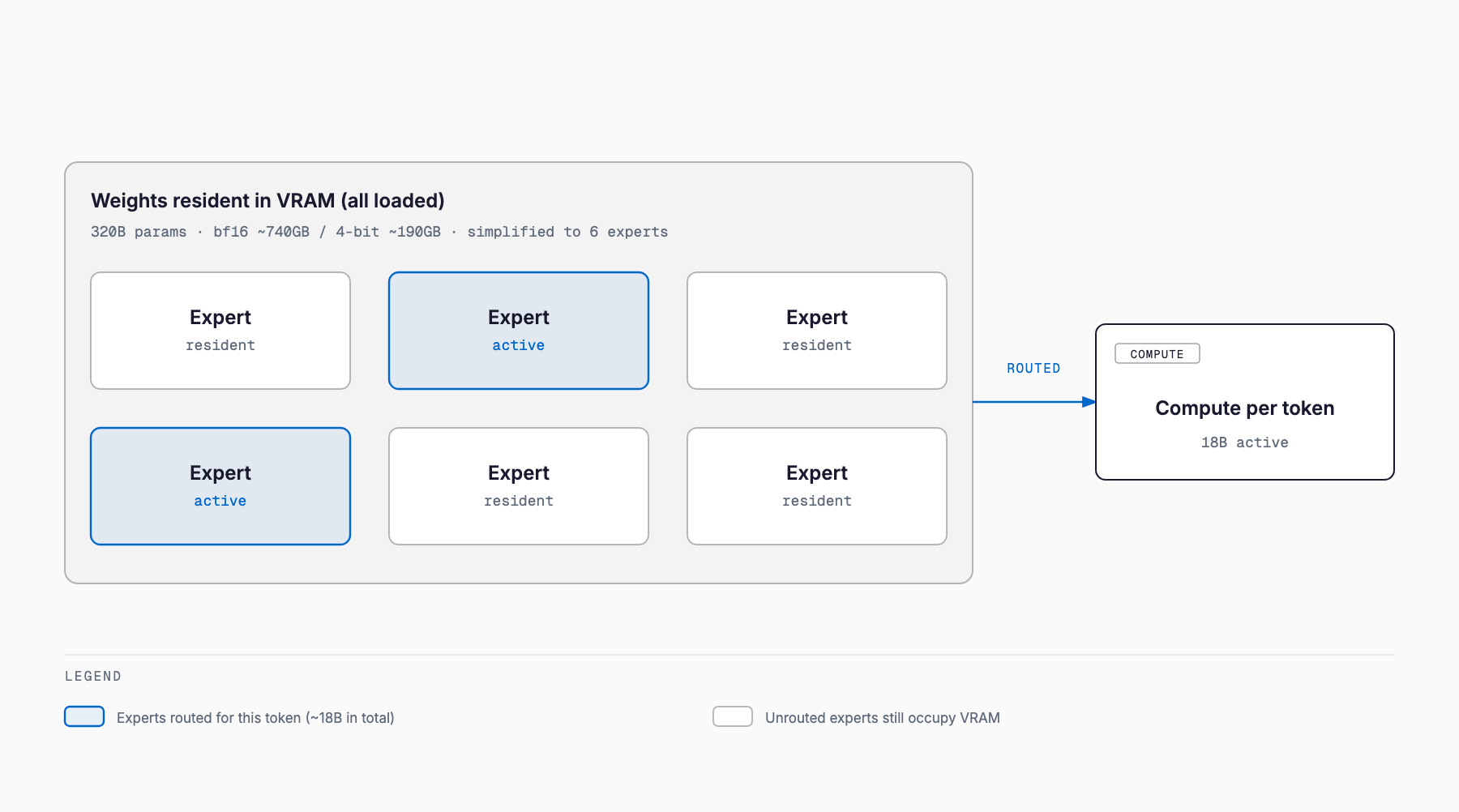
It is tempting to assume that with only 18B active parameters, a GPU in the low tens of GB would suffice — but this is a mistake. An MoE (Mixture-of-Experts) model dynamically switches which experts it calls per token, so the actual compute (FLOPs) is light, equivalent to 18B active. But because you cannot know in advance which experts will be called, inference requires holding the weights of all 320B parameters' worth of experts in memory. So the required VRAM is determined by the 320B total parameter count; the 18B active figure only affects compute speed and throughput.
Inference Backend Support (vLLM / SGLang / Unsloth)
Z.ai gave Unsloth day-0 access to the model, and quantized weights (GGUF, FP8, etc.) are already distributed via Unsloth on Hugging Face. As covered in our write-up on the flagship GLM-5.3 model, Z.ai itself serves the model at scale on its own SGLang-based stack that separates encoding, prefill, and decoding; official mainline support in vLLM and SGLang is still being merged as of this writing. Converting to GGUF format also lets you run it quantized on llama.cpp or Ollama, so check each engine's current support status before setting up your environment.
Local vs. API Cost Break-Even, Extra Memory for the 1M Context, and Use-Case Recommendations
Z.ai's official API pricing is $0.15/M input tokens, $0.03/M for cached input, and $0.50/M output tokens, halved further under the launch discount through September 9, 2026 (note that the flagship GLM-5.3, not Flash, is priced separately at $1.40/M input and $4.40/M output — don't confuse the two). Weighed against the fixed cost of permanently reserving 190GB–740GB of GPU memory, API use is the lower-risk option for pilots or when usage is hard to predict; once requirements firm up — data that cannot leave your premises, or heavy, stable usage — it becomes sensible to evaluate the TCO of running locally. When fully using the 1M-token context, the KV cache still grows by tens of GB even with IndexPool's compression, so plan for more GPU headroom than the tables above suggest. By use case, coding and agentic workloads that need long-context stability and reliable tool calls are better served at 8-bit or higher, while multimodal use cases (image/video input) can reasonably run at 4-bit if memory bandwidth and throughput are balanced.
What Changed from GLM-5.2, and Troubleshooting
Compared with the previous generation GLM-5.2 (753B total, about 40B active), GLM-5.3-Flash shrinks total parameters to well under half at 320B while adding native multimodality and the new linear+sparse attention hybrid architecture. Inference cost is also dramatically lower than GLM-5.2, so the bar for local deployment has come down on both memory and GPU-count fronts. If you hit an out-of-memory error such as "CUDA out of memory" during local inference, the standard fix order is: drop the quantization by one bit level, cap the context length, reduce batch size (concurrent requests), and check whether KV-cache offloading is configured. On multi-GPU setups, a mismatch between the tensor-parallelism split and the number of GPUs can also cause load failures, so check your inference engine's documentation for recommended GPU-count combinations (typically powers of two) before you start.
FAQ
Is GLM-5.3-Flash the same model as Ox Alpha?
Yes. According to Z.ai's official announcement on August 26, 2026, the stealth model known as "Ox Alpha" that drew attention on OpenRouter and elsewhere turned out to be GLM-5.3-Flash.
Can it run on a single consumer GPU?
No. Even the lightest 1-bit quantization needs about 45–50GB of inference memory, more than a typical 24–32GB consumer GPU can hold.
With only 18B active parameters, can't a smaller GPU run it?
That's a common MoE misconception. At inference time all 320B parameters' worth of expert weights must be held in memory, so required VRAM is set by the 320B total; the 18B active figure only affects compute speed.
Can GLM-5.3-Flash be used commercially?
Yes. It is released under the MIT license, which broadly permits commercial use, modification, and redistribution.
Can I use it right away with vLLM or SGLang?
Unsloth already distributes quantized weights from day zero, but official mainline integration into vLLM and SGLang is still being merged as of this writing, so check each engine's current support status before use.
How much extra memory does the 1M-token context need?
IndexPool's compression helps, but fully using the long context still grows the KV cache by tens of GB, so it's safer to plan for more GPU headroom than the quick-lookup tables suggest.
Related free tools (no sign-up, instant results)
Feel free to contact us
Contact Us