DeepSeek V4.1 Flash Requirements
VRAM, GPU & Mac Guide (1017, 2026)
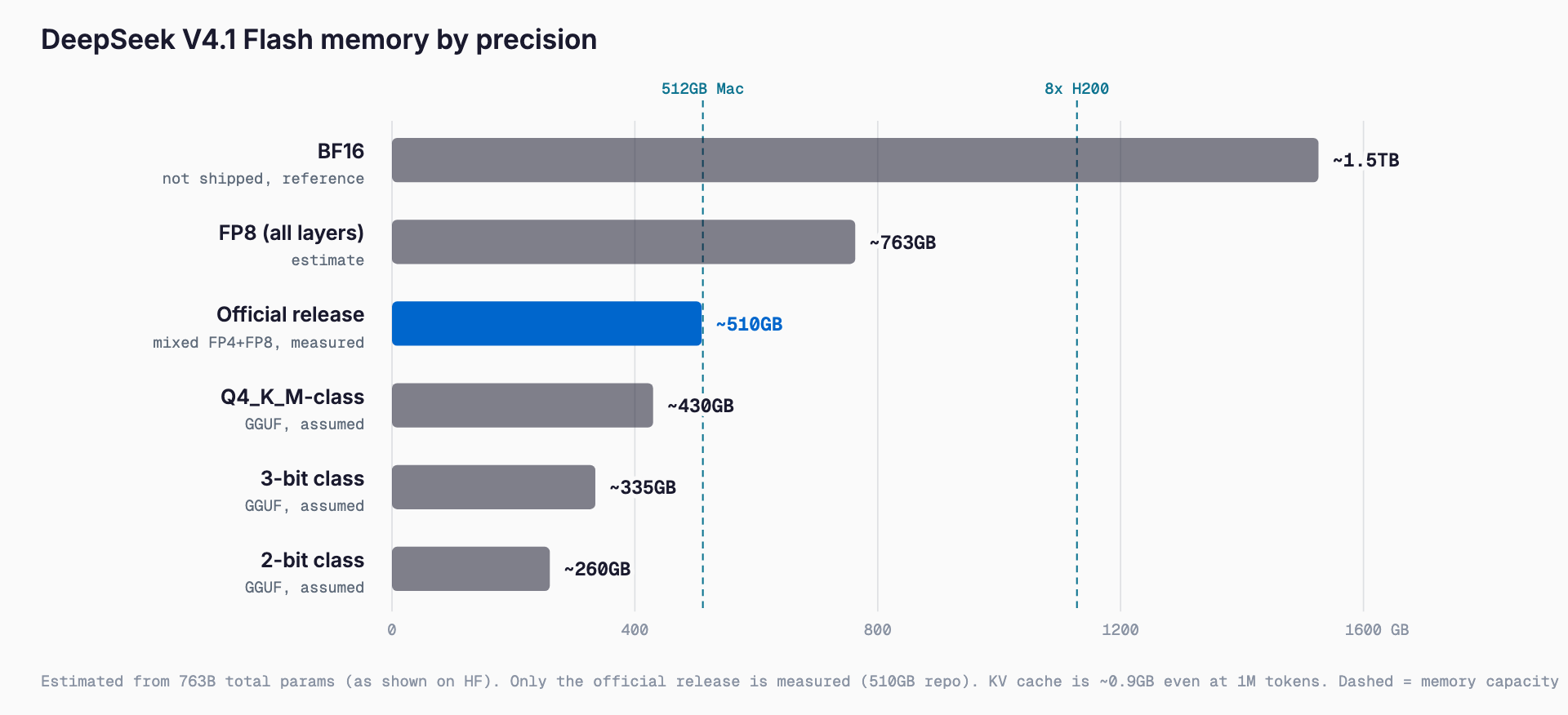
DeepSeek V4.1 Flash (1017) needs ~510GB for the official weights, ~430GB at 4-bit class: 8x H200 or a 512GB Mac. Updated Oct 2026: 763B vs 552B, memory by quant, API pricing.
Running DeepSeek V4.1 Flash (latest checkpoint V4.1-Flash-1017, released October 17, 2026) locally takes about 510GB for the official weights as shipped, or roughly 430GB after a typical 4-bit-class requantization. A single 24GB consumer GPU is nowhere near enough; you need a server such as 8x H200 or a Mac with about 512GB of unified memory. The total parameter count is 763B on Hugging Face but 552B for the backbone in the paper and model card text, so this article sizes memory from 763B and the measured 510GB repository. If local is not a must, the official API is cheap at $1.20 per million output tokens at peak, and is the practical option.
Requirements at a glance
| Precision / quantization | Weight memory | Suggested hardware (estimate) |
|---|---|---|
| BF16 (reference, not shipped) | ~1.5TB | 12+ H200s; impractical |
| FP8 (all layers, estimate) | ~763GB | 8x H200 (1,128GB), 6+ B200 |
| Official release (mixed FP4+FP8) | ~510GB (repo size) | 8x H200, 8x H100 80GB (640GB), 4x B200 (720GB) |
| Q4_K_M-class (~4.5-bit) | ~430GB | 4x H200 (564GB), 512GB-class Mac |
| 3-bit class | ~335GB | 512GB-class Mac, 4x RTX PRO 6000 (96GB) |
| 2-bit class | ~260GB | 384GB-class Mac, 4x RTX PRO 6000 |
If you want a quick check of whether your GPU or Mac can handle it, our VRAM calculator (free, no sign-up) estimates the required VRAM from the model, quantization and context length you choose. DeepSeek V4.1 Flash is available in its model list.
In the table above, only the official ~510GB comes from the Hugging Face repository; everything else is our estimate from 763B parameters using common sizes (FP8 = 1 byte, Q4_K_M-class ~4.5 bits, 3-bit ~3.5 bits, 2-bit ~2.7 bits). The model card does not give GPU configurations or memory requirements. Actual usage varies with the inference engine, quantization and concurrency. The KV cache is tiny (see below), but leave several to a few tens of GB for runtime buffers. For choosing a format, see our GGUF quantization guide (Q4, Q5, Q8).
Why the parameter count is 763B, 552B or 748B
Different sources give different totals for the same model. Here is what we could confirm.
| Figure | Source | Meaning |
|---|---|---|
| 763B | Hugging Face model page (Safetensors metadata) | Sum of all tensors in the weight files |
| 552B | Model card text and paper (arXiv 2609.19969) | Backbone (the MoE body) |
| 196B | Model card text | Engram conditional memory, counted separately |
| 748B | 552B + 196B | Total used in some press coverage |
552B plus 196B is 748B, leaving roughly 15B unexplained against Hugging Face's 763B; the model card does not explain it. The config.json lists a 32-layer vision encoder, three next-token-prediction layers and a speculative-decoding head (dspark), which may account for the gap, but that is our guess, not an official explanation. For memory planning, the 763B figure, which counts what you actually download, is the safer basis. The model card says the 196B Engram memory is accessed sparsely, but it does not say whether it can be offloaded to SSD or CPU memory in local setups.
What V4.1 Flash is — weights versus speed
V4.1 Flash is an open-weight MoE model DeepSeek announced on September 10, 2026. For the full introduction see our V4.1-Flash release explainer; here we stick to what matters for hardware.
- Active parameters: about 8B during prefill and 16B during decode. All weights must sit in memory, but per-token compute is small
- Layout: 40 layers (20-layer encoder plus 20-layer decoder). In config.json: hidden size 5,120, 64 attention heads, 1 KV head
- MoE: 1 shared expert plus 384 routed experts, 6 selected per token
- Weight precision: Safetensors types are a mix of BF16, F32, F8_E4M3 and I8. The config uses FP8 (32x32 blocks) with FP4 for the experts
- Context: up to 1,048,576 tokens (1M). The API caps output at 384K; the model card recommends max_tokens of 256K or more
- License: MIT (code and weights)
- Recommended sampling: temperature 1.0, top_p 1.0
The repository is 510GB, which divided by 763B is an average of about 5.3 bits per parameter. That is consistent with FP4 experts and FP8 for everything else, so the official release is already close to 4 to 5 bits. Requantizing to Q4_K_M-class (~430GB) only saves a bit under 20%. Cutting capacity substantially means going to 3-bit or below, at a cost in quality.
The KV cache is only ~0.9GB at 1M tokens
After weights, the KV cache is what usually hurts local setups, but V4.1 Flash is unusually small here. According to the paper, the global KV cache kept in HBM is about 890 bytes per token, roughly a quarter of the previous V4-Flash. At 1M tokens that is 890 bytes x 1,000,000, or about 0.9GB. The persistent tier on SSD or host memory is also about one eighth of V4-Flash thanks to a technique called SWA Bounded Replay. Extra memory for long context is nearly negligible, one of the few operational upsides of such a huge model. These are the paper's figures for the cache representation; real usage depends on the engine and batch size, so verify on your own setup.
What changed in the 1017 checkpoint (V4.1-Flash-1017)
V4.1-Flash-1017 is a minor update to the September 10 V4.1 Flash. Architecture, total parameters, license and API pricing are unchanged. The improvement is in post-training: the model card cites gains in reasoning, coding, agentic and visual benchmarks, plus shorter task execution time and output length (which lowers cost). It is tuned for DeepSeek Harness, Tencent CodeBuddy and WorkBuddy, and DeepSeek Harness 0.2.1-rc.1 or later is recommended. The API model name remains deepseek-flash, and the official web and app models were updated at the same time. The memory figures in this article therefore apply to both versions.
| Benchmark | 1017 | Sep 10 | Delta |
|---|---|---|---|
| HLE (no tools) | 42.6 | 36.8 | +5.8 |
| Terminal-Bench 4.0 | 42.3 | 31.2 | +11.1 |
| DeepSWE v1.1 | 77.0 | 74.2 | +2.8 |
| ProgramBench | 29.1 | 20.3 | +8.8 |
| NL2Repo-Bench | 68.2 | 65.4 | +2.8 |
| Automation-Bench v1.0.6 | 60.5 | 54.8 | +5.7 |
| Agents' Last Exam | 35.4 | 31.8 | +3.6 |
| Apex Bench v1.1 | 72.1 | 64.6 | +7.5 |
| Chartography (w/ tools) | 83.0 | 78.9 | +4.1 |
| BabyVision (w/ tools) | 92.5 | 89.6 | +2.9 |
| ZeroBench-main (w/ tools) | 51.0 | 49.0 | +2.0 |
All numbers are vendor-reported; we have not seen independent reproductions. The model card also lists rival models: on Terminal-Bench 4.0, GPT-5.6 Sol scores 39.9 and Opus 5 scores 51.8, and on DeepSWE v1.1 GPT-5.6 Sol scores 73.0 and Opus 5 scores 74.0. So it matches or beats closed models on some coding tasks, while Opus 5 (56.3) leads clearly on knowledge and reasoning such as HLE. Results vary by task, so compare on your own workload before committing.
Comparison with V4-Flash and V4-Pro
| Item | V4-Flash (284B-A13B) | V4.1-Flash (1017) | V4-Pro |
|---|---|---|---|
| Total parameters | 284B | 763B (HF) / 552B (backbone) | 1.6T |
| Active parameters | ~13B | ~8B prefill / ~16B decode | ~49B |
| Weights (4-bit class) | ~160GB | ~430GB | ~920GB |
| Context | 1M | 1M | 1M |
| KV cache | baseline | ~1/4 (890 bytes/token) | n/a |
| Multimodal | separate Vision-Exp build | image input built in | n/a |
| License | MIT | MIT | MIT |
V4-Flash fit in about 160GB at 4-bit, which put it within reach of sub-512GB Macs and multi-GPU workstations. V4.1 Flash is more than 2.5 times larger in weights, so the bar for running locally has clearly gone up. In return, image input is standard and agentic benchmarks improved a lot. For V4-Flash requirements see DeepSeek V4 requirements, for V4-Pro see V4-Pro 0813 GA, and for the vision build see V4-Flash vision support.
Recommended setups by budget
| Option | Example setup | Notes |
|---|---|---|
| Use the API | Official API (deepseek-flash) | No upfront cost; see pricing below. Most practical |
| Rent cloud GPUs | A node with 8x H200 or 8x H100 80GB | The 510GB official weights fit as-is; hourly billing suits testing |
| Own server | 4x H200 (564GB) for 4-bit class, 8x H200 for the official weights | About 130GB headroom even at 4-bit; go 8x H200 for many users |
| Mac Studio (512GB class) | 3-bit to Q4 class | Capacity is there, but runtimes are reportedly not ready (see below) |
| Workstation GPUs | 4x RTX PRO 6000 (96GB) = 384GB | Only 2 to 3-bit class, trading off quality |
| Consumer GPUs (24-32GB) | RTX 4090, 5090, etc. | Not feasible alone or in small numbers; not enough room for the weights |
All of these are estimates from weight capacity only, not tested results. Because MoE activates few parameters, it can sometimes run with weights spilled to CPU memory or SSD, but speed collapses. One extreme third-party report ran it on a 16GB M1 Mac mini by streaming weights from SSD, at about 22.8 seconds per token. That is a curiosity, not a usable speed.
How to run it — vLLM, SGLang, Transformers
These are the commands on the model card. No recommended GPU configuration is given, so adjust options such as --tensor-parallel-size to your GPU count.
# vLLM
pip install vllm
vllm serve "deepseek-ai/DeepSeek-V4.1-Flash-1017"

# SGLang
pip install sglang
python3 -m sglang.launch_server --model-path "deepseek-ai/DeepSeek-V4.1-Flash-1017" --host 0.0.0.0 --port 30000

# Docker Model Runner
docker model run hf.co/deepseek-ai/DeepSeek-V4.1-Flash-1017
- Chat template: no Jinja template is bundled; the encoding folder has a Python reference implementation (encoding.py). Rust libraries in deepseek-recipe are suggested for production
- Transformers: loads via AutoModelForCausalLM.from_pretrained(..., device_map="auto"), but at 510GB it is not practical for real serving
- llama.cpp, Ollama, LM Studio, MLX: the model card mentions quantized versions, but as of October 19, 2026 we could not confirm any usable weight files. A late-September third-party analysis said these runtimes did not yet support the encoder-decoder layout. We could not confirm community GGUF or MLX sizes, so treat our 3-bit and below figures as theoretical
If local is hard — the API as an alternative
The official API model is deepseek-flash (V4.1-Flash-1017): 1M context, up to 384K output, thinking and non-thinking modes, image input, and a concurrency limit of 2,500. Prices per million tokens are below. Peak hours are 01:00-04:00 and 06:00-10:00 UTC on weekdays (10:00-13:00 and 15:00-19:00 JST); all other times are off-peak at half price, and Chinese public holidays are off-peak all day.
| Token type | Off-peak | Peak |
|---|---|---|
| Input (cache hit) | $0.003 | $0.006 |
| Input (cache miss) | $0.15 | $0.30 |
| Output | $0.60 | $1.20 |
For example, 10M input tokens (cache miss) plus 2M output tokens costs about $5.40 at peak or $2.70 off-peak. Unless your monthly volume is very high, that is cheaper than renting an 8x H200 node. Unless you must keep data in-house or run offline, test behavior on the API first. Note that DeepSeek said API prices were cut on September 10, but its page shows no old figures, so it cannot be compared directly with the earlier V4-Flash ($0.14 cache-miss input, $0.28 output).
Common problems and troubleshooting
- Out of memory: you need runtime buffers on top of weights. If you put 510GB of weights on a 640GB node, limit concurrent requests and batch size
- Won't load on a Mac: likely a runtime support gap; enough capacity does not guarantee it will run
- Output cut off: check that max_tokens is not below the recommended 256K or more
- Slow responses: thinking mode is the default; switch to non-thinking if you do not need it
- Download never finishes: the repository is 510GB; check disk space and bandwidth first
FAQ
How much memory does DeepSeek V4.1 Flash need to run locally?
The official weights are about 510GB (Hugging Face repository size). Requantized, expect about 430GB at Q4_K_M-class, 335GB at 3-bit and 260GB at 2-bit. Everything except the official size is our estimate from 763B parameters. The KV cache is only ~0.9GB at 1M tokens, but you still need some GB of runtime headroom.
Is the total 763B, 552B or 748B?
Hugging Face shows 763B, the model card text and paper give 552B for the backbone, and adding the 196B Engram memory gives 748B. The ~15B gap to 763B is not explained officially. For memory planning, 763B, which counts all downloaded files, is the safer basis.
Can an RTX 4090 or 5090 run it?
Not alone or in small numbers. Even the smallest 2-bit class needs about 260GB of weights, far beyond a 24-32GB GPU. For local experiments, a smaller model or the official API is more realistic.
Can I run it on a Mac?
A 512GB-class unified-memory Mac has the capacity for roughly 3-bit to Q4 class, but an analysis says llama.cpp, MLX and Ollama do not yet support the encoder-decoder layout, and we could not confirm a usable quantized build. Capacity alone may not be enough.
How much does the API cost?
For deepseek-flash, per million tokens: at peak, $0.30 cache-miss input and $1.20 output; off-peak is half ($0.15 input, $0.60 output). Cache-hit input is $0.006 at peak and $0.003 off-peak.
Can I use it commercially?
Code and weights are released under the MIT license, which allows commercial use. Read the LICENSE file in the repository yourself before deploying.
Summary
DeepSeek V4.1 Flash (1017) keeps the architecture and weight size of the September 10 release and raises benchmark scores through post-training alone. Local memory needs are large: about 510GB for the official weights and about 430GB at a 4-bit class, so an 8x H200-class server or a 512GB-class Mac is the entry point, with Mac runtime support still unconfirmed. The sensible path is to test behavior on the inexpensive official API first and design a local setup only when you need one. For your own hardware, try the VRAM calculator.
Related free tools (no sign-up, instant results)
Feel free to contact us
Contact Us