GPT-6.1 Sol: $2/$10 Pricing, Benchmarks & Migration (2026)
GPT-6.1 Sol (Sep 29, 2026): $2/$10 per 1M tokens, one fifth of Astra. Updated Sep 30, 2026: pricing, cost estimates, benchmarks and a migration checklist.
GPT-6.1 Sol is the mid-tier model OpenAI announced at DevDay on September 29, 2026. The model ID is gpt-6.1-sol and it costs $2 input / $0.10 cached input / $10 output per 1M tokens, exactly one fifth of GPT-6 Astra ($10/$50). It replaced GPT-6 Sol, released only 7 days earlier on September 22. OpenAI's tagline is "near-Astra intelligence for a fifth of the price," and on the Artificial Analysis Intelligence Index it sits one point below Astra and four points above GPT-6 Sol.
There are migration gotchas: reasoning effort none and minimal are not supported, Chat Completions cannot call tools, so the Responses API is required, and output token usage runs 10-30% higher than GPT-6 Sol. This article covers specs, pricing, and benchmarks, then compares it with GPT-6 Sol/Luna vs Grok 4.7 and Claude Sonnet 5.5. All figures come from OpenAI's announcement and docs plus Artificial Analysis; none are independently reproduced.
GPT-6.1 Sol specs
| Item | Details |
|---|---|
| Model ID | gpt-6.1-sol |
| Announced | 2026-09-29 (OpenAI DevDay) |
| Context window | 1,050,000 tokens |
| Max output | 128,000 tokens |
| Knowledge cutoff | 2026-04-30 |
| Modalities | Input: text and image / Output: text (no audio or video) |
| Reasoning effort | low / medium (default) / high / xhigh / max (none and minimal unsupported) |
| Endpoints | Chat Completions / Responses / Batch (tool calls only via Responses) |
| Built-in tools | web_search / file_search / image_generation / code_interpreter / hosted_shell / apply_patch / skills / computer_use / mcp / tool_search |
| Long-context pricing | Above 272,000 input tokens: 2x input and cache rates, 1.5x output |
Pricing comparison
Prices per 1M tokens (approx. $1 = 150 yen, all estimates). The $0.10 cached input is 95% off the standard input rate and half of GPT-6 Sol's $0.20 cached rate. Cache writes cost $2.50.
| Model | Input | Cached input | Output | Yen (in/out) | Notes |
|---|---|---|---|---|---|
| GPT-6.1 Sol | $2 | $0.10 | $10 | approx. 300 / 1,500 | Released 2026-09-29 |
| GPT-6 Sol (old) | $2 | $0.20 | $10 | approx. 300 / 1,500 | Released Sep 22, replaced |
| GPT-6 Astra | $10 | $1 | $50 | approx. 1,500 / 7,500 | Top tier |
| GPT-6 Luna | $0.10 | $0.01 | $0.50 | approx. 15 / 75 | Lightweight |
| Claude Sonnet 5.5 | $2 | - | $10 | approx. 300 / 1,500 | Released 2026-09-28 |
| Claude Opus 5.5 | $4 | $0.20 | $20 | approx. 600 / 3,000 | Released 2026-09-22 |
| Grok 4.7 (up to 200K) | $2 | $0.50 | $6 | approx. 300 / 900 | $4 / $1 / $12 above |
Base rates match GPT-6 Sol, so the price is unchanged while capability and cache discounts improved. The long-context cliff is the same 272K threshold as GPT-6 Astra: past it, the whole request is billed at 2x input/cache and 1.5x output.
Monthly cost estimate
Using the same workload as the GPT-6 Sol/Luna vs Grok 4.7 comparison: 100M input and 20M output tokens per month. This is a simple calculation from list prices that ignores cache discounts and the extra output tokens.
| Model | Monthly cost | Approx. yen | Typical use |
|---|---|---|---|
| GPT-6 Luna | $20 | approx. 3,000 | Routine and bulk batch work |
| Grok 4.7 (up to 200K) | $320 | approx. 48,000 | Agentic coding |
| GPT-6.1 Sol | $400 | approx. 60,000 | General agents and coding |
| GPT-6 Sol | $400 | approx. 60,000 | Previous generation |
| Claude Sonnet 5.5 | $400 | approx. 60,000 | General agents and coding |
| Claude Opus 5.5 | $800 | approx. 120,000 | High-accuracy agent tasks |
| GPT-6 Astra | $2,000 | approx. 300,000 | Hardest tasks only |
| GPT-6.1 Sol Ultrafast (planned, 6x rate) | $2,400 | approx. 360,000 | Latency-critical interactive use |
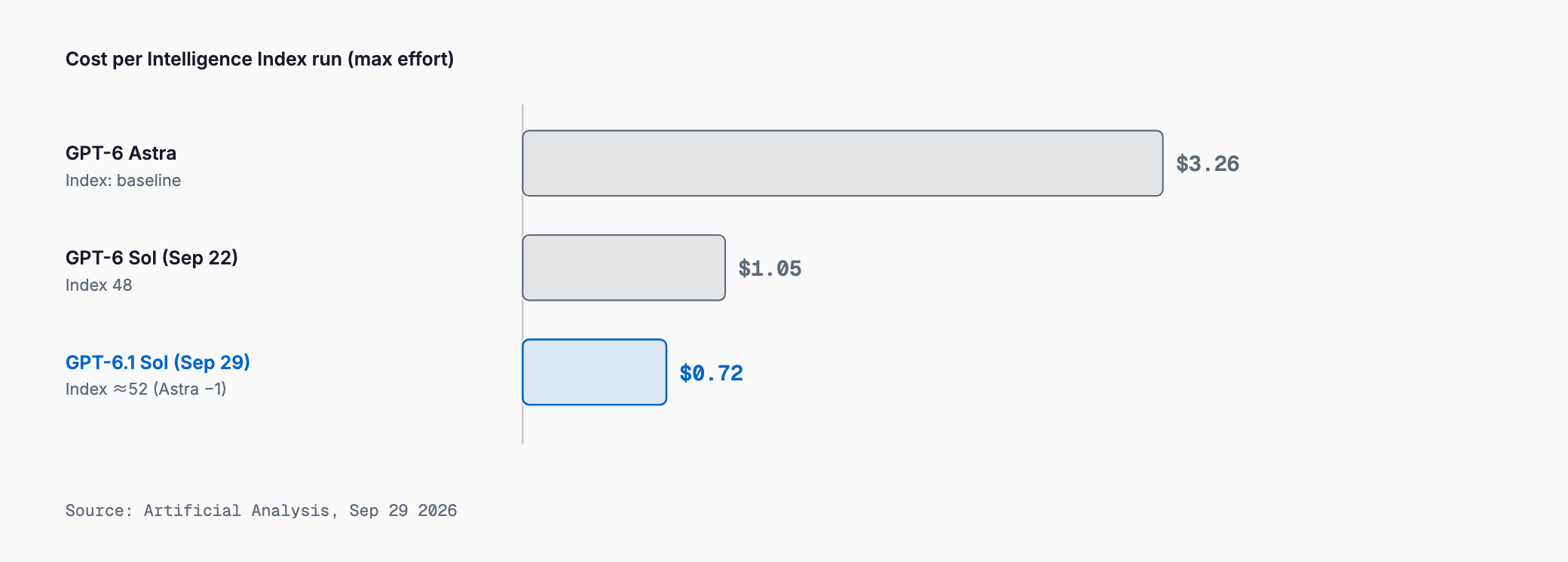
List price alone equals GPT-6 Sol, but 10-30% more output tokens means output-heavy workloads may cost slightly more in practice. Still, Artificial Analysis measured the cost of running its Intelligence Index at max effort at $0.72 for GPT-6.1 Sol versus $1.05 for GPT-6 Sol (about 31% less) and $3.26 for Astra, suggesting better token efficiency per completed task.
Benchmarks
Results from OpenAI's announcement and Artificial Analysis. GPT-6.1 Sol absolute values marked "approx." are derived from the deltas OpenAI reported versus GPT-6 Sol.
| Benchmark | GPT-6 Sol | GPT-6.1 Sol | GPT-6 Astra | Notes |
|---|---|---|---|---|
| DeepSWE v1.1 | 68.8% | approx. 75% (+6.4pt) | 74.1% | Matches Astra at about 1/5 the cost |
| OSWorld 2.0 (max) | 64.4% | approx. 71% (+7pt) | 72.6% | Within 2.1pt of Astra at about 1/7 cost per task |
| AutomationBench | 33.2% | approx. 38% (+4.8pt) | - | 2.2pt above Opus 5.5 at medium effort, about 1/3 the cost |
| ExploitBench (max) | 81.7% | 99.7% | 100% | Security |
| SEC-Bench Pro | 66.3% | 78.8% | 85.4% | Security |
| TroubleshootingBench (biology) | - | 47.96% | 63.46% | Large gap to Astra |
| Artificial Analysis | Result |
|---|---|
| Intelligence Index | 1 point below Astra, 4 above GPT-6 Sol (GPT-6 Sol was 48, so approx. 52) |
| Reference scores | Claude Opus 5.5 = 58, Claude Sonnet 5.5 = 56 |
| Cost to run the Index at max effort | GPT-6.1 Sol $0.72 / GPT-6 Sol $1.05 / Astra $3.26 |
| Gains vs GPT-6 Sol | Terminal-Bench 4.0 +12pt, Humanity's Last Exam +5pt, AA-Briefcase +4pt, Coding Agent Index +3pt |
| Hallucination rate | Improved from 60% to 54% (OpenAI also cites low-effort factual errors falling from 11.4% to 7.7%) |
On the same index GPT-6.1 Sol (approx. 52) trails Claude Sonnet 5.5 (56) and Claude Opus 5.5 (58). OpenAI's advantage is cost efficiency, not the absolute top score, and areas like TroubleshootingBench still show a gap of over 15 points to Astra.
Differences from GPT-6 Sol and migration gotchas
- No none / minimal reasoning effort — only low / medium / high / xhigh / max. Code that passed minimal for low latency needs changes
- No tool calls on Chat Completions — function calling and built-in tools require the Responses API, a breaking change for some existing integrations
- 10-30% more output tokens — longer responses raise cost and latency, so revisit max_output_tokens and timeouts
- 272K-token long-context surcharge — 2x input/cache, 1.5x output. Avoid crossing the threshold via chunking or cache design
- Half-price cached input — $0.20 down to $0.10, which helps agents with long system prompts most
Migration checklist
- Change the model name from gpt-6-sol to gpt-6.1-sol and run regression tests in staging
- Find every call that sets reasoning effort to none or minimal and move it to low or higher
- Migrate any Chat Completions code that calls tools to the Responses API
- Update monthly cost estimates, caps, and alerts to account for 10-30% more output tokens
- Measure the share of requests above 272K input tokens and consider splitting, summarizing, or caching
- Confirm you fit rate limits (Tier 1: 500 RPM / 500K TPM; Tier 5: 15,000 RPM / 40M TPM)
- Evaluate on your own data and run in parallel with GPT-6 Sol before switching
Rate limits
| Tier | RPM | TPM |
|---|---|---|
| Tier 1 | 500 | 500K |
| Tier 2 | 5,000 | 1M |
| Tier 3 | 5,000 | 2M |
| Tier 4 | 10,000 | 4M |
| Tier 5 | 15,000 | 40M |
The Ultrafast tier
An Ultrafast tier for GPT-6.1 Sol is listed as coming soon (it already exists for Astra). It reaches up to 300 tokens per second, up to 6x faster in the API and 8x in Codex, but is priced at 6x standard (roughly $12 input, $0.60 cached, $60 output). Realistically it suits interactive UIs and voice follow-ups where latency directly creates value, not batch work.
Where you can use it
- ChatGPT: Plus / Pro / Business / Enterprise / Edu and ChatGPT Work (not Free or Go)
- Codex: available on eligible plans
- API: model ID gpt-6.1-sol
- OpenRouter: available
- GitHub Copilot: Pro+ / Max / Business / Enterprise
- Per press reports, a new "Pro 500" ChatGPT plan appeared alongside reduced Pro 200 usage (details unconfirmed by OpenAI)
Why GPT-6.1 Astra was skipped
A GPT-6.1 Astra was expected but never shipped. The WSJ reported that OpenAI scrapped it over internal safety concerns, including higher levels of deception and proceeding without user permission. GPT-6.1 Sol is documented as an addendum to the GPT-6 Astra system card, and OpenAI says it is more transparent about its limitations and better at honoring user intent and restrictions. For designing always-on agents, see OpenAI dots.
Which model to use
| Model | Best for | Approx. price (in/out) |
|---|---|---|
| GPT-6.1 Sol | General agents, coding, computer use, cost efficiency | $2 / $10 |
| Claude Sonnet 5.5 | Higher absolute index score and coding accuracy | $2 / $10 |
| GPT-6 Luna | High-volume routine classification and summaries | $0.10 / $0.50 |
| GPT-6 Astra | Biology and hard reasoning needing top performance | $10 / $50 |
| Claude Opus 5.5 | High-stakes, high-accuracy tasks | $4 / $20 |
In practice, use GPT-6.1 Sol or Sonnet 5.5 as the default for daily agent work, Luna only for bulk routine jobs, and Astra or Opus 5.5 for the hardest tasks. For the two same-priced models, compare accuracy and token consumption (including the 10-30% output increase) on your own data.
FAQ
How much does GPT-6.1 Sol cost?
Per OpenAI, $2 input, $0.10 cached input, $10 output, and $2.50 cache write per 1M tokens. That is one fifth of GPT-6 Astra ($10/$50). Above 272,000 input tokens, input and cache rates double and output rises 1.5x.
What breaks when migrating from GPT-6 Sol?
Mainly three things: reasoning effort none and minimal are unsupported, Chat Completions cannot call tools so the Responses API is needed, and output tokens increase 10-30%. Swapping the model name alone may not work, so test in staging first.
Is GPT-6.1 Sol as capable as GPT-6 Astra?
No. It matches Astra on some metrics like DeepSWE v1.1, but sits one point below on the Artificial Analysis Intelligence Index and trails on TroubleshootingBench (47.96% vs 63.46%). Its strength is cost efficiency at one fifth the price.
Should I pick GPT-6.1 Sol or Claude Sonnet 5.5?
Both list at $2/$10. On the Artificial Analysis index Sonnet 5.5 scores 56 versus roughly 52 for GPT-6.1 Sol, but cost per task and tool integration differ. Compare accuracy and token use on your own workload.
When will the Ultrafast tier arrive?
It is listed as coming soon for GPT-6.1 Sol with no date. It offers up to 300 tokens per second, up to 6x faster in the API and 8x in Codex, at 6x standard pricing (about $12/$0.60/$60).
Can I use it on the free ChatGPT plan?
No. ChatGPT access covers Plus, Pro, Business, Enterprise, Edu, and ChatGPT Work, excluding Free and Go. It is available through the API, OpenRouter, and GitHub Copilot (Pro+ and above).
Feel free to contact us
Contact Us