i-have-adhd & Ponytail: 2 Trending Agent Skills (2026)
A guide to two Agent Skills for coding agents that surged on GitHub's weekly trending charts: i-have-adhd (+16,740 stars/week), which stops the agent from burying its answer and leads with the next action, and ponytail (+8,444 stars/week), which makes the agent think like the laziest senior developer in the room and avoid writing unnecessary code. Covers what's inside each SKILL.md, how to install them in Claude Code and Codex, and how they differ from grill-me, superpowers, and humanizer.
What i-have-adhd and Ponytail actually do
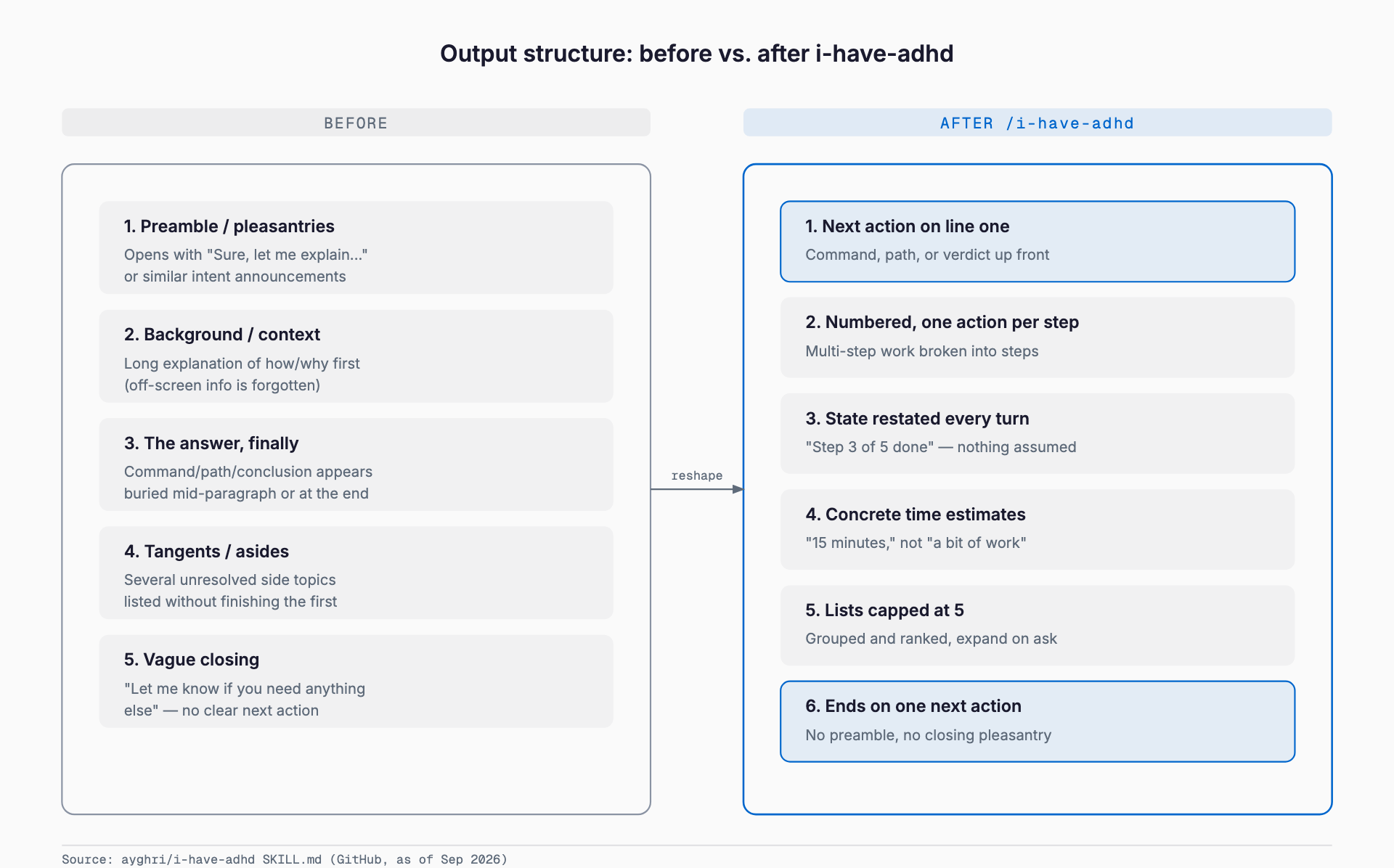
"i-have-adhd" (ayghri/i-have-adhd) and "ponytail" (DietrichGebert/ponytail) are Agent Skills you install on top of coding agents such as Claude Code, Codex, and Cursor, and as of September 2026 both have been trending heavily on GitHub's weekly charts. i-have-adhd reshapes the agent's output structure: instead of burying the answer under a preamble and background explanation, it forces the agent to lead with the next action, number multi-step work, and restate progress. Ponytail instead reshapes the agent's coding judgment: under the instruction to "think like the laziest senior developer in the room," it makes the agent first question whether a feature is even needed, prefer reusing existing patterns and standard libraries, and suppress unnecessary code additions. Neither swaps out the underlying model — both change behavior purely through instructions (a Markdown behavior-rules file the agent reads).
Why they went viral
By GitHub Trending's weekly star-gain metric, i-have-adhd added +16,740 stars and ponytail added +8,444 stars in a single week; as of September 14, 2026 their cumulative totals stand at roughly 44,300 and 137,300 respectively (measured via the GitHub API; both repos are MIT-licensed). i-have-adhd's repo was created on May 13, 2026 and ponytail's on June 12, 2026 — both reaching this scale in under six months. The backdrop is that as coding agents increasingly run long, autonomous tasks, two complaints surfaced at once: "I can't tell what I'm actually supposed to do next" and "it wrote code I never asked for." The two skills gained traction as targeted fixes for each complaint respectively.
What is i-have-adhd
i-have-adhd is an Agent Skill focused specifically on not letting the agent bury its answer. Its README and SKILL.md lay out five premises drawn from ADHD-related cognitive traits: (1) working memory is small, so anything off-screen gets forgotten; (2) there's friction between knowing what to do and actually doing it, and that friction is what kills follow-through; (3) starting requires an obvious, small first step; (4) vague time estimates ('some work') feel indistinguishable from each other; and (5) since dopamine is scarce, visible progress matters.
- Put the answer on the very first line — conclusion, command, or path up front
- Number multi-step work, with exactly one bounded action per step
- Restate current state every turn ("3 of 5 steps done")
- Give concrete time estimates ("15 minutes"), never vague ones
- Make wins visibly concrete (countering dopamine scarcity)
- State errors matter-of-factly — cause and fix, no alarm language
- Cap lists at 5 items; group the rest and expand only on request
- Cut intent-announcing preambles and "let me know if anything else" closers
What is Ponytail
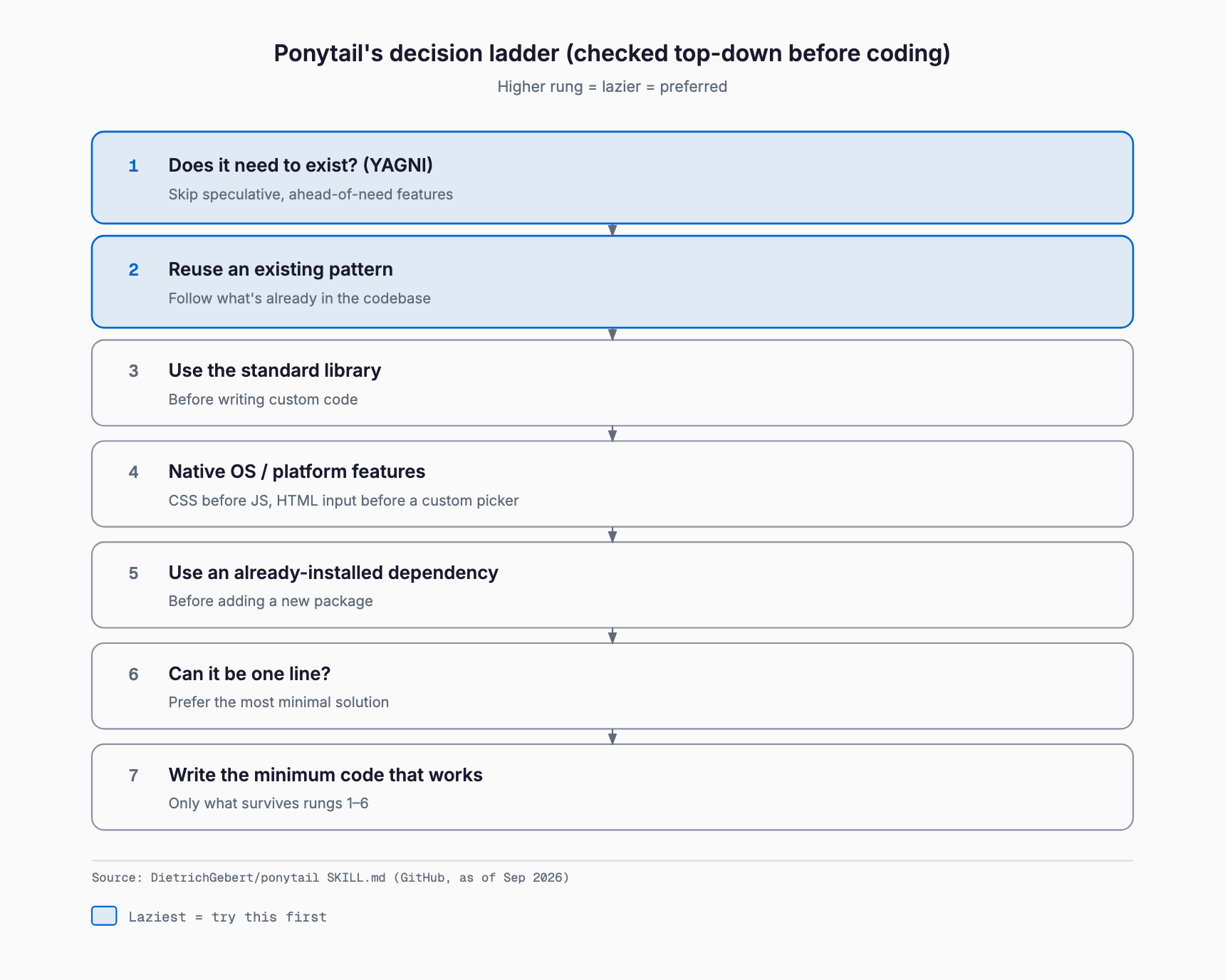
Ponytail is an Agent Skill built around making the agent "think like the laziest senior dev in the room." The repo's own tagline is: "The best code is the code you never wrote." It triggers on words like "ponytail," "be lazy," "lazy mode," "simplest solution," "YAGNI," and "do less," and applies only to coding tasks — writing, refactoring, fixing, reviewing, or designing code. Before writing anything, it works down a 7-rung decision ladder, stopping as soon as a higher rung resolves the need.
| Rung | Check | Goal |
|---|---|---|
| 1 | Does it need to exist? (YAGNI) | No speculative, ahead-of-need features |
| 2 | Can an existing pattern be reused? | Follow what's already in the codebase |
| 3 | Does the standard library cover it? | Prefer language/framework standards over custom code |
| 4 | Does a native OS/platform feature cover it? | CSS over JS, HTML input over a custom picker |
| 5 | Does an already-installed dependency cover it? | Prefer what's installed over adding a new package |
| 6 | Can it be one line? | Prefer the most minimal solution |
| 7 | Write the minimum code that works | Only what survives rungs 1–6 |
Intensity levels (lite / full / ultra) and the non-negotiables
Ponytail exposes three intensity levels. "Lite" builds what was asked but suggests a lazier alternative alongside it. The default "full" applies the decision ladder strictly and aims for the smallest diff. "Ultra" is YAGNI-extremist and questions the requirement itself. Default intensity is configurable via the PONYTAIL_DEFAULT_MODE environment variable or the defaultMode field in ~/.config/ponytail/config.json. At every intensity, though, the skill spells out non-negotiables it will never simplify: input validation, error handling, security, accessibility, explicitly requested features, and domain-specific tuning (e.g., hardware calibration). Deliberate shortcuts must be flagged with a ponytail: comment naming the ceiling it hit.
What's actually inside each SKILL.md
Both are distributed through the Agent Skills mechanism: a Markdown behavior-rules file (SKILL.md) the agent loads and activates via an explicit command (i-have-adhd: /i-have-adhd) or trigger word (ponytail: "be lazy," etc.), with no fine-tuning of the underlying model involved. i-have-adhd's SKILL.md is organized around "10 core rules" plus a pre-send checklist that instructs the agent to delete intent-announcing preambles, "anything else?" closers, hedging adverbs, and figurative language before sending a reply. Ponytail's SKILL.md, beyond the 7-rung ladder, explicitly bars unrequested abstractions (single-implementation interfaces, unnecessary config options), states that deletion beats addition, and insists on root-cause fixes over symptom patches.
Installing in Claude Code, Codex, and elsewhere
Both skills support Claude Code's plugin mechanism, Codex's plugin mechanism, and the generic npx skills CLI. Representative commands (as of Sep 2026, per each repo's INSTALL.md/README.md):
# --- i-have-adhd ---
# Claude Code
claude plugin marketplace add ayghri/i-have-adhd
claude plugin install i-have-adhd@i-have-adhd
# Activate: type /i-have-adhd in a session

# Codex
codex plugin marketplace add ayghri/i-have-adhd --ref main
codex plugin add i-have-adhd@i-have-adhd
# Activate: $i-have-adhd

# Generic (Cursor, GitHub Copilot, etc.)
npx skills add ayghri/i-have-adhd -a <your-agent>


# --- ponytail ---
# Claude Code
/plugin marketplace add DietrichGebert/ponytail
/plugin install ponytail@ponytail

# Codex
codex plugin marketplace add DietrichGebert/ponytail
codex plugin add ponytail@ponytail

# Editors without plugin support: copy the rules file instead
# e.g. .cursor/rules/, .windsurf/rules/, .clinerules/
Ponytail's README documents install steps for 20+ agents and harnesses (OpenCode, Gemini CLI, Grok Build, Devin CLI, and more), plus a rules-file fallback for editors with no plugin system. i-have-adhd has its own per-client paths too — a "create skill from URL" flow for Zed, qwen extensions install for Qwen Code, and so on. In both cases, installing the skill alone does not change behavior — it still needs the explicit command or trigger word to activate.
When to reach for each one
- i-have-adhd: long interactive pair-programming sessions where you want to skim the agent's output for just what's needed right now
- i-have-adhd: multi-step migrations or debugging sessions where you don't want to lose track of how far you've gotten
- i-have-adhd: review or investigation requests where you want the conclusion first, with detail still available to reference afterward (the checklist enforces "conclusion, then detail")
- ponytail: new feature work where the agent tends to add config options or abstraction layers beyond what was requested
- ponytail: small-to-mid-size projects where you want to avoid adding dependencies and prefer reusing standard libraries or existing code
- ponytail: as a pre-review pass to get a minimal-diff implementation before a human review (it also ships subcommands like /ponytail-review)
How they differ from other agent skills
Agent Skills for coding agents have proliferated through 2026, and we've previously covered grill-me (Matt Pocock's skill that interrogates you with questions before implementation to get full alignment) and archify (a skill that compiles a JSON intermediate representation into diagrams). i-have-adhd and ponytail target different axes — output readability versus implementation minimalism — so their role differs from both.
| Skill | What it changes | Core mechanism | Main effect | How it differs from i-have-adhd/ponytail |
|---|---|---|---|---|
| i-have-adhd | Output structure | Pre-send checklist strips preambles and buried answers | Answer lands on line one; progress stays visible | (subject of this article) |
| ponytail | Coding judgment | 7-rung decision ladder favoring YAGNI and reuse | Suppresses unnecessary implementation and abstraction | (subject of this article) |
| grill-me | Amount of pre-implementation questioning | Asks 18–24 sequential questions before coding starts | Cuts the plan → build → re-plan loop | Opposite direction from i-have-adhd — it adds dialogue rather than compressing output, to raise accuracy |
| obra/superpowers | The whole development process | Composable skills (brainstorming, TDD, git worktrees, etc.) | Auto-applies methodologies like RED-GREEN-REFACTOR | Governs *how* work proceeds, not *what* to build (ponytail) or *how output reads* (i-have-adhd) |
| blader/humanizer | Prose tone | Detects AI-writing patterns and matches a human writing sample | Reduces the "AI-sounding" quality of generated text | Targets prose generation, not code; different goal from i-have-adhd's structural changes |
| archify | Diagram generation | Compiles a JSON IR deterministically into HTML/SVG | Produces architecture diagrams that don't break | Changes an output *format* (diagrams), not text structure or coding judgment |
Caveats before adopting
Because i-have-adhd compresses output, it can be a poor fit for learning-oriented exchanges that need detailed background explanation — the checklist's instruction to strip hedging language and figurative phrasing can cost nuance you actually wanted. Ponytail's "ultra" intensity questions the requirement itself, so for work where you need the spec followed exactly, staying at "lite" or "full" — or explicitly telling it not to simplify a requested feature — is safer. Both are relatively young projects launched in May–June 2026, and the contents of their SKILL.md files are likely to keep changing.
Summary
i-have-adhd addresses "the answer is buried" through instruction-based output reshaping, while ponytail addresses "it wrote code nobody asked for" through an instruction-based decision ladder. Neither requires swapping models — installing the skill and activating it is enough — and both run across Claude Code, Codex, and a wide range of other agent platforms. They pull in the opposite direction from a skill like grill-me, which adds dialogue to raise accuracy rather than compressing output, and the two families can be combined depending on what you need.
Related Articles
- What Is Context Mode? — The MCP Server That Cuts AI Agent Tool Output by 98%
- What Is archify? — The Agent Skill That Makes Diagrams Verifiable via JSON IR
Can i-have-adhd and ponytail be installed together?
In principle yes — they target different axes (output structure vs. coding judgment) and don't directly conflict. One friction point: i-have-adhd's push for concise output could work against ponytail's rule to leave a ponytail: comment explaining a deliberate shortcut. Check the actual output when running both together and adjust as needed.
Do they work outside Claude Code?
Yes. i-have-adhd supports Codex, Cursor, GitHub Copilot, Qwen Code, Zed, and Grok, among others; ponytail supports 20+ agents and harnesses including OpenCode, Gemini CLI, and Devin CLI. Editors without plugin support can use a rules-file fallback.
Does behavior change automatically after installing?
No. Both require explicit activation after install — i-have-adhd via the /i-have-adhd command, ponytail via a trigger word or plugin invocation. Installing alone does not change behavior.
Which should I use versus grill-me?
They solve different problems. Use grill-me if you want more upfront alignment before implementation starts, i-have-adhd if you want the agent's output easier to scan, and ponytail if you want implementation itself kept to a minimum. They can also be combined.
Is there a cost to use them?
Both are open source under the MIT license and free as of September 2026. Usage costs for the underlying coding agent (Claude Code, Codex, etc.) apply separately.
Related free tools (no sign-up, instant results)
Feel free to contact us
Contact Us