K2 Horizon Requirements
VRAM, GPU and RAM for All 6 Models (0.9B–375B, 2026)
As of Sep 2026, K2 Horizon from MBZUAI's Institute of Foundation Models spans 0.9B to 375B parameters, needing anywhere from under 1GB to roughly 750GB of VRAM depending on quantization. Here is a per-model, per-quantization sizing table plus GPU and Apple Silicon build guidance.
K2 Horizon needs under 1GB for the 0.9B model and roughly 750GB for 375B-A23B at BF16
K2 Horizon is a family of six open-weight models, from 0.9B to 375B parameters, released on September 3, 2026 by the Institute of Foundation Models (IFM), part of MBZUAI. Required VRAM ranges enormously by model and quantization: the smallest 0.9B model fits in under 1GB at 4-bit quantization, while the largest 375B-A23B model needs roughly 750GB of memory at BF16 precision. Below is a per-model, per-quantization breakdown.
What is K2 Horizon
K2 Horizon comes from the Institute of Foundation Models (IFM), a research organization under MBZUAI (Mohamed bin Zayed University of Artificial Intelligence) led by Eric Xing, with sites in Abu Dhabi, Silicon Valley, and Paris. IFM frames K2 Horizon as "fully open": beyond the weights, it aims to release the training code, training data, data mixture ratios, and training logs, all under an Apache 2.0 license for both the models and the code. As of September 7, 2026, however, that complete package is confirmed only for the 3.7B and 7B models — for the 32B, MoVA-36B-A4B, and 375B-A23B models, weights are out but some intermediate checkpoints, training code, and data are described as scheduled for a later release (more on this below).
| Model | Total parameters | Active parameters | Type | Context length |
|---|---|---|---|---|
| K2-Horizon-0.9B | 0.9B | 0.9B (dense) | Dense | 128K |
| K2-Horizon-3.7B | 3.7B | 3.7B (dense) | Dense | 512K |
| K2-Horizon-7B | 7B | 7B (dense) | Dense | 512K |
| K2-Horizon-32B | 32B | 32B (dense) | Dense | 512K |
| K2-Horizon-MoVA-36B-A4B | 36B | 4B | Sparse MoE + MoVA | 512K |
| K2-Horizon-375B-A23B | 375B | 23B | Sparse MoE | 512K |
Requirements sizing table (model × quantization)
| Model | Q4_K_M (~4.5-bit, est.) | Q8_0 (8-bit, est.) | BF16 (16-bit, est.) |
|---|---|---|---|
| K2-Horizon-0.9B | ~0.5GB | ~0.9GB | ~1.8GB |
| K2-Horizon-3.7B | ~2.1GB | ~3.7GB | ~7.4GB |
| K2-Horizon-7B | ~3.9GB | ~7GB | ~14GB |
| K2-Horizon-32B | ~18GB | ~32GB | ~64GB |
| K2-Horizon-MoVA-36B-A4B | ~22.4GB (measured GGUF) | ~39.8GB (measured GGUF) | ~72GB (est.) |
| K2-Horizon-375B-A23B | ~211GB | ~375GB | ~750GB |
If you want a quick answer for your own GPU or Mac, our free VRAM calculator (no signup required) estimates required VRAM once you pick a model, quantization, and context length. K2 Horizon's models are selectable from the model list there too.
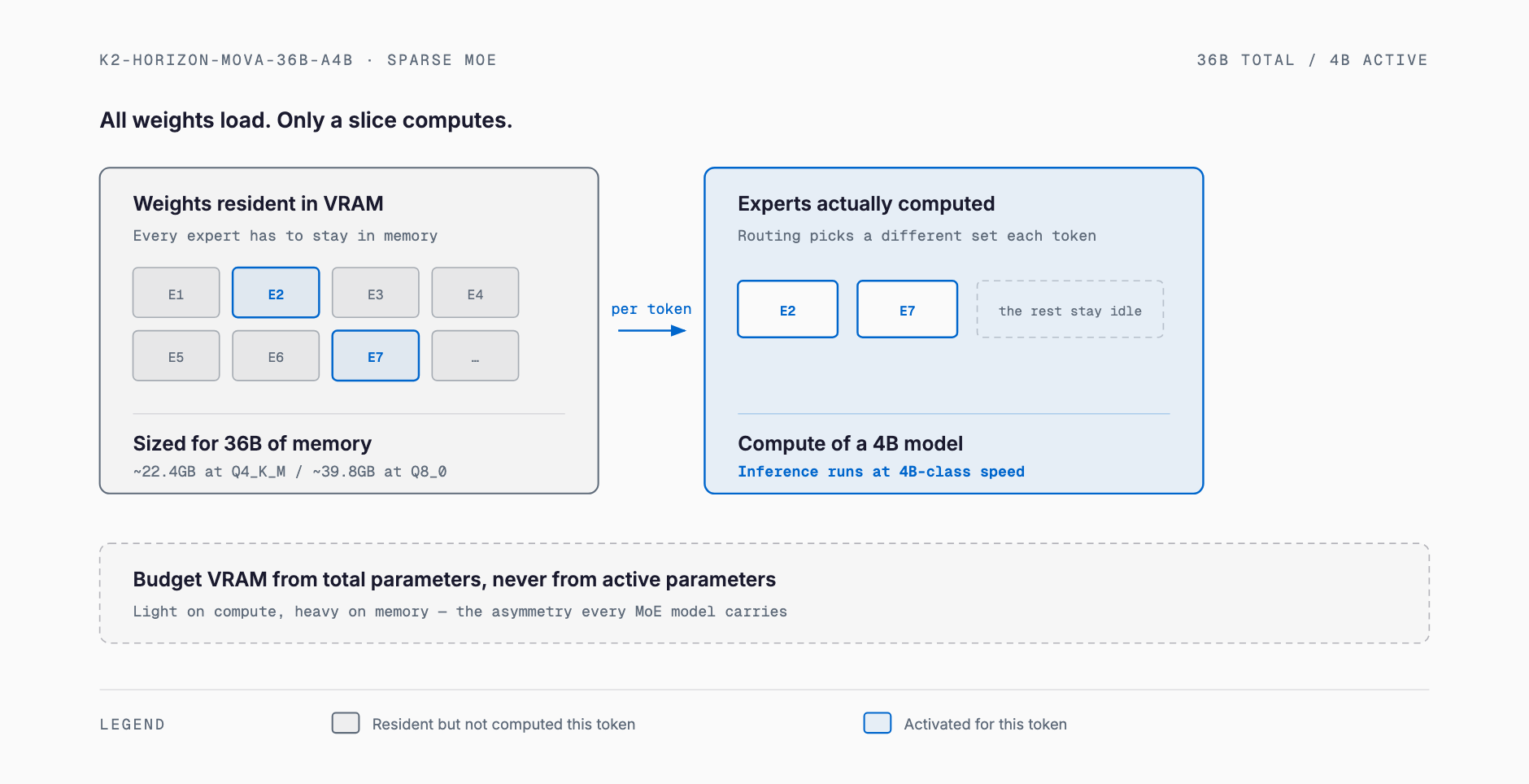
How the VRAM math works — MoE is still sized on total parameters, and what "4B active" really means
The table above is estimated as "total parameters (B) × bits per weight ÷ 8." That holds even for the MoE-based K2-Horizon-MoVA-36B-A4B and 375B-A23B: sizing is based on total parameters, not active parameters. The reason is straightforward — in an MoE model, which experts get called changes token by token, so every expert's weights have to sit resident in memory even though only a subset fires on any given token. So "4B active" describes compute cost (i.e., inference speed roughly matching a 4B model), while VRAM consumption still has to be budgeted against the 36B total. Light on compute, heavy on memory — that asymmetry is the defining trait of MoE models.
What is MoVA (Mixture-of-Values attention)
MoVA is the attention mechanism used in K2-Horizon-MoVA-36B-A4B, applying the same sparse-routing idea as MoE inside the attention block itself. Instead of a single value projection, it draws from a pool of learned value experts and activates only a subset per token. IFM says this lets the model store a richer set of representational "styles" without paying the full inference cost for all of them. IFM reports that this design lets the 36B-A4B model beat other open-weight MoE models with roughly 15x more active parameters on benchmarks such as tau3-Banking (agentic tasks) and GPQA Diamond (graduate-level science QA). As for KV cache impact, because the attention mechanism itself is different, it's not yet clear whether standard KV-cache sizing formulas apply directly, and IFM had not published detailed KV cache specifications as of September 7, 2026. For the general relationship between context length and KV cache, see our guide to KV cache and context length VRAM impact.
A note on Kimi K2
The shared "K2" name makes this confusing, but K2 Horizon and Moonshot AI's Kimi K2 series are unrelated models from different developers. K2 Horizon comes from IFM under MBZUAI; Kimi K2 comes from China's Moonshot AI. The architectures and licensing approaches also differ. This site has coverage of the Kimi K2 line as well, so when searching or comparing, it's worth double-checking whether a given result is about IFM's model or Moonshot AI's.
Measured sizes by quantization (K2-Horizon-MoVA-36B-A4B)
| Quantization | Measured size (GGUF) |
|---|---|
| Q3_K_M | ~17.7GB |
| Q4_0 | ~21.3GB |
| Q4_K_M | ~22.4GB |
| Q5_K_M | ~26.4GB |
| Q6_K | ~30.8GB |
| Q8_0 | ~39.8GB |
Because published GGUF builds exist for MoVA-36B-A4B, the figures above are measured values rather than formula-based estimates. Note that, as of September 7, 2026, loading K2-Horizon GGUF files reportedly requires the MBZUAI-IFM fork of llama.cpp (its k2-horizon branch), since support has not yet landed in upstream llama.cpp.
Running K2 Horizon on Apple Silicon and NVIDIA GPUs
- Apple Silicon (unified memory): The 0.9B–7B models run comfortably even on a 16GB M2/M3 Mac. The 32B model needs roughly an M3 Max with 64GB or more once you account for OS overhead; MoVA-36B-A4B is similar (64GB minimum, 96GB+ recommended for headroom). The 375B-A23B model needs over 200GB even at 4-bit, so it's tight even on a 192GB M2/M3 Ultra — heavier quantization or a cloud API is more realistic
- RTX 4060 / 4070 (8–12GB): Suitable for the 0.9B–7B range at Q4. 32B and above won't fit on their own
- RTX 4090 (24GB): Can just about fit the 32B model at Q4_K_M, or MoVA-36B-A4B at Q4_K_M (~22.4GB) — but a long context window can push you over via KV cache
- RTX 6000 Ada / A100 (48–80GB): Comfortable headroom for 32B and MoVA-36B-A4B even up to Q8_0. 375B-A23B still needs multiple cards
- Multi-GPU H100/H200 setups: The realistic path for running 375B-A23B in production; targeting full BF16 precision needs roughly 750GB of combined VRAM
Recommended builds by budget
- Under ~$1,000 (including used GPUs): A card like a used RTX 3060 12GB handles 0.9B–7B at Q4–Q8, good for everyday writing and summarization tasks
- Around ~$2,500: An RTX 4090 24GB build runs the 32B model or MoVA-36B-A4B at Q4, suitable for coding assistance and agentic-task experimentation
- $10,000+ (multi-GPU or a used A100): Runs 32B and MoVA-36B-A4B comfortably at higher-precision quantization, and puts 375B-A23B within reach with strong quantization and multiple cards
- Cloud API as an alternative: If you just want to try 375B-A23B at full precision, using a cloud API through a supported provider is cheaper upfront than buying hardware
Comparison with other open-weight models
| Model | Total / active parameters | Type | Details |
|---|---|---|---|
| K2-Horizon-MoVA-36B-A4B | 36B / 4B | MoE + MoVA | This article |
| Solar Open2 250B-A15B | 250B / 15B | MoE | Requirements article available |
| GLM-5.3-Flash | 320B / 18B | MoE | Requirements article available |
| Qwen3.8-Flash-Next | Not disclosed (lightweight Flash configuration) | MoE-style | Requirements article available |
| Ornith-1.5 | 35B / ~3B active | MoE | Requirements article available |
Licensing, what "fully open" means, and current limitations
K2 Horizon's models and code are both released under Apache 2.0, which is permissive enough for commercial use. IFM's "fully open" claim goes beyond weights: releasing training data, data mixture ratios, and training logs is meant to let third parties reproduce and verify results, or use the release as a foundation for their own fine-tuning and ablation research. As of September 7, 2026, though, that full package is confirmed only for the 3.7B and 7B models; for the 32B, MoVA-36B-A4B, and 375B-A23B models, weights are available but some intermediate checkpoints, training code, and data are described as scheduled for later release. Public information also indicates the 32B release is an early-stage checkpoint rather than a final version. For local runtime options, see our comparison of local inference engines and overview of the local LLM landscape.
FAQ
Which quantization of K2 Horizon fits on an RTX 4090 (24GB)?
K2-Horizon-32B fits at roughly 18GB in estimated Q4_K_M, leaving headroom on a 24GB card. K2-Horizon-MoVA-36B-A4B measures about 22.4GB at Q4_K_M in real GGUF builds, so a 24GB card leaves little room for KV cache unless the context is kept short. The 375B-A23B model cannot fit on a single 24GB card at any practical quantization and requires multiple GPUs or CPU offload.
Why does the 36B-A4B model need VRAM close to 36B if only 4B parameters are active?
In a mixture-of-experts model, which experts get called changes token by token, so every expert has to sit in memory even though only a subset fires on any given token. Compute cost (speed) tracks the 4B active count, but memory capacity has to be sized against the 36B total parameter count.
Is K2 Horizon the same as Moonshot AI's Kimi K2?
No, they are unrelated products. K2 Horizon is the model family released in September 2026 by the Institute of Foundation Models (IFM), part of MBZUAI. The developer, architecture, and licensing approach all differ from Moonshot AI's Kimi K2 series. Because the names are easy to confuse, it is worth double-checking which developer (IFM or Moonshot AI) a given result refers to.
How "fully open" is K2 Horizon in practice?
IFM states its goal as releasing weights, code, training data, data mixture ratios, and training logs. As of September 7, 2026, that full package is confirmed only for the 3.7B and 7B models. For the 32B, 36B-A4B, and 375B-A23B models, weights are out, but intermediate checkpoints and some training code and data are described as scheduled for a later release. The 32B release is also described as an early-stage checkpoint rather than a final version.
What devices can run the 0.9B model?
At Q4_K_M quantization, the 0.9B model comes in under 1GB, small enough to run on smartphones, smartwatches, or Raspberry Pi-class edge hardware. IFM itself frames it as targeting highly constrained devices such as watches and smart glasses.
How much extra VRAM does a 512K context window add?
The sizing-table figures cover the model weights only, not KV cache. Using the full 512K context can add tens of gigabytes of extra VRAM depending on model size, so for real deployments it's worth running the numbers with the VRAM calculator at a specific context length, or reading our guide to KV cache and context length VRAM impact.
Related free tools (no sign-up, instant results)
Feel free to contact us
Contact Us