What Is OpenSEO? The Open Source SEO Tool Turning Fixed Subs
criptions into Pay-As-You-Go
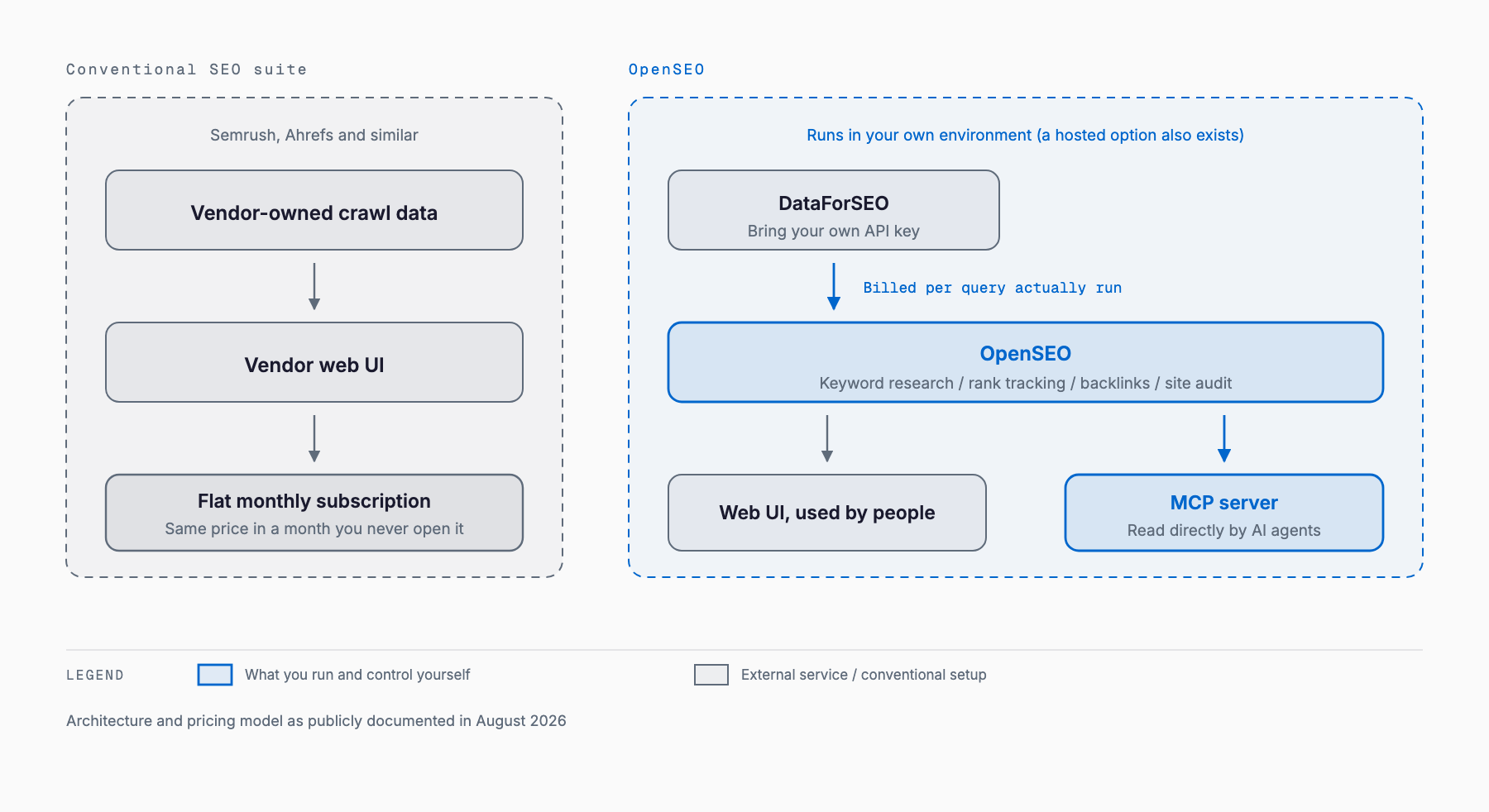
every-app/open-seo is an open source SEO tool that runs keyword research, rank tracking, backlink analysis, and site audits on the pay-as-you-go DataForSEO API. It also ships an MCP server for AI agents like Claude Code. Here's what it costs, how to self-host it, and how it compares to existing tools.
What Is OpenSEO
OpenSEO (every-app/open-seo) is an open source project that replaces paid SEO suites like Semrush and Ahrefs. Instead of a fixed monthly subscription, it uses the DataForSEO API with your own API key and charges you only for what you actually use, pay-as-you-go. It's built by a developer named Ben, publicly framed as a reaction to existing SEO tools being "too expensive and too bloated."
It was featured on Product Hunt in July 2026 as "the open source Ahrefs alternative" and hit #1 for the day. As of August 31, 2026 it's also appearing on GitHub's daily Trending page, with roughly 15,200 cumulative stars as of that date. It's released under the MIT license, so anyone can read, modify, and use it commercially.
What It Does (4 Core Features)
- Keyword research — search volume, difficulty, and related keywords
- Rank tracking — ongoing monitoring of search rankings for target keywords
- Backlink analysis — referring domains and backlink sources
- Site audit — surfacing technical SEO issues (crawling, structure, etc.)
According to the README, it also covers competitor analysis and AI visibility (how a site shows up in AI search results and citations) on top of these four. It's built to cover the core workflows of a paid SEO suite within an open source scope.
How the Pricing Works — Why It Can Be Cheaper
OpenSEO itself carries no subscription fee. The only real cost comes from the pay-as-you-go DataForSEO API calls used to fetch keyword and backlink data — you sign up for your own DataForSEO account and pay only for what you use. For a light workload, say a few hundred queries a month, this can end up far cheaper than even the cheapest Semrush or Ahrefs plan. On the flip side, a workload that monitors large numbers of keywords and URLs continuously could push the metered cost above what a fixed subscription would have cost.
If you self-host with your own DataForSEO key, there's no markup — you pay DataForSEO's actual rates. If you use the developer's hosted version instead, it costs $10/month (free trial available) plus a 28% markup on every DataForSEO request. It's positioned as an option for teams that don't want to run their own infrastructure. For general context on SEO tool costs, see our guide to SEO service pricing (Japanese).
| Tool | Approx. monthly cost as of Aug 2026 |
|---|---|
| Semrush (Pro) | $139.95/mo |
| Semrush (Guru) | $249.95/mo |
| Semrush (Business) | $499.95/mo |
| Ahrefs (Starter) | $29/mo |
| Ahrefs (Lite) | $129/mo |
| Ahrefs (Standard) | $249/mo |
| Ahrefs (Advanced) | $449/mo |
| OpenSEO (self-hosted) | No subscription — DataForSEO usage only (metered) |
| OpenSEO (hosted) | $10/mo + 28% markup on DataForSEO requests |
Installation / Self-Hosting
OpenSEO is designed to be self-hosted on your own server or cloud environment, and the official repository's docs describe three paths. The exact commands live inside each doc file, so check the linked documentation directly before you actually deploy it.
- Docker — self-hosting steps are documented in docs/SELF_HOSTING_DOCKER.md
- Cloudflare — hosting steps on Cloudflare are documented in docs/SELF_HOSTING_CLOUDFLARE.md
- Local development — steps for running it locally are documented in docs/LOCAL_DEVELOPMENT.md
Whichever path you choose, a DataForSEO API key is required to run it. You create a DataForSEO account, obtain an API key, and configure it inside OpenSEO. The README also mentions Google Search Console integration, but we couldn't verify the exact setup steps from the top-level README alone — check the relevant doc in the repository directly if you need this.
How to Use It — The Fastest Path
1. Create a DataForSEO account and generate an API key
2. Self-host OpenSEO via Docker, Cloudflare, or local development (or sign up for the hosted version at $10/month)
3. Configure the DataForSEO API key inside OpenSEO
4. Register the domain you want to audit
5. Run a Site Audit and review the list of technical SEO issues
If the root cause of your SEO issues turns out to be site structure itself, our guide to SEO-friendly website design (Japanese) can help you make sense of the audit results.
Using It as an MCP Server
One of OpenSEO's distinguishing features is that it ships its own MCP (Model Context Protocol) server. MCP is a standard protocol that lets AI agents call out to external tools and data sources. Connect OpenSEO as an MCP server, and an AI agent like Claude Code can query keyword data, ranking data, and backlink data directly inside a conversation — no more exporting a CSV from a dashboard and manually feeding it into a separate AI tool.
Setup instructions for the MCP server live at openseo.so/docs/mcp, and Agent Skills configuration for agents like Claude Code, OpenClaw, and Hermes is documented at openseo.so/docs/skills/setup. Because the exact connection setup can change as the product evolves, check these official docs directly when you actually wire it in.
Having AI agents autonomously pull and analyze SEO data ties into a broader shift: caring not just about how you rank in search engines, but how generative AI cites you in its answers. We cover that angle in our complete guide to GEO (Generative Engine Optimization) (Japanese).
How It Compares to Existing Tools
Compared with paid all-in-one suites like Semrush and Ahrefs, the lighter-weight Ubersuggest, and Google's own free Google Search Console, OpenSEO's position is that it offers suite-level functionality while being self-hostable and metered.
| OpenSEO | Semrush | Ahrefs | Ubersuggest | Google Search Console | |
|---|---|---|---|---|---|
| Pricing model | Metered (DataForSEO usage) or hosted $10/mo + 28% | Fixed monthly ($139.95+) | Fixed monthly ($29+) | Fixed monthly (budget tier) | Free |
| Data source | DataForSEO API | Proprietary crawl/database | Proprietary crawl/database | Proprietary + some external data | Real Google search data only |
| Rank tracking | Yes | Yes | Yes | Yes | No (impressions/clicks only) |
| Backlink analysis | Yes | Yes (large-scale) | Yes (industry-leading) | Basic | No |
| Self-hostable | Yes (Docker/Cloudflare) | No (SaaS only) | No (SaaS only) | No (SaaS only) | No (Google-hosted) |
| AI agent integration (MCP) | Yes | Not confirmed in README research | Not confirmed in README research | Not confirmed in README research | Not confirmed in README research |
| Japanese keyword support | Depends on DataForSEO (can't confirm from README) | Yes | Yes | Yes | Yes (own site data only) |
How well OpenSEO handles Japanese-language keywords isn't really about OpenSEO's own code — it depends on how well DataForSEO, the underlying data source, covers Japanese search data. The README alone doesn't settle this, so if you're planning serious use in a Japanese-language market, check DataForSEO's own documentation for Japanese data coverage before committing.
Who It Fits, and Who It Doesn't
- Good fit: Solo developers or small site operators tracking a small number of keywords — light enough usage that a fixed Semrush/Ahrefs subscription wouldn't pay for itself
- Good fit: Small businesses with in-house engineering that are comfortable running Docker and managing API keys
- Good fit: Teams that want SEO data built directly into an AI agent workflow like Claude Code
- Poor fit: Workloads that continuously monitor large numbers of keywords and URLs, where metered DataForSEO usage could end up costing more than a fixed subscription
- Poor fit: Non-technical teams with no one to own self-hosting or API key management, who want everything to work from a dashboard alone
The exact break-even point — how many queries a month before metered pricing stops being the cheaper option — depends on DataForSEO's actual unit pricing and how heavily your team uses it, so we can't state a single universal number here. Before adopting it, run the math on your expected query volume against DataForSEO's pricing and compare it with the cheapest Semrush/Ahrefs tier.
Things to Check Before You Adopt It
- A DataForSEO account is a hard prerequisite. OpenSEO doesn't function on its own — it always needs a DataForSEO API key
- Data quality depends on the DataForSEO API. OpenSEO is essentially a front-end and orchestration layer; the accuracy of rankings and backlinks comes down to the underlying data provider
- Self-hosting carries operational cost. Hosting via Docker or Cloudflare, managing API keys, and keeping up with updates all become work your team has to own
- Google Search Console integration details couldn't be fully verified from the README alone. If you're planning around that integration, check the relevant doc in the repository before deciding
FAQ
Is OpenSEO free to use?
OpenSEO itself has no subscription fee, but you'll pay for the DataForSEO API usage it relies on to fetch data. Self-hosting means paying DataForSEO's actual rates only; using the hosted version costs $10/month plus a 28% markup on DataForSEO requests. It isn't completely free.
Is it worth switching from Semrush or Ahrefs?
If you track relatively few keywords and aren't using enough of a paid tool to justify its fixed monthly cost, OpenSEO's metered model can be significantly cheaper. If you monitor a large volume of keywords continuously, metered usage could end up costing more than a fixed plan, so it's worth estimating DataForSEO costs against your actual usage before deciding.
What skills do I need to self-host it?
Experience with Docker or Cloudflare hosting makes setup much smoother. Exact steps are documented in docs/SELF_HOSTING_DOCKER.md and docs/SELF_HOSTING_CLOUDFLARE.md in the repository. Teams less comfortable running infrastructure can consider the hosted version starting at $10/month instead.
What is an MCP server, and what does it let me do?
MCP (Model Context Protocol) is a standard protocol that lets AI agents call out to external tools and data sources. Connecting OpenSEO as an MCP server means an AI agent like Claude Code can query keyword and ranking data directly inside a conversation, removing the manual back-and-forth of exporting from a dashboard and feeding it into a separate AI tool.
Can it be used for Japanese-language keyword research?
That depends on how well DataForSEO, the underlying data source, covers Japanese search data — something the OpenSEO README alone doesn't confirm. If you're planning serious use in a Japanese-language market, check DataForSEO's own documentation for coverage before committing.
What license is it released under? Can I use it commercially?
It's released under the MIT license, which permits free use, modification, and redistribution, including for commercial purposes.
Does it integrate with Google Search Console?
The README references a Google Search Console integration, but the exact setup steps couldn't be confirmed from the top-level README alone. If you're planning around this integration, check the relevant doc in the repository directly.
Feel free to contact us
Contact Us