Solar Open2 250B Requirements: VRAM & GPU by Quant (2026)
Solar-Open2-250B (15B active MoE): GGUF IQ4_XS ~127GB, Q2_K ~89GB, Q6_K ~191GB. Official spec is 4-8x H200, but a single 96GB GPU works too. As of Sep 2026.
Bottom line: ~127GB for IQ4_XS, ~89GB for Q2_K, ~191GB for Q6_K
Running Upstage's Solar-Open2-250B locally requires roughly 127GB in total for the GGUF IQ4_XS quantization, about 89GB for Q2_K, and about 191GB for the near-lossless Q6_K. Upstage's official recommendation is a server-class setup of at least 4x NVIDIA H200, with 8x recommended, but by choosing the right quantization the model can also run on a single 96GB-class GPU or on Apple Silicon unified memory. This article lays out realistic setups by environment based on facts confirmed as of September 2026: measured GGUF quantization sizes, the official recommended configuration, and the model's architectural characteristics.
Requirements at a glance, by quantization
| Quant | Bits/weight | Size | Perplexity | Realistic setup | Assessment |
|---|---|---|---|---|---|
| Q6_K | 6.57 | ~191GB | 4.123 | 4-8x H200, or CPU+GPU hybrid | Near-lossless baseline quality |
| IQ4_XS | 4.35 | ~127GB | 4.159 | ~92GB VRAM + ~35GB system RAM (-ncmoe 15) | Best quality-to-size ratio. Recommended |
| Q2_K | 3.05 | ~89GB | 4.774 | Single 96GB GPU, no offload, ~2.5x faster | Practical minimum quality floor |
| IQ1_M | 1.93 | ~56GB | 7.717 | 64GB unified memory, or 2x 32GB | Significant quality loss; niche use only |
To check quickly whether your own GPU or Mac can run it, our VRAM calculator (free, no sign-up) estimates the requirement from model, quantization and context length — Solar Open2 250B-A15B is in the model list.
The sizes above are the weight-file footprint only. Actual inference memory adds inference overhead on top of this — KV cache and activations that scale with context length and batch size — so real-world usage will run higher than these baseline figures, especially with long-context workloads.
Model overview: 250B total, 15B active, Hybrid-Attention MoE
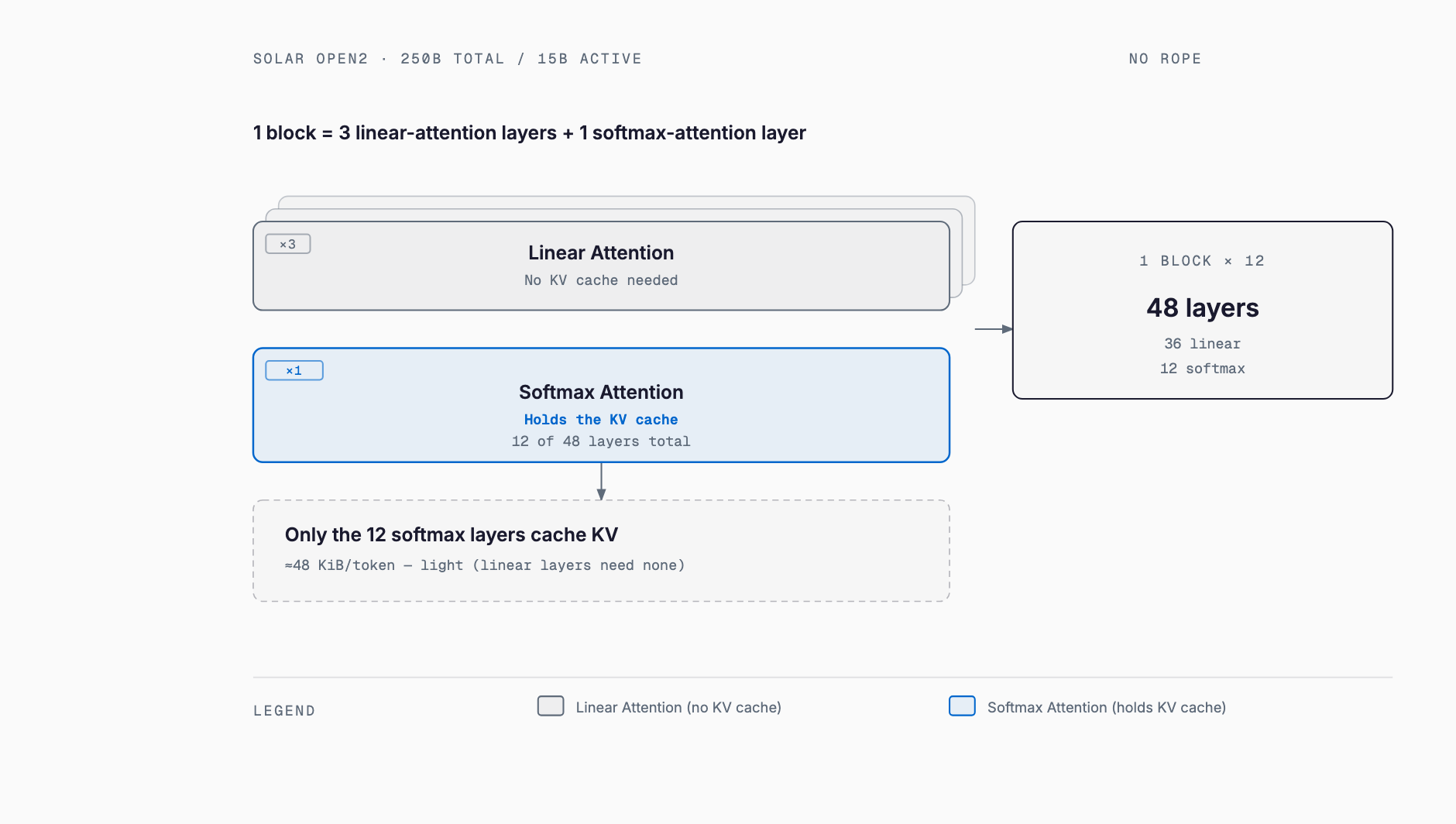
Solar-Open2-250B is an open-weight model released by South Korea's Upstage on July 22, 2026. Despite 250B total parameters, only 15B are active per token thanks to a Mixture-of-Experts (MoE) design with 320 routed experts plus 1 shared expert; at inference time, 8 routed experts and the 1 shared expert (9 total) are activated per token. The architecture is described as "Hybrid-Attention MoE": across 48 layers (12 repeated blocks), it uses a ratio of 3 linear-attention layers to 1 softmax-attention layer, and notably uses no RoPE (rotary positional encoding) at all. Training used roughly 12 trillion tokens and about 2 million NVIDIA B200 GPU-hours, with English, Korean, and Japanese as the primary languages. The model was initialized via selective weight transfer from the prior Solar Open 1 (102B) — only about 2.3% of weights that survived the architecture change were transferred, with the rest randomly initialized. Context length reaches up to 1M tokens, extended reasoning supports up to 131K tokens, and the model supports tool calling via an OpenAI-compatible API.
Why the KV cache is so light: only 12 of 48 layers cache anything
The 1M-token context length is practical largely because of how light the KV cache is under this Hybrid-Attention design. Of the 48 layers, only the 12 softmax-attention layers need to hold a KV cache; the remaining 36 linear-attention layers require none. The result is a KV cache footprint of only about 48 KiB per token. In a conventional model where every layer uses softmax attention, the KV cache balloons quickly at long context lengths and eats into VRAM; Solar-Open2-250B avoids much of that pressure, making long-context memory planning far more tractable. That said, this is a separate line item from the model weights themselves and still needs to be budgeted on top of the base sizes above.
Running it by environment
The realistic choice depends on the combination of quantization level and available hardware. A rough guide by environment:
- Apple Silicon (unified memory): IQ1_M (~56GB) may fit on a 64GB machine. IQ4_XS (~127GB) realistically needs a Mac Studio-class machine with 192GB or more
- Single 96GB GPU: Q2_K (~89GB) fits on a single card with no offload and reportedly runs about 2.5x faster than Q6_K, though perplexity degrades noticeably
- Multi-GPU: For anything from IQ4_XS up to Q6_K spread reliably across multiple cards, a multi-GPU setup is the safe bet — the official 4-8x H200 recommendation is an extension of this approach
- CPU+GPU hybrid offload: For IQ4_XS, an option like -ncmoe 15 offloads part of the MoE layers to system RAM, splitting the load roughly as ~92GB VRAM plus ~35GB system RAM
Benchmarks and positioning
| Benchmark | Solar-Open2-250B |
|---|---|
| MMLU-Pro | 86.2 |
| SWE-Bench Verified | 70.4 |
| AIME 2026 | 95.7 |
| LiveCodeBench | 92.4 |
| APEX-Agents | 16.6 (vs. DeepSeek-V4-Flash 13.4 / MiMo-V2.5 13.2) |
The model shows a lead over comparable models on agentic benchmarks like APEX-Agents, suggesting a design oriented toward coding-agent workloads. The 250B-total/15B-active split reflects the broader recent trend in open-weight MoE models: aiming for large-model-class capability while keeping per-token inference cost down.
Running it in llama.cpp: a custom build is mandatory
As of September 2026, Solar-Open2-250B's Hybrid-Attention MoE architecture is not supported by mainline llama.cpp. Running it requires a custom build with the supporting patch applied — that's the first thing to plan for.
- Use a batch size of -ub 512 or -ub 4096. Avoid -ub 2048, which causes a CUDA crash
- Use the -ncmoe option to offload MoE layers to CPU (-ncmoe 15 is a reasonable starting point for IQ4_XS)
- Across every quantization level, attention and embedding weights stay at Q6_K, a deliberate choice to preserve retrieval accuracy
- GGUF quantizations are distributed as prometheusAIR/Solar-Open2-250B-GGUF, and NotaAI also offers INT4 / NVFP4 quantized versions
Serving it with vLLM: the official recommended setup
For production serving with multiple concurrent users, Upstage's officially recommended runtime is vLLM. The recommended configuration combines tensor parallelism of 8 with expert parallelism, using the Triton backend — a setup that pairs naturally with the 8x H200 hardware recommendation. 4x H200 is the stated floor, while 8x is recommended to get adequate throughput and concurrency in real deployments. As for API access, no major API provider was confirmed to be hosting the model as of September 2026, so self-hosting is effectively the only option today.
License notes: the Solar License's derivative-naming requirement
Solar-Open2-250B ships under the "Upstage Solar License," an Apache 2.0 derivative. Commercial use is permitted, but unlike plain Apache 2.0, creating and distributing a derivative model (e.g., via fine-tuning) requires prefixing the model name with "Solar" and providing attribution to Upstage. This isn't much of a constraint for inference-only use inside your own service, but if you plan to fine-tune and publish or redistribute a derivative model, check the naming and attribution requirements ahead of time.
How it compares to other open-weight MoE models
| Model | Total params | Active | Context | Approx. memory at 4-bit | License |
|---|---|---|---|---|---|
| Solar-Open2-250B | 250B | 15B | 1M | ~127GB (IQ4_XS) | Upstage Solar License (Apache 2.0 derivative) |
| GLM-5.3-Flash | ~320B | ~18B (A18B) | Long-context, based on public info (exact limit not confirmed here) | Roughly in the 150GB range, based on public info | Based on public info (verify before relying on it) |
| DeepSeek-V4-Flash | Based on public info (not fully disclosed) | Appears to be a comparatively small active size, based on public info | Long-context, based on public info | Roughly tens of GB, based on public info | Based on public info (verify before relying on it) |
| Qwen3.8-Flash-Next | Based on public info (see linked article) | Comparatively lightweight active size, based on public info | Long-context | Comparatively small, based on public info | Based on public info (verify; often Apache-family) |
For the detailed, quantization-level requirements of the comparison models, see GLM-5.3-Flash requirements and Qwen3.8-Flash-Next requirements. Beyond raw total/active parameter counts, differences in KV cache footprint and architecture matter a great deal for real-world memory planning, so it's worth checking those alongside the numbers here. If you want to try a MoE at a smaller size, the K2 Horizon requirements guide covers six models from 0.9B up to 375B-A23B.
FAQ
How good is Solar-Open2-250B's Japanese-language performance?
The training data includes English, Korean, and Japanese, and the model is positioned as multilingual across these. However, the public benchmarks referenced here (MMLU-Pro, SWE-Bench Verified, etc.) aren't Japanese-specific evaluations, so actual Japanese-task accuracy needs to be verified in your own environment.
Can it run on a single GPU?
The Q2_K quantization (~89GB) reportedly fits on a single 96GB GPU with no offload. That said, its perplexity degradation is comparatively large, so the choice comes down to prioritizing quality versus single-GPU convenience. IQ4_XS and above won't fit on a single 96GB GPU without CPU offload or multiple GPUs.
Is the 1M-token context length actually practical?
Because only 12 of 48 layers hold a KV cache, at roughly 48 KiB per token, the memory burden of long context is much lighter than in a conventional all-softmax-attention model. That said, using context anywhere near 1M tokens still adds KV cache memory on top of the weight sizes in this article's table, so treat those sizes as a weights-only baseline.
Can it be used easily via an API?
As of September 2026, no major API provider has been confirmed to host the model. It's effectively a self-hosted-only model today, so anyone wanting simple API access should look at other options.
What's the license situation for fine-tuning and redistributing it?
Under the Upstage Solar License, creating and distributing a derivative model requires prefixing the model name with "Solar" and providing attribution to Upstage — a stricter requirement than plain Apache 2.0. Check the license text carefully before any redistribution plan.
Is IQ1_M (~56GB) usable in practice?
Its perplexity of 7.717, versus 4.123 for Q6_K, represents significant degradation, and it's officially acknowledged as a lossy option. It's best reserved for cases where memory constraints are the top priority and quality can be sacrificed — e.g., a 64GB unified-memory machine or a 2x 32GB setup.
Related free tools (no sign-up, instant results)
Feel free to contact us
Contact Us