Cloudflare security-audit-skill Explained
An Open-Source Six-Phase Vulnerability Audit Skill for Coding Agents, and How It Differs from SkillSpector, /security-review, Codex Security and Semgrep (2026)
security-audit-skill is Cloudflare's MIT-licensed skill that turns a coding agent into a six-phase vulnerability auditor. Install, output, profiles and how it compares with Semgrep and Codex Security. Updated Oct 2026.
security-audit-skill is an open-source (MIT) agent skill from Cloudflare that turns a coding agent such as Claude Code into a vulnerability auditor running six phases: recon, hunting, validation, structured output, independent verification and reporting. Separate agents hunt for bugs and try to disprove them, and the results land in a machine-readable findings.json with evidence. It is a strong first-pass screening tool for code you own, but every result still needs human review.
The repository was published on June 18, 2026 and showed roughly 47k stars on GitHub as of October 2026. Cloudflare describes it as the single-repo starting point of its internal vulnerability discovery harness. This guide draws on the GitHub README, Cloudflare's official blog post and third-party write-ups to cover installation, usage, differences from related tools and caveats. Anything the maintainers have not stated, such as guaranteed agent support, false-positive rates or run costs, is marked as not disclosed.
What security-audit-skill is
It is a skill (a SKILL.md plus supporting reference files) for coding agents. Point an agent at a repository and ask for a security audit, and it runs isolated sub-agents in sequence, keeping only vulnerability leads whose attack path has been traced. Cloudflare's blog post, Build your own vulnerability harness, says the project started as a roughly 450-line skill run on one repository and grew in about six weeks into an internal harness scanning 128 repositories. What is published is that single-repo starting point; the fleet-scale harness is not public, and while Cloudflare says it may follow, no date is disclosed.
| Item | Details |
|---|---|
| Publisher | Cloudflare (GitHub: cloudflare/security-audit-skill) |
| License | MIT |
| Released | June 2026 (blog post dated June 18, updated in July) |
| Stars | About 47k as of October 2026 per GitHub (changes over time, so re-check) |
| Type | Agent skill (SKILL.md plus hunting reference files) |
| Requirements | A coding agent whose model supports tool use and parallel sub-agents; Node.js for the validators |
| Supported agents | The README names no specific products (agent-neutral design). The Skills CLI lets you pick agents such as Claude Code or Codex, but official support guarantees are not disclosed |
| Default output | ~/security-audit-skill/<repo-name>/run-<N> |
| Price | The skill is free; model token costs follow your agent plan (estimates not disclosed) |
What it does
- 1. Recon: maps architecture, trust boundaries, input surfaces and prior evidence into architecture.md and coverage-ledger.json
- 2. Coverage-led hunting: isolated hunters work through ledger units while coverage critics flag gaps
- 3. Candidate validation: a fresh verifier tries to disprove each candidate
- 4. Structured output: writes confirmed, needs_validation and rejected records to findings.json, checked against report-schema.json
- 5. Independent verification: further fresh agents re-check the final source claims
- 6. Reporting: produces REPORT.md, FINDINGS-DETAIL.md and NEEDS-VALIDATION.md
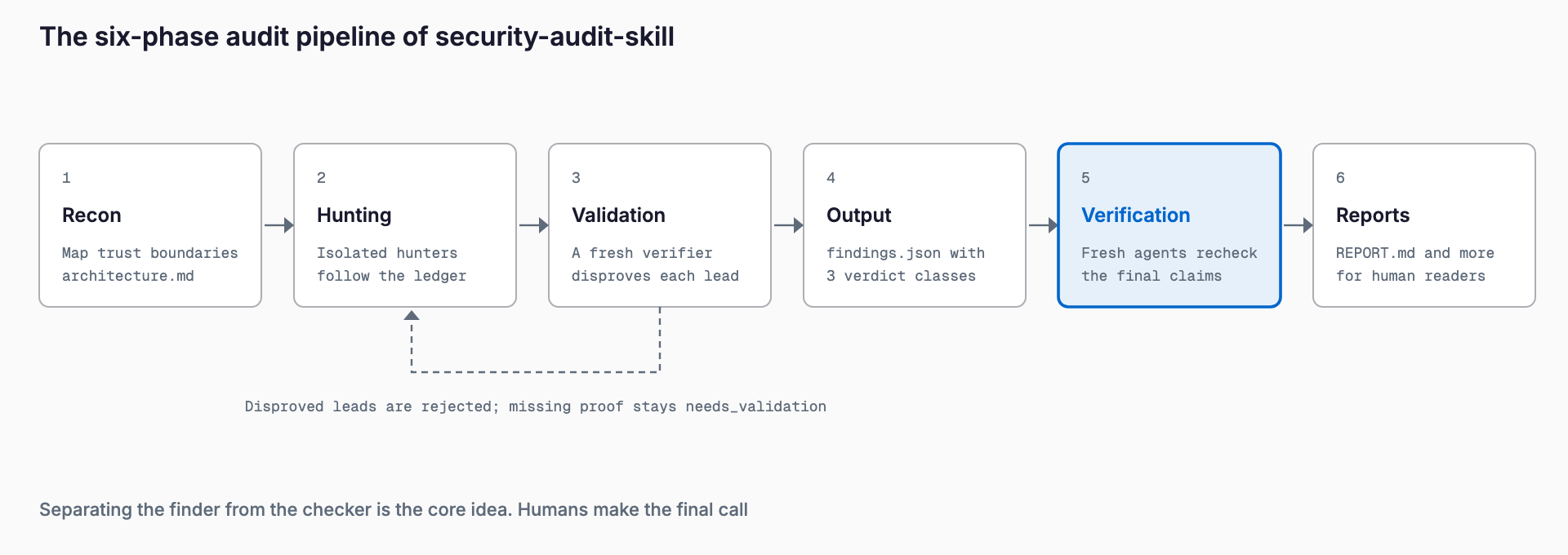
The verdicts are strict. Confirmed means a complete source trace with a bounded observed result; needs_validation means one exact fact is still unresolved, and no severity is assigned; rejected means a disproved lead. Mere defense-in-depth gaps are classed as hardening notes rather than vulnerabilities. Runs can be tuned with quick, standard and deep profiles: per a third-party guide (SmartScope), quick suits small targets and re-runs, while deep suits large or high-risk targets and adds an independent second pass. Later runs read earlier ledgers and findings to fill gaps, and the README and blog report that in Cloudflare's tests a single run found roughly half of what repeated runs found in total. The tool is designed to be run more than once.
Install and pricing
# Install into the current project
npx skills add https://github.com/cloudflare/security-audit-skill \
  --skill security-audit

# Add --global for a user-level install
npx skills add https://github.com/cloudflare/security-audit-skill \
  --skill security-audit \
  --global

# See agent selection and non-interactive options
npx skills --help
The Skills CLI (npx skills) lets you choose which agent to install for. The skill itself is free; the cost is the model usage of whichever coding agent you run it in. Because it fans out many sub-agents, large repositories can burn a lot of tokens, but no official estimate is given. Validation that involves running target code (builds, tests, fuzzers) is only allowed inside an OS-enforced sandbox with external networking disabled, an allowlisted environment, resource limits and restricted write paths. Without such a sandbox the skill does not execute target code and leaves the lead as needs_validation.
How to use it (shortest path)
- 1. Confirm authorization: audit only code you own or have explicit permission to test. Never run dynamic checks against someone else's service or project
- 2. Install the skill: run the npx skills add command above and pick your agent
- 3. Ask the agent: open the agent in the target repository and use the prompt below to start full audit mode
- 4. Pick an output location: by default reports go to ~/security-audit-skill/<repo-name>/run-<N>; the skill writes inside the repo only if you choose a directory that version control ignores
- 5. Read REPORT.md and NEEDS-VALIDATION.md: even for confirmed findings, follow the cited code yourself to confirm reproducibility
- 6. Re-run if needed: the second run reads the first run's ledger and fills gaps; in Cloudflare's tests more runs surfaced more bugs
# Example prompt to give your agent (Claude Code, etc.)
security audit this codebase
How it differs from related tools
| Tool | What it examines | How it works | Best for |
|---|---|---|---|
| security-audit-skill (Cloudflare) | Vulnerabilities across your own codebase | Agents hunt in six phases; other agents disprove and re-check; ledger supports repeated runs | First-pass screening, broad pre-release sweeps |
| NVIDIA SkillSpector | Agent skills themselves | Static analysis plus an LLM scores a skill before you install it | Vetting third-party skills (a different purpose; complementary) |
| Claude Code /security-review | Pending changes on a branch | Built-in command where the agent reviews the diff | Quick checks per pull request |
| OpenAI Codex Security | Code vulnerabilities | Detect, sandbox-validate and propose patches; CLI/SDK with CI output (SARIF) | CI or pre-commit integration, and fix suggestions |
| Semgrep | Violations of known patterns | Rule-based static analysis (deterministic, fast) | Always-on CI checks with reproducible results |
| CodeQL | Data-flow vulnerabilities | Builds a code database and queries it | Broad, continuous detection of known vulnerability classes |
A rough rule of thumb: for identical results on every CI run, use deterministic static analysis such as Semgrep or CodeQL; for a fast review of a diff, use /security-review; for validation and patches wired into CI, Codex Security fits. security-audit-skill complements them when you want agent-driven exploration to surface logic flaws and authorization gaps that span many files. Cloudflare's blog notes that Semgrep was wired into its own harness but the hunters never invoked it, which suggests the two approaches play different roles. SkillSpector targets skills rather than application code, so its purpose differs from this tool's.
Caveats and poor fits
- Do not use it on code you are not authorized to test: audit only code you control or have permission to examine. Dynamic testing of third-party systems can amount to unauthorized access
- Always review results by hand: false-positive and false-negative rates are not disclosed, and Cloudflare's blog says it claims no false-negative rate. Hunters are deliberately tuned to over-report, so filtering is expected
- It is not a replacement for a professional assessment: a formal vulnerability assessment of a production service, or one meant for auditors or customers, needs qualified specialists
- It depends on your environment: installing the skill does not guarantee a full audit, and results vary with the agent, the model and parallel sub-agent support. User reports on GitHub include issues on Windows, ZIP installs and stalled parallel sub-agents in some agents
- No dynamic validation without a sandbox: without an OS-enforced sandbox it will not run target code and stops at needs_validation
- Mind where your code goes: repository content is sent to your model provider, so check contracts and settings before using it on sensitive code
- It does not fix anything: its job is to find and report; applying fixes is up to you
For related reading, see NVIDIA SkillSpector for vetting skills before you install them, the Codex Security CLI guide for an open-source CLI that fits into CI, and first steps in security for small businesses for where to start. Costs of a formal vulnerability assessment are covered in vulnerability assessment costs.
FAQ
Is security-audit-skill free?
The skill itself is MIT-licensed open source and free. You pay for the model usage of the coding agent that runs it, which can grow on large repositories because many sub-agents run in parallel. No official token or time estimate is published.
Does it work with Claude Code?
The README names no specific products, but it is designed for any agent whose model supports tool use and parallel sub-agents, and npx skills add lets you pick agents such as Claude Code or Codex. Official support guarantees per agent are not disclosed and users have reported problems in some environments, so try it on a small repository first.
Does one run find everything?
No. According to the README, a single run in Cloudflare's tests found roughly half of what repeated runs found in total. Later runs read the earlier ledger and findings to cover what was missed, so multiple runs are expected.
Does it modify code or make network calls?
Its role is to identify and report, not to fix. Validation that runs target code happens only inside an OS-enforced sandbox with external networking disabled; otherwise the lead stays as needs_validation. Repository content is still sent to your model provider, so check your agreement before using it on confidential code.
Can I audit someone else's open-source project or a client's code?
Only with explicit permission. Running dynamic checks against third-party systems without authorization may be unlawful. If you find a problem in someone else's project, report it privately to the maintainers before disclosing it publicly (responsible disclosure).
If I already have Semgrep or /security-review, do I still need it?
They play different roles. Semgrep is deterministic and reproducible, which suits every CI run. security-audit-skill explores more broadly for cross-file logic flaws, but its output varies and contains false positives. None of them replaces a formal assessment by professionals.
Feel free to contact us
Contact Us