Hy4 Preview Requirements
VRAM 385GB to 1.5TB [Tencent's 770B MoE, 1M Context, Apache 2.0, Aug 2026]
Hy4 preview needs about 385GB VRAM at 4-bit and 1.54TB at BF16. Tencent open-weighted this 770B MoE with 1M context in Aug 2026. VRAM tables, GPUs, API cost.
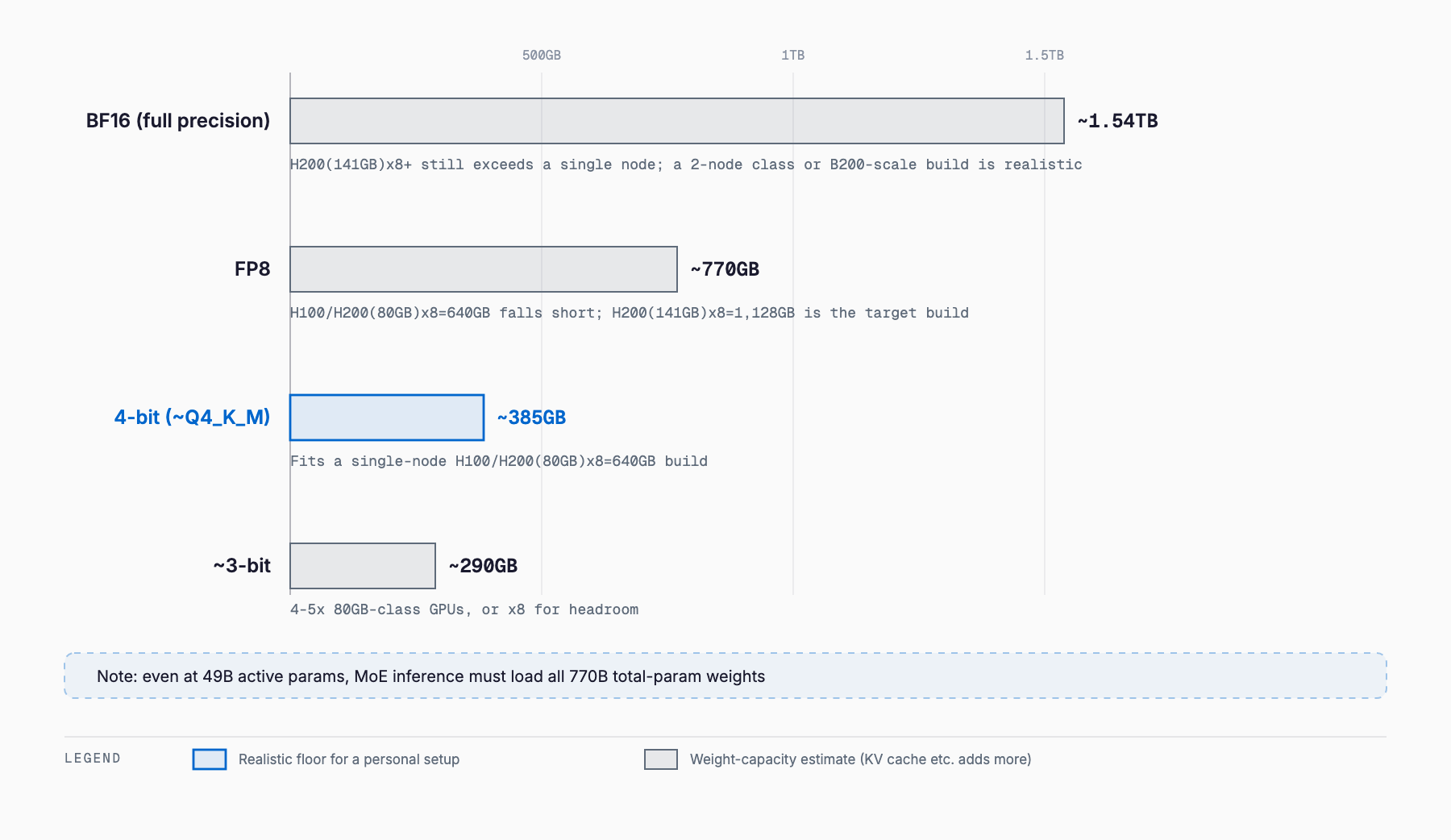
To run Hy4 preview on local GPUs, plan on roughly 385GB of inference memory (VRAM total) at 4-bit quantization, and about 1.54TB at full BF16 precision. Released by Tencent Hunyuan (the Hy Team) on August 28, 2026 under the Apache License 2.0, it is an open-weight MoE with 770B total parameters and 49B active parameters, capable of handling a context window of up to 1,048,576 tokens (roughly 1M tokens). The tables below are estimates that add inference overhead (KV cache, activations, etc.) to the raw weight size, and they vary with context length and batch size. The short answer up front: running this locally for everyday use is not realistic for an individual — the practical options are the API or a large-scale GPU cluster.
VRAM Quick-Lookup by Quantization (Estimated)
| Precision / quantization | Approx. memory (weight size) | Example GPU configuration |
|---|---|---|
| BF16 (full precision) | ~1.54TB | Exceeds a single node even at 8x H200 (141GB); realistically 2-node class or larger, e.g. B200-class |
| FP8 | ~770GB | 8x H100/H200 (80GB) = 640GB is not enough; 8x H200 (141GB) = 1,128GB is the guideline |
| 4-bit (Q4_K_M equivalent) | ~385GB | Fits within a single node of 8x H100/H200 (80GB) = 640GB |
| ~3-bit | ~290GB | 4-5x 80GB-class GPUs, or 8x for extra margin |
To check quickly whether your own GPU or Mac can run it, our VRAM calculator (free, no sign-up) estimates the requirement from model, quantization and context length — Hy4 preview 770B-A49B is in the model list.
The table above is a raw-weight-size estimate (770B x bit-width); real deployments should budget an extra 10-20% for KV cache and activations. Fully using a 1M-token-class context grows the KV cache further, so plan for more GPU headroom than the numbers suggest. Compared with the similarly large Kimi K3 (2.8T total parameters) requirements, or the also-MoE GLM-5.3-Flash requirements and DeepSeek V4 requirements, Hy4 preview's 770B class puts it well over 1TB at BF16, and running it unquantized is essentially off the table for individuals.
Model Specifications
| Item | Value |
|---|---|
| Total parameters | 770B |
| Active parameters | 49B per token |
| Layers | 78 (layer 1 is a standard dense FFN, the remaining 77 are MoE) |
| Expert configuration | Each MoE layer has 256 routed experts + 1 shared expert; top-8 routed + shared are activated per token |
| Hidden size | 6,144 |
| Vocabulary | 120,832 |
| Attention | Gated DeepSeek Sparse Attention (with IndexCache) |
| Context length | 1,048,576 tokens (max output 64,000 tokens) |
| MTP (speculative decoding) layer | 10B total parameters / 0.7B active |
| License | Apache License 2.0 (BF16 and FP8-quantized weights released) |
The MoE Misconception — VRAM Is Set by the 770B Total, Not the 49B Active
It's tempting to assume that with only 49B active parameters, a mid-sized GPU configuration would suffice — but this is a mistake. An MoE (Mixture-of-Experts) model dynamically switches which experts it calls per token, so the actual compute (FLOPs) is light, equivalent to 49B active. But because you cannot know in advance which experts will be called, inference requires holding the weights of all 770B parameters' worth of experts (256 routed + 1 shared expert across 77 MoE layers) in memory. So the required VRAM is set by the 770B total parameter count; the 49B active figure only affects compute speed and throughput. The same logic applies to other ultra-large MoE models such as Qwen3-8-Max (2.4T total parameters).
The 1M Context and Its Memory Impact — Gated DeepSeek Sparse Attention / IndexCache
Hy4 preview supports a context window of up to 1,048,576 tokens, but fully using it puts heavy pressure on inference memory through KV-cache growth. Its attention mechanism pairs Gated DeepSeek Sparse Attention with IndexCache, a design intended to avoid full pairwise attention across all tokens and hold down the compute and memory growth at long context lengths — but even so, KV-cache memory keeps growing as the context lengthens. The VRAM tables above assume short-to-moderate context lengths; if you plan to run at the 1M-token scale routinely, budget substantially more headroom (potentially hundreds of GB more).
Inference Backends (vLLM / SGLang, Official Docker Images, TP8, MTP Speculative Decoding)
The recommended deployment path is vLLM or SGLang, with official Docker images provided as vllm/vllm-openai:hy4-preview and lmsysorg/sglang:hy4-preview. An 8-way tensor-parallel (TP8) configuration is recommended, and given the 770B scale, spreading weights across multiple GPUs via TP8 is essentially a prerequisite. The model also supports speculative decoding via its MTP (Multi-Token Prediction) layer (10B total / 0.7B active parameters), which can improve decode speed when enabled on a supporting backend.
Benchmarks and Positioning
| Benchmark | Hy4 preview | Note |
|---|---|---|
| GPQA Diamond | 92.3 | Tencent-reported |
| SWE-bench Pro | 65.7 | Tencent-reported |
| SWE-bench Multilingual | 82.9 | Tencent-reported |
| vs. GLM-5.3 / Kimi K3 | Reported as ahead | Per Tencent's own disclosure and internal evaluation (not independently verified) |
Tencent reports GPQA Diamond at 92.3, SWE-bench Pro at 65.7, and SWE-bench Multilingual at 82.9, and states that internal evaluations put Hy4 preview ahead of GLM-5.3 and Kimi K3. These figures come from Tencent's own disclosure and internal evaluation, not independent third-party verification, so treat them accordingly.
API Cost vs. the Local-Deployment Break-Even Point
Via OpenRouter, where Tencent Cloud is the sole provider, API pricing is $0.834 per 1M input tokens, $2.501 per 1M output tokens, and $0.042 per 1M cached-read tokens. Weighed against the fixed cost of permanently reserving 385GB to 1.54TB of GPU memory, API use is overwhelmingly the lower-risk option for pilots or when usage volume is hard to predict. Only once requirements firm up — data that cannot leave your premises, or heavy and stable usage — does it make sense to evaluate the TCO of local deployment, and even then on a large-scale GPU cluster rather than an individual's setup.
Who Should (and Shouldn't) Use It
- Good fit: Organizations that own and operate large GPU clusters (8+ GPUs at the 80GB class in a TP8 configuration), or enterprises that need local inference because data cannot leave their premises
- Good fit: Developers and companies that want to consume Tencent Cloud's API pricing and performance directly
- Not a good fit: Individuals who want to run it routinely on a local setup — even 4-bit quantization needs about 385GB of VRAM, out of reach of consumer GPU configurations
- Not a good fit: Spinning up a dedicated GPU cluster just for a one-off evaluation or prototype — validate behavior via the API first
FAQ
Can Hy4 preview run on a personal local PC?
Not realistically. Even the lightest 4-bit quantization needs about 385GB of inference memory, beyond any typical consumer GPU configuration. It is aimed at API users or organizations with large-scale GPU clusters.
With only 49B active parameters, can a mid-sized GPU setup run it?
That's a common MoE misconception. At inference time, all 770B parameters' worth of expert weights must be held in memory, so required VRAM is set by the 770B total; the 49B active figure only affects compute speed.
Can Hy4 preview be used commercially?
Yes. It is released under the Apache License 2.0, which broadly permits commercial use, modification, and redistribution.
Can I use it right away with vLLM or SGLang?
Yes. Official Docker images vllm/vllm-openai:hy4-preview and lmsysorg/sglang:hy4-preview are provided, with an 8-way tensor-parallel (TP8) configuration recommended.
How much extra memory does the 1M-token context need?
Gated DeepSeek Sparse Attention and IndexCache help compress it, but fully using the long context can still add hundreds of GB to the KV cache, so plan for significantly more GPU headroom than the quick-lookup tables suggest.
Should I use the FP8 or BF16 version?
FP8 (about 770GB) is the practical first choice, halving memory with near-lossless quality. Full BF16 precision (about 1.54TB) is hard to fit on a single node and generally requires a 2-node-class configuration or larger.
Related free tools (no sign-up, instant results)
Feel free to contact us
Contact Us