Kimi K3.1 Pro Requirements: 2.8T MoE at ~1.4TB (Est.), API $2/$10
Weights Due Nov 4 [2026]
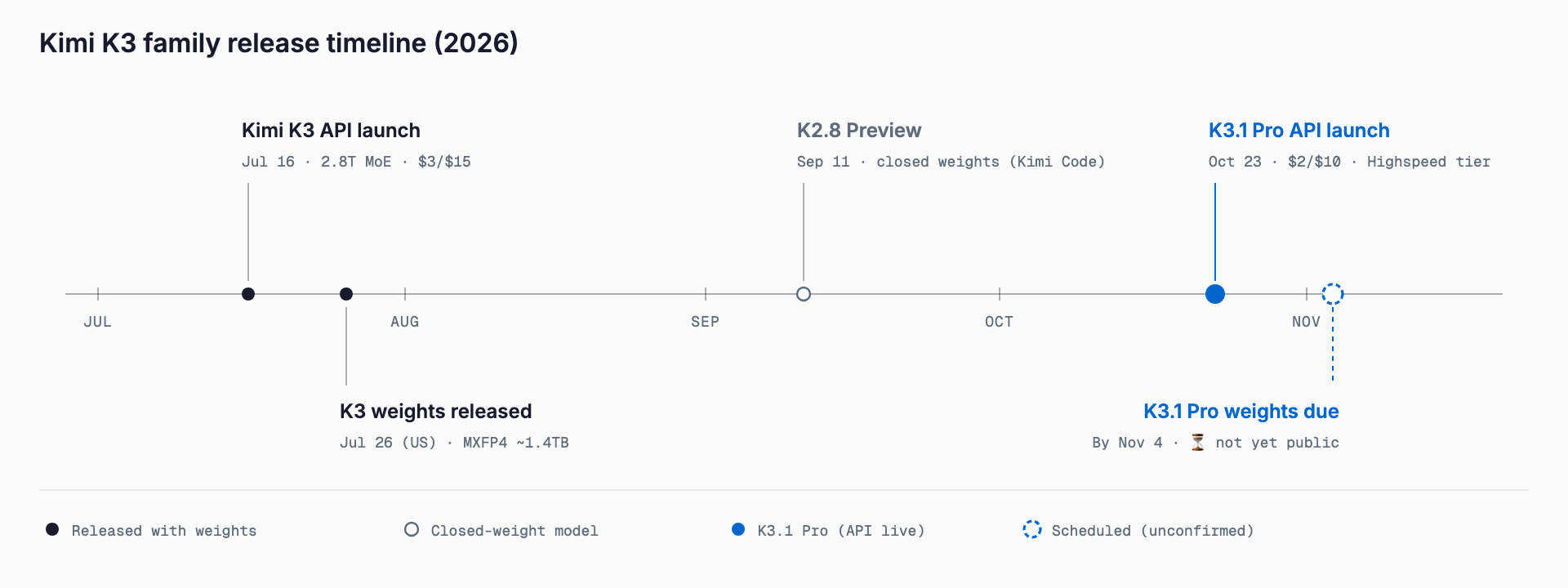
Kimi K3.1 Pro requirements: a ~2.8T MoE needs ~1.4TB at 4-bit (est.), so most teams will use the API at $2/$10 per 1M tokens, a third cheaper than K3. Updated Oct 2026.
Kimi K3.1 Pro is a roughly 2.8T-parameter Mixture-of-Experts model announced by Moonshot AI on October 23, 2026 (US time), a post-trained upgrade of Kimi K3 from July. Self-hosting it needs about 1.4TB for the weights alone even at 4-bit (estimate) ⏳ Pending weights, which means a multi-node GPU cluster, so for most people the practical route is the official API at $2 input / $10 output per 1M tokens.
Values marked ⏳ Pending weights are estimates based on K3's published figures, and we will replace them with confirmed values after the weights and model card are published (promised by November 4). Pricing and Moonshot-reported benchmarks are official figures and carry no marker. For background, see What is Kimi K3 and Kimi K3 open weights and self-hosting requirements.
Requirements at a glance
| Precision | Weight size (est.) | Typical hardware | Status |
|---|---|---|---|
| BF16 | ~5.6TB | 70+ H100 80GB (theoretical) | ⏳ Pending weights |
| 8-bit | ~2.8TB | 35+ H100 80GB (theoretical) | ⏳ Pending weights |
| 4-bit (assuming MXFP4) | ~1.4TB | For K3, 64 H100s (8 nodes, 5.12TB total) was the practical floor | ⏳ Pending weights |
| 2-bit | ~700GB | Two 512GB Macs, or roughly 12-16 H100 80GB (theoretical; quality and speed unknown) | ⏳ Pending weights |
These are theoretical values derived from the 2.8T parameter count. In practice you also need room for the KV cache, routing, buffers, and the vision encoder.
If you want to check quickly whether a model fits your GPU or Mac, our free VRAM calculator (no sign-up) estimates required VRAM from the model, quantization, and context length. Kimi K3.1 Pro is available in the model list (numbers are estimates until the weights are released).
Kimi K3.1 Pro basic specs
| Item | Value | Status |
|---|---|---|
| Announced | October 23, 2026 (US time; some outlets say October 24 JST) | Official |
| Position | First model of the K3.1 series; post-trained upgrade of K3 | Official |
| Total parameters | ~2.8T (some outlets say 3T-class) | Reported |
| Architecture | MoE, 896 experts, 16 active per token (same family as K3) | Reported |
| Active parameters | ~104B reported; K3 coverage said ~50B equivalent, so the figures disagree | ⏳ Pending weights |
| Context length | 1M tokens (1,048,576) | Official |
| Modalities | Text + image in, text out | Official |
| Attention | Kimi Delta Attention (KDA) + Attention Residuals, presumably carried over from K3 | ⏳ Pending weights |
| Weight format | K3 shipped MXFP4 weights / MXFP8 activations at ~1.4TB; whether K3.1 Pro does too is unconfirmed | ⏳ Pending weights |
| Weights release | Promised by November 4, 2026 | Official |
| License | Not announced (K3 was reported as modified-MIT style) | ⏳ Pending weights |
| API model IDs | kimi-k3.1-pro / kimi-k3.1-pro-highspeed | Official |
It is available immediately in the Kimi apps, Kimi Code, and the API. The API offers a Zero Data Retention option, and free-plan usage is limited. Highspeed requires the Pro plan or higher in Kimi Code, and so does the 1M-token context there.
What changed from K3
| Item | Kimi K3 | Kimi K3.1 Pro |
|---|---|---|
| API input (per 1M tokens) | $3 | $2 (one-third cheaper) |
| API output (per 1M tokens) | $15 | $10 |
| Kimi Code Bench 3.0 | 55.95% | 61.2% |
| Kimi Hallu Bench Hard (claim-level error, lower is better) | 23.4% | 8.3% |
| Internal cyber exploitation test (xdev-bench-hard pass@3) | 33.3% | 81.0% |
| Active parameters (reported) | ~50B equivalent | ~104B ⏳ Pending weights |
| Weights status | Released | Due by November 4 |
K3.1 Pro is described as K3 with substantially more post-training compute and additional reinforcement learning focused on coding, knowledge work, and agent tasks. Before the open release, Moonshot also removed cyberattack-related data from training to limit misuse; the test score dropped from 90.5% before removal to 81.0% for the released model. Note that the K3 repository and the K3.1 Pro checkpoint are separate artifacts, so K3 files cannot be reused.
Benchmarks
| Benchmark | Kimi K3.1 Pro | Comparison | Source |
|---|---|---|---|
| Terminal-Bench 4.0 | 65.7% | Claude Opus 5.5 66.4%, GPT-6 Astra 58.2% | Official (self-reported) |
| Terminal-Bench 4.0 (independent) | 67% | — | Artificial Analysis |
| Kimi Code Bench 3.0 (long-horizon) | 61.2% | K3 55.95% | Official (self-reported) |
| BenchCAD (with tools) | 92.7% | Within ~4 points of GPT-6 Astra and Claude Opus 5.5 | Official (self-reported) |
| OfficeQA Pro v2 | 64.4 | Moonshot says above both Astra and Opus 5.5 | Official (self-reported) |
| Kimi Hallu Bench Hard (error rate) | 8.3% | K3 23.4% (lower is better) | Official (self-reported) |
| xdev-bench-hard pass@3 (cyber) | 81.0% | 90.5% before removal, K3 33.3%, DeepSeek V4.1-Flash 85.7% (Moonshot's count) | Official (self-reported) |
| Artificial Analysis Intelligence Index | 55 (rank 4 of 215) | Reported likely to be the top open-weight model once weights ship | Artificial Analysis |
Most of these numbers are Moonshot's own measurements; independent verification so far comes mainly from Artificial Analysis. Cyber benchmarks trail Claude Opus 5.5 and GPT-6 Astra. VentureBeat also reported allegations that some influencers promoted the model without disclosing paid relationships, which is one more reason to lean on independent benchmarks and your own test data. On the Kimi API, output speed is about 57.5 tokens per second with a time to first token of about 3.07 seconds (as of October 26).
API pricing
| Model | Input | Output | Cache write | Cache hit |
|---|---|---|---|---|
| Kimi K3.1 Pro | $2 | $10 | $2 | $0.20 |
| Kimi K3.1 Pro Highspeed | $4 | $20 | $4 | $0.20 |
| Kimi K3 (previous) | $3 | $15 | $3 | $0.30 |
Per 1M tokens, Kimi official API.
K3.1 Pro is about one-third cheaper than K3. Artificial Analysis puts the blended price (7:2:1 input, cache, output) at $1.54 per 1M tokens and the cost per Intelligence Index task at $2.11. However, the model is verbose: it produced about 150M output tokens on the index versus a median of 87M, so output-heavy workloads cost more than the headline price suggests. Highspeed doubles the unit price and Moonshot claims it is 2-3x faster, so reserve it for latency-sensitive uses such as interactive coding assistants and run batch jobs on the standard model.
Why the weights come to about 1.4TB
An MoE model uses only 16 of its 896 experts per token, so compute scales with the active parameters. But which experts get picked depends on the input, so every expert must stay resident in memory. A small active count lowers compute cost, not the memory requirement. At 4 bits (0.5 bytes) per parameter, 2.8T parameters come to about 1.4TB, which is the basis of our estimate. K3 was trained with quantization-aware training for native MXFP4 weights, and its roughly 1.4TB distribution size reflects that. Whether K3.1 Pro ships in the same MXFP4 format is ⏳ Pending weights; a different format would change the real size considerably.
NVIDIA GPU configurations
| Configuration | Total memory | Feasible? | Status |
|---|---|---|---|
| RTX 5090 x1 | 32GB | Impossible | ⏳ Pending weights |
| H100 80GB x8 | 640GB | Cannot even hold the weights | ⏳ Pending weights |
| H100 80GB x16 | 1.28TB | Short for the 4-bit weights | ⏳ Pending weights |
| H100 80GB x64 (8 nodes) | 5.12TB | Practical floor for K3; comfortable for 4-bit weights plus KV cache | ⏳ Pending weights |
| H200 / B200 cluster | Varies | Fewer GPUs needed thanks to more memory each; check counts after release | ⏳ Pending weights |
For K3, Moonshot recommended an expert-parallel plus tensor-parallel "supernode" of 64 or more accelerators with InfiniBand or NVLink-class interconnect. The same is likely for K3.1 Pro, but that is ⏳ Pending weights.
Running on Apple Silicon (Mac)
Even an M3 Ultra with 512GB cannot hold the 4-bit weights of ~1.4TB (estimate) ⏳ Pending weights. Two 512GB Macs (1TB total) still fall short at 4-bit. A 2-bit build (~700GB) might fit across two Macs, but its quality and speed are unknown, so any practical verdict has to wait for post-release testing. For now, assume there is no realistic way to run Kimi K3.1 Pro locally on a Mac.
Inference engine support (vLLM, SGLang)
For K3, Moonshot contributed its KDA implementation (including prefill caching) to the vLLM community alongside the weights; check SGLang support separately. If K3.1 Pro uses the same attention, similar support is likely, but you must verify the supported versions ⏳ Pending weights. An engine without KDA support may start up yet produce wrong output. Also, because the K3 and K3.1 Pro checkpoints are separate artifacts, converted files and configs prepared for K3 cannot be reused as is. Engine support can lag right after release, so read the release notes and open issues before settling on a setup.
Choosing between self-hosting, hosted providers, and the API
| Option | Characteristics | Best for | Status |
|---|---|---|---|
| Official API | Available now; $2/$10; Zero Data Retention option | Trying it out, ordinary production use | Official |
| Official API (Highspeed) | 2-3x faster, double the price | Latency-sensitive work such as interactive dev assistance | Official |
| Third-party hosting | For K3, providers such as Together AI and Modal were available on day 0; K3.1 Pro support is unconfirmed | Using open weights without your own cluster | ⏳ Pending weights |
| Own cluster | Requires a 64-class GPU cluster with fast interconnect | When data sovereignty or full control is required | ⏳ Pending weights |
The main reason to self-host is data sovereignty, not cost. Buying and running a 64-class GPU cluster tends to cost orders of magnitude more than API usage. Unless your data cannot leave your environment, the realistic order is to validate quality and real cost on the API first, then decide whether self-hosting is justified.
Comparison with other large open-weight models of the same period
| Model | Scale | Approx. weight size | Notes |
|---|---|---|---|
| Muse Spark Open | 816B-A42B | ~700GB (NVFP4) | — |
| DeepSeek V4.1 Flash | 763B | — | Weights out, MIT |
| MiniMax M3.1 Flash | 428B-A23B | ~250GB (4-bit) | — |
| Reflection Beam | 501B | — | — |
| Kimi K3.1 Pro | ~2.8T | ~1.4TB (4-bit est.) | ⏳ Pending weights |
If your goal is to run a model locally, the shortest path is to pick one that fits your VRAM. See How to choose a GGUF quantization for guidance. As a reference point, the WASTE inference engine ran K3 on 29GB of RAM by streaming from SSD, but it is experimental and very slow, not suitable for production. Whether it works for K3.1 Pro is ⏳ Pending weights.
What to check when the weights ship (by November 4)
- Full license text (commercial use, redistribution, usage restrictions)
- Active parameter count (about 104B, or K3-like ~50B equivalent)
- Weight format and file size (MXFP4 or something else)
- vLLM and SGLang versions that support KDA
- Which providers offer day-0 hosting
- Vision encoder size and the extra memory image input needs
Troubleshooting
- OOM at load: first confirm the weights fit in total memory, with headroom for the KV cache and vision encoder; retry with a shorter context length
- Wrong output on an engine without KDA: check the engine version and upgrade to a KDA-capable release; do not reuse K3 configs or checkpoints
- Slow because of cross-node bandwidth: expert-parallel traffic becomes the bottleneck; redesign around InfiniBand or NVLink-class interconnect
- Cost overrun from verbose output: cap output length, ask for concise answers in the prompt, and measure output tokens to see real cost
- Hitting limits on the free plan: you have reached the usage cap; Highspeed and the 1M-token context need the Pro plan or higher in Kimi Code
If you are considering how to handle data when using a Chinese model's API internally, or running open-weight models on your own infrastructure, we also take inquiries through our AI consulting service.
FAQ
When can I run it locally?
The weights are promised by November 4, 2026. Even then, you need about 1.4TB (estimate) ⏳ Pending weights at 4-bit, so it will not run on an ordinary PC. A 64-class GPU cluster looks like the practical floor.
Will it run on an RTX 5090 or a Mac?
No. An RTX 5090 with 32GB cannot hold even a fraction of the weights, and a 512GB Mac (M3 Ultra) cannot hold the 4-bit weights. Two such Macs (1TB) still fall short; a 2-bit build (~700GB) might fit, but quality and speed are unknown ⏳ Pending weights.
How does it differ from K3, and should I switch?
K3.1 Pro is a post-trained upgrade of K3: Kimi Code Bench 3.0 went from 55.95% to 61.2% and the hallucination rate from 23.4% to 8.3%. Pricing also dropped from $3 to $2 input and $15 to $10 output. If you use the API, switching generally makes sense, but check the model's verbosity on your own data.
Is the API cheaper than K3, and what should I watch for in real cost?
The unit price is about one-third lower ($2 input, $10 output). However, Artificial Analysis measured about 150M output tokens on its index versus a median of 87M, so for output-heavy workloads the savings may be smaller than the price difference suggests.
What is the difference with Highspeed?
Highspeed (kimi-k3.1-pro-highspeed) is claimed by Moonshot to be 2-3x faster at double the price: $4 input and $20 output. In Kimi Code it requires the Pro plan or higher. Use it for interactive work and run batch jobs on the standard model.
Can I use it commercially?
Commercial use of the API is possible within the terms of service, but the open-weight license has not been announced ⏳ Pending weights. K3 was reported as modified-MIT style, but K3.1 Pro may differ. Read the full LICENSE when the weights are released.
Related free tools (no sign-up, instant results)
Feel free to contact us
Contact Us