Ornith 1.5 Requirements
VRAM, GPU and Quantization by Model Size (9B / 35B-A3B / 397B, MIT, August 2026)
Ornith 1.5 is an MIT open-weight LLM needing 8GB to 800GB VRAM. Compare GPU picks and quantized VRAM needs for 9B, 35B-A3B and 397B. As of August 2026.
Ornith-1.5 runs across a 8GB to 800GB VRAM range. For on-device testing, the 9B model at Q4 quantization runs from an 8GB-class GPU, while 35B-A3B at Q4 is the practical first choice for solo developers and small teams at 24-32GB-class VRAM.
Requirements Cheat Sheet
| Model | Precision | Weight size (approx.) | VRAM (short/medium context) | Target hardware |
|---|---|---|---|---|
| 9B | bf16 | ~19GB | 24GB | RTX 4090 / 5090, 2x L4 |
| 9B | Q8 | ~10.5GB | 12-16GB | RTX 4070 Ti Super 16GB |
| 9B | Q4_K_M | ~5.8GB | 8GB (12GB for headroom) | RTX 4060 Ti 8/16GB, 16GB Mac |
| 9B-Mobile | Device-optimized | — | — | iOS / Android devices |
| 35B-A3B | bf16 | ~70GB | 1x 80GB (2x 80GB or 1x H200 141GB recommended) | H100 / H200 |
| 35B-A3B | FP8 | ~35GB | 40-48GB | L40S 48GB, A6000 48GB |
| 35B-A3B | Q4_K_M | ~20GB | 24-32GB | RTX 5090 32GB, RTX 4090 24GB (short context), 32GB unified-memory Mac |
| 397B | bf16 | ~800GB | 8x H200 141GB (TP=8) | 1 node, 8 GPUs |
| 397B | FP8 | ~400GB | 8x 80GB | 8x H100 |
| 397B | INT4 / Q4 | ~200GB | 4x 80GB, or a large-unified-memory Mac Studio class machine | — |
To estimate VRAM for your own GPU, model size, and quantization scheme, plug them into the VRAM Calculator for an estimate and a list of compatible GPUs or Macs.
This table assumes a short-to-medium context, not the full 262,144-token window. If you actually use the full 262K context, the KV cache grows substantially on top of the model weights. For sustained long-context use, budget extra VRAM or combine it with KV cache quantization. Post-quantization sizes above are approximate and vary with implementation, batch size, and context length.
What Is Ornith-1.5
DeepReinforce (Hugging Face org: ornith-ai) released Ornith-1.5 on August 20, 2026; the 35B weights appeared on Hugging Face on August 19-20. It ships under the MIT license. The lineup covers a dense 9B, an MoE 35B-A3B (roughly 35B total parameters, ~3B active), and an MoE 397B, all built via continued pretraining and reinforcement learning on top of Qwen3.5 and Gemma 4. All three sizes support a 262,144-token context, extendable to roughly 1M tokens with YaRN factor 4.0. The 9B also has an Ornith-1.5-9B-Mobile variant for iOS / Android, and 35B-A3B ships with 79 quantized variants compatible with llama.cpp / Ollama / LM Studio.
The Self-Improving Loop — What's New
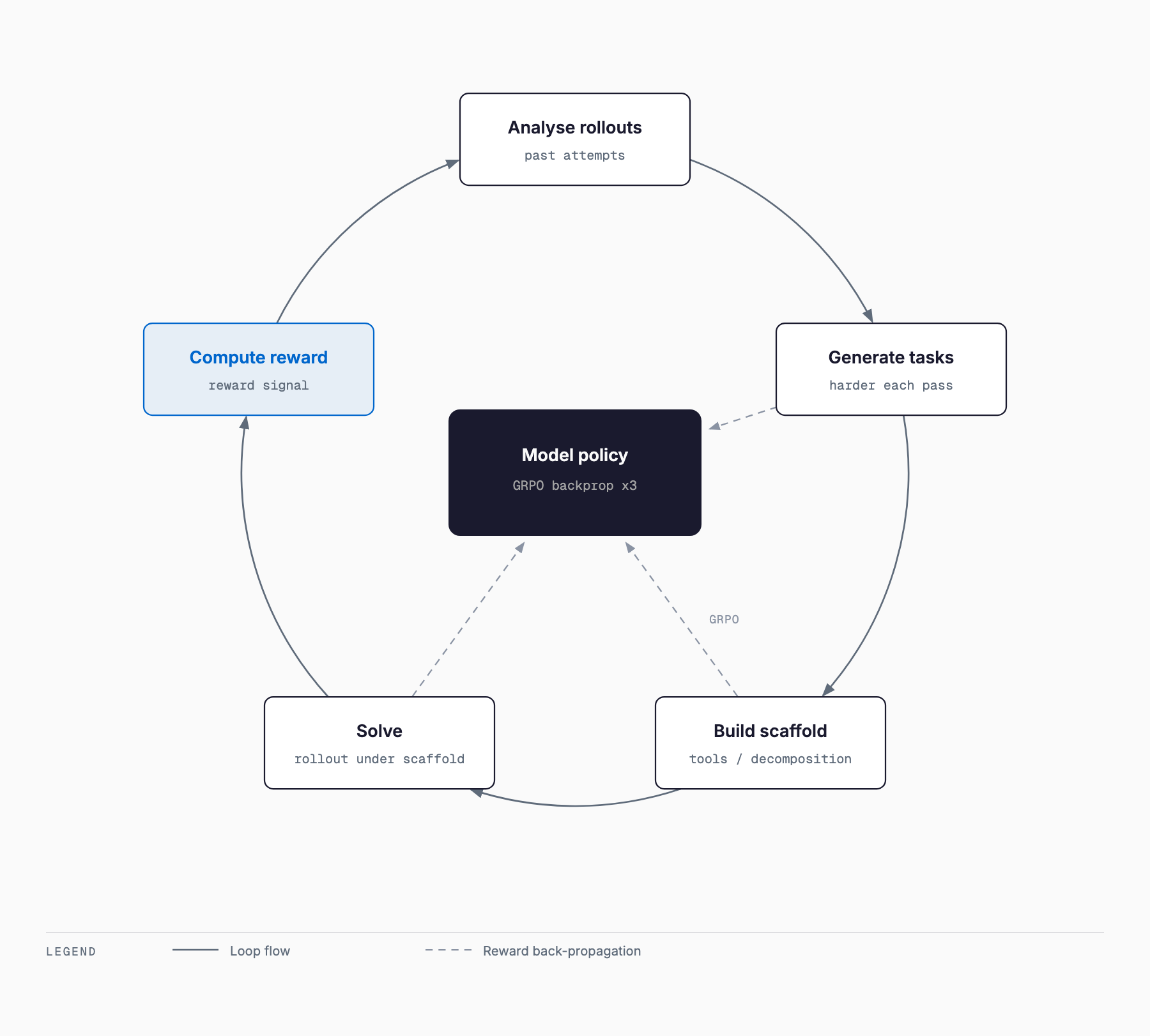
The core of Ornith-1.5 is its self-improving loop. During training, the model jointly learns to (1) analyze its own solve history and generate harder tasks for itself, (2) build a task-specific scaffold (instructions, tools, decomposition strategy) for that task, and (3) solve the task under that scaffold — with reward from the solution backpropagated through all three stages via GRPO. DeepReinforce calls this a "data flywheel."
The prior generation, Ornith-1.0, optimized scaffolding alongside solution rollouts; Ornith-1.5 extends this to task generation itself, which is the biggest architectural leap between the two generations. Because the model raises its own task difficulty as training proceeds, dependence on hand-designed curricula is reduced.
- Task generation: analyze solve history and author harder tasks
- Scaffold construction: design task-specific instructions, tools, and decomposition strategy
- Solving: solve the task under the constructed scaffold
- Reward from solving backpropagates through all three stages via GRPO
What Changed Since Ornith-1.0
The prior generation, Ornith-1.0, launched on June 26, 2026. The biggest difference at the 35B tier is disclosure: Ornith-1.0's 35B was MoE but never disclosed its active-parameter count, whereas Ornith-1.5 explicitly labels it A3B (~3B active). That makes the "large total, small active" characteristic of 35B-A3B far easier for users to reason about when planning hardware.
| Model | Ornith-1.0 SWE-bench Verified | Ornith-1.5 SWE-bench Verified |
|---|---|---|
| 9B | 69.4 | 70.6 |
| 35B | 75.6 | 79.0 |
| 397B | 82.4 | 86.0 |
Benchmarks (Self-Reported by the Developer)
| Benchmark | 9B | 35B-A3B | 397B |
|---|---|---|---|
| SWE-bench Verified | 70.6 | 79.0 | 86.0 |
| SWE-bench Pro | 47.5 | 59.6 | 65.1 |
| SWE-bench Multilingual | — | 71.4 | 79.6 |
| Terminal-Bench 2.1 (Terminus-2) | 46.2 | 67.8 | 86.1 |
| Terminal-Bench 2.1 (Claude Code harness) | 47.0 | — | 85.2 |
| GPQA Diamond | 86.4 | 89.2 | 92.8 |
| MCP-Atlas | — | 70.2 | 80.0 |
DeepReinforce claims 397B's Terminal-Bench 2.1 score of 86.1 slightly edges out Claude Opus 4.8's 85.0, noting it as "the average of 5 independent runs." They also claim 35B-A3B beats the same-size Qwen3.6-35B-A3B across every published coding/agentic benchmark, and even outpaces larger dense models like Gemma 4-31B and Muse Glimmer-30B on agentic coding. All of these are the developer's own measurements — independent third-party verification is not yet established.
Which Size to Pick
- 9B: single-GPU testing and on-device use; the easiest entry point, including the Mobile variant
- 35B-A3B: the go-to for solo developers and small teams — large total parameter count but ~3B active means Q4 quantization stays practical on 24-32GB-class GPUs or a Mac's unified memory
- 397B: datacenter-only, requiring a TP=8 node (e.g., 8x H200 141GB); not a personal-use option
Estimating Quantized VRAM Needs
Weight size is roughly "parameter count x bits per weight / 8" (bf16=16 bit, Q8=8 bit, Q4-class formats ~4-5 bit equivalent). For MoE models like 35B-A3B and 397B, remember that the weight footprint that must fit in memory is set by total parameters, while generation speed is set by active parameters — these are easy to conflate. That separation is exactly why 35B-A3B is "large yet fast."
Getting It Running (Fastest Path)
- Ollama: pull and run with a tag, e.g. ollama run hf.co/<repo>:<quant>
- llama.cpp (GGUF): download a GGUF build from the ornith-ai org on Hugging Face and launch with e.g. llama-server -m ornith-1.5-9b.Q4_K_M.gguf
- vLLM: use vLLM >= 0.19.1 (SGLang >= 0.5.9, Transformers >= 5.8.1) and serve it behind an OpenAI-compatible endpoint
# Hugging Face の GGUF を直接指定して実行する例(repo名・量子化タグは配布元の表記に合わせる)
ollama run hf.co/ornith-ai/Ornith-1.5-9B-GGUF:Q4_K_M
Inference returns chain-of-thought reasoning in a dedicated reasoning_content field, separate from the final answer, which is convenient for applications that don't want reasoning mixed into the response body. Function calling / tool use is supported, so it can be wired into agent pipelines over the OpenAI-compatible API.
How It Compares to Other Open-Weight Models
| Model | License | Total params | Active params | Context | Q4 VRAM estimate | Strength |
|---|---|---|---|---|---|---|
| Ornith-1.5-35B-A3B | MIT | ~35B | ~3B | 262K (~1M with YaRN) | 24-32GB class | Agentic coding |
| Qwen3.8-27B | Apache-2.0 | ~27B | — (dense) | 262K (up to 1M with YaRN) | ~16-18GB | General purpose, vision-language |
| GLM-5.2 | MIT | ~753B | ~40B | — | ~430GB (VRAM+RAM combined) | Large-scale reasoning, top-tier OSS |
For detailed requirements on the Qwen and GLM families, see the Qwen3.8-27B requirements cheat sheet and the GLM-5.2 requirements cheat sheet.
Caveats
- All benchmark figures in this article are self-reported by developer DeepReinforce; independent third-party verification is not yet established
- Claims of superiority over closed models, including the Claude Opus 4.8 comparison, have drawn some skepticism from the community
- Effective output quality of quantized builds (FP8/INT4/Q4, etc.) needs separate verification from the bf16 baseline
- VRAM figures assume short-to-medium context; long-context use requires additional headroom
- All figures and specs reflect publicly available information as of August 2026
Does 35B-A3B run on an RTX 4090 24GB?
Yes, with Q4_K_M quantization (roughly 20GB of weights) it fits on an RTX 4090 24GB, provided you keep the context length modest to leave headroom for the KV cache. For sustained long-context use, an RTX 5090 32GB or more VRAM, or 32GB+ of Mac unified memory, is recommended.
Can I use Ornith-1.5 commercially under the MIT license?
Ornith-1.5 is released under the MIT license, which in principle does not impose the user-count caps or derivative-relicensing restrictions seen in many other open-weight models. Before commercial deployment, always check the current license text posted at the distribution source on Hugging Face (org: ornith-ai).
What's the difference between 9B and the Mobile variant?
They share the same base architecture, but Ornith-1.5-9B-Mobile is optimized specifically for running on iOS / Android devices, with a distribution format and target runtime different from the standard 9B (bf16 / GGUF quantized) used on GPU servers or PCs.
Can I actually use the full 262K context?
Architecturally, yes — all sizes support 262,144 tokens, extendable to roughly 1M with YaRN factor 4.0. In practice, using the full context grows the KV cache substantially on top of the model weights, so the GPUs in this article's VRAM table assume short-to-medium context. Sustained long-context use requires extra VRAM headroom or KV cache quantization.
What's the fastest way to get it running with Ollama?
Install Ollama, then run a command like ollama run hf.co/<repo>:<quant> to pull and launch the model in one step. For the larger 35B-A3B or 397B sizes, check the VRAM cheat sheet first and pick a quantized tag that matches your available VRAM.
Related free tools (no sign-up, instant results)
Feel free to contact us
Contact Us