Qwen3.8-Flash-Next Requirements
VRAM 75GB to 354GB by Quantization [125B MoE, Runs on a Single RTX 4090, Aug 2026]
Qwen3.8-Flash-Next needs roughly 75GB (1-bit) to 354GB (BF16) of memory depending on quantization. This 125B-total/6B-active open-weight MoE has been run on a single 24GB RTX 4090 via MoE expert offloading, while the official vLLM/SGLang FP8 recipe needs ~250GB across multiple datacenter GPUs. VRAM and GPU tables inside. Updated August 2026.
Qwen3.8-Flash-Next needs roughly 75GB to 354GB of memory depending on quantization, and has run on a single consumer GPU
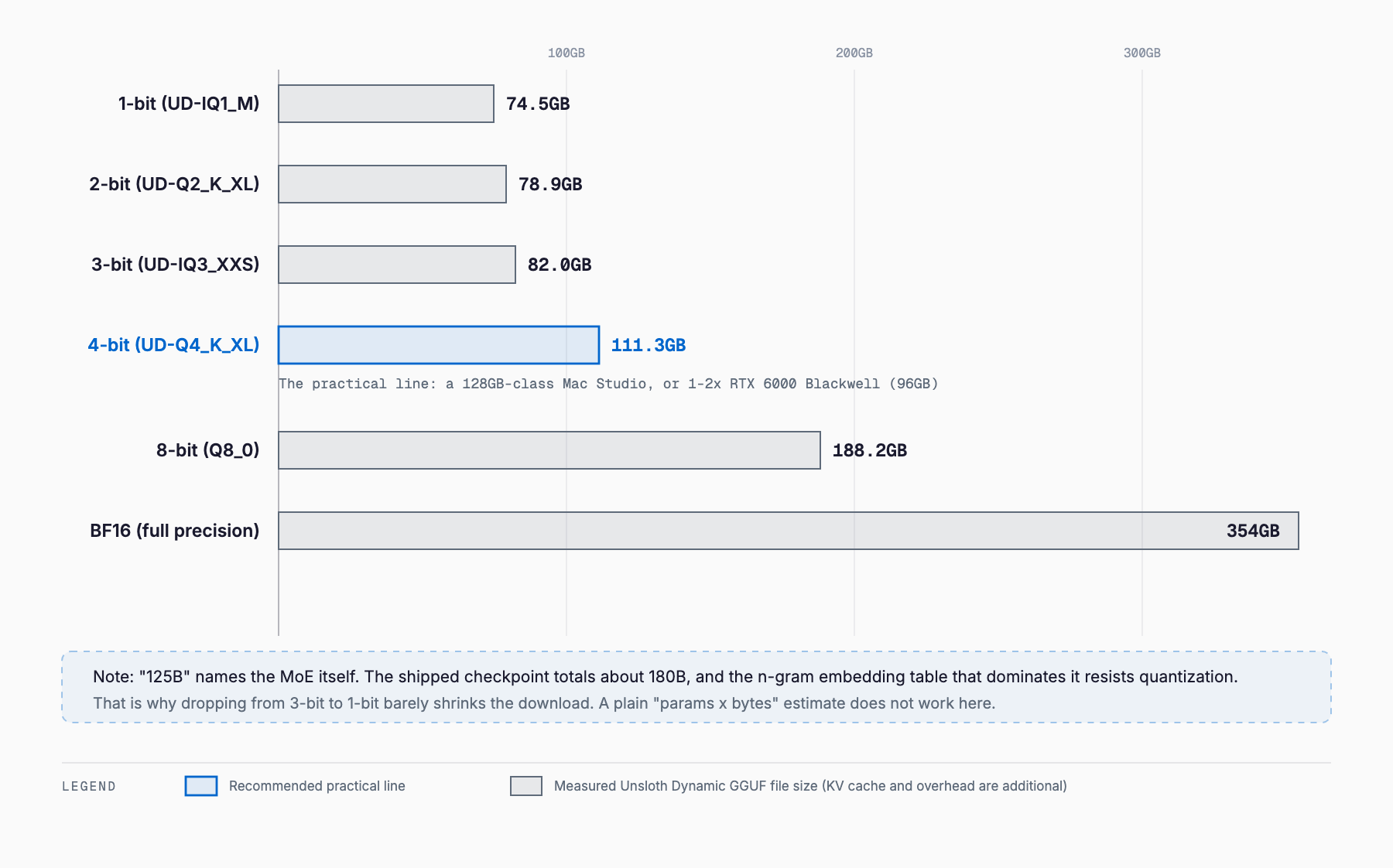
To run Qwen3.8-Flash-Next locally, the memory footprint runs from about 75GB at 1-bit quantization to about 111GB at 4-bit, up to roughly 354GB at full BF16 precision. Alibaba's Qwen team released this open-weight MoE on August 26, 2026 — 125B total parameters with about 6B active per token, positioned as a preview of the Qwen4 architecture — with a native 262,144-token context extendable to 1,048,576 tokens via YaRN, plus multimodal input. The most striking finding: using MoE expert offloading (as implemented in llama.cpp-family tooling), the model has actually been run on a single 24GB-class consumer GPU (RTX 4090). At the same time, Alibaba's official vLLM/SGLang production serving recipe (FP8) budgets roughly 250GB of aggregate GPU memory and is not officially supported on a single H100 — or even a single H200 — making this a model with an unusually wide gap between quantized local use and the official production configuration.
Recommended specs by environment
| Environment | Configuration | Realism |
|---|---|---|
| Consumer GPU + CPU offload (llama.cpp-family) | RTX 4090/5090 (24-32GB) + 96GB+ system RAM | Reported working with 4-bit quantization + MoE expert offloading (slower, roughly 21-30 t/s) |
| Apple Silicon Mac | Mac Studio 96GB-192GB (Unified Memory) | 96GB is enough for 1-3 bit; 128GB+ recommended for 4-bit |
| Workstation GPU (self-hosted, quantized) | RTX 6000 Blackwell (96GB) x1-2 | 4-bit quantization fits on a single card; two cards leave more headroom |
| Datacenter GPU (official vLLM/SGLang, FP8) | H200 (141GB) x2+, GB300 x4 recommended | Official recipe needs ~250GB aggregate; a single H100/H200 is unsupported |
To check quickly whether your own GPU or Mac can run it, our VRAM calculator (free, no sign-up) estimates the requirement from model, quantization and context length — Qwen3.8-Flash-Next 125B-A6B is in the model list.
VRAM/memory by quantization level
| Quantization | File size (measured, Unsloth Dynamic GGUF) | Quality retained | Recommended system memory (with margin) |
|---|---|---|---|
| 1-bit (UD-IQ1_M) | ~74.5GB | ~80% (large drop, limited use) | 96GB+ |
| 2-bit (UD-Q2_K_XL) | ~78.9GB | ~83% | 96GB+ |
| 3-bit (UD-IQ3_XXS) | ~82.0GB | ~85% | 96-128GB |
| 4-bit (UD-Q4_K_XL) | ~111.3GB | ~92% (essentially usable) | 128-192GB |
| 8-bit (Q8_0) | ~188.2GB | ~94% (near-lossless) | 192-256GB |
| BF16 (full precision) | ~354GB | 100% | 384GB+ (multi-GPU or large-memory Mac) |
Model overview — 125B-A6B MoE, 262K to 1M context, a Qwen4 preview
Qwen3.8-Flash-Next centers on a sparse MoE with 125B total parameters and roughly 6B active per token, using a 48-layer hybrid of Gated DeltaNet and Qwen Sparse Attention (512 experts, with 10 routed plus 1 shared active at any time). It also carries a roughly 51B-parameter n-gram embedding table and a 4B-parameter MTP (Multi-Token Prediction) head; including these, the full checkpoint totals roughly 180B parameters, or about 354GB in BF16 — consistent with the actual Hugging Face repository size. Alibaba frames this release as an "experimental preview of the next-generation Qwen4 architecture," a different, efficiency-focused line from the 2.4T-class flagship Qwen3.8-Max. It is natively multimodal (image input), and licensed not under Apache-2.0 but the Qwen Community License 1.0 (free commercial use, but products exceeding 100M monthly active users or $20M monthly revenue must prominently display the model name, and MaaS/AI-work-assistant businesses need a separate license) — a different arrangement from the Apache-2.0 Qwen3.8-27B.
Why an MoE still needs memory for its full parameter count
Because MoE (Mixture of Experts) models route each token through only a subset of experts, the "~6B active" figure gets emphasized as if it were the memory footprint. But in a setup that keeps the whole model resident on GPU, which experts get chosen changes token by token — so effectively every expert (the full 125B-equivalent parameter count, plus the n-gram table and other components) has to sit in memory, which is the basis for the ~354GB BF16 and ~111GB 4-bit figures. There is an exception, though: llama.cpp and similar implementations support "MoE expert offloading," which keeps infrequently used expert weights in system RAM and transfers only what's needed for each token to the GPU, dramatically cutting VRAM usage. On X (formerly Twitter), one user reported running Qwen3.8-Flash-Next on a single RTX 4090 (24GB VRAM) with a 250,000-token context, at 21 t/s decode and 364 t/s prefill (without MTP, dflash, or KV cache quantization). The key to understanding this model is thinking in terms of total effective memory — VRAM plus system RAM — rather than VRAM alone.
Running on Apple Silicon Macs
Apple Silicon's Unified Memory architecture, which draws no distinction between VRAM and system RAM, is a good fit for this model because it lets a quantized checkpoint load without needing to think about MoE offloading. Unsloth's official documentation recommends "at least 96GB of RAM/unified memory for practical use, even at the smallest 1-bit quantization (~74.5GB)." As a rule of thumb, an M3/M4 Max MacBook Pro (128GB ceiling) is workable for 1-3 bit quantization, while a Mac Studio in the 128GB-192GB range (M3/M4 Ultra class) is the realistic choice for running 4-bit (~111GB) reliably. MLX-format distributions are also referenced, and Metal-enabled llama.cpp builds work as well. Keep in mind that the actual quantized file size — which includes the n-gram table and MTP head — runs larger than a naive "4-bit means 63GB" calculation would suggest.
Compatibility by NVIDIA GPU
| GPU | VRAM | Local quantized use |
|---|---|---|
| RTX 5090 | 32GB | Not realistic alone; needs MoE offload plus ample system RAM |
| RTX 4090 | 24GB | Reported working with offload (low-to-mid quantization, modest speed) |
| RTX 6000 Blackwell | 96GB | 4-bit quantization fits within VRAM alone; 8-bit is tight |
| H100 | 80GB | Even 4-bit's actual file size (~111GB) doesn't fit alone; unsupported for official FP8 serving |
| H200 | 141GB | 4-bit fits on a single card, but the official vLLM/SGLang recipe still assumes multiple cards |
| GB300 (official recipe) | ~250GB aggregate | Official FP8 serving minimum is 2 cards, 4 recommended |
Context length and KV cache — what grows at 262K vs. 1M
Beyond the native 262,144 tokens, YaRN-based RoPE scaling extends context up to 1,048,576 tokens. Using this extension on self-hosted deployments (vLLM/SGLang/TokenSpeed) requires explicitly editing rope_parameters in config.json or passing the relevant YaRN flags — it's not on by default (the hosted QwenCloud API defaults to a 1M context). As context grows, KV cache memory scales roughly linearly, so memory needs at full 262K versus full 1M usage can differ by tens of gigabytes. If you plan to run long context routinely, budget beyond the quantization table above. Alibaba reports up to 8.6x faster 1M-token prefill throughput versus the prior-generation Qwen3.7-Plus (vendor-reported figure).
Local vs. API — the $0.16/$0.47 pay-as-you-go rate vs. your own GPU breakeven
| Item | Local (4-bit quantized) | QwenCloud API (Qwen3.8-Flash) |
|---|---|---|
| Upfront cost | GPU/Mac Studio purchase or existing hardware (hundreds to thousands of USD) | None |
| Running cost | Electricity only | $0.16 input / $0.47 output per 1M tokens |
| Data leaves your environment | No | Yes (via QwenCloud) |
| Throughput | Depends on GPU/memory config (slower with offloading) | Stable on official infrastructure |
| Breakeven rule of thumb | Hardware cost becomes recoverable at tens of millions of tokens/month of sustained use | Better for evaluation, low/variable-volume use |
Benchmarks
| Benchmark | Qwen3.8-Flash-Next | Claude Opus 4.6 (Max) |
|---|---|---|
| SWE-bench Pro | 62.5 | 53.4 |
| CoWorkBench (office agents) | 73.9 | 68.2 |
| JobBench | 55.7 | 36.6 |
| DeepSWE | 58.7 | Not disclosed (no comparison available) |
| Humanity's Last Exam | 35.9 | 40.0 |
On agentic tasks — SWE-bench Pro, CoWorkBench, JobBench — Qwen3.8-Flash-Next outperforms Claude Opus 4.6 Max, while on Humanity's Last Exam, a broad knowledge/reasoning benchmark, Opus scores higher. All figures are vendor-reported; real-world differences will depend on the evaluation set, prompting, and tool setup.
How it compares to other Qwen models
| Model | Architecture | License | Cost / VRAM |
|---|---|---|---|
| Qwen3.8-Flash-Next (this article) | 125B total, ~6B active MoE, 262K to 1M context | Qwen Community License 1.0 | 75-354GB quantized; API $0.16/$0.47 per 1M tokens |
| Qwen3.8-27B | 27B dense | Apache-2.0 | VRAM 9-56GB (Q4_K_M: 17.1GB) |
| Qwen3.8-Max | 2.4T total, ~95B active MoE (closed) | Undisclosed (open weights promised) | API $2.00 input / $6.00 output per 1M tokens; SWE-bench 87.3% |
| Qwen3.7-Flash | Closed, vision-capable | Undisclosed (weights not released) | API from $0.03 per 1M tokens; up to 1M context |
Fastest path to getting it running
- Quantized local (llama.cpp / Unsloth Desktop): pull a quantized file such as UD-Q4_K_XL from unsloth/Qwen3.8-Flash-Next-GGUF, and run it with a Metal-enabled llama.cpp build or the Unsloth Desktop app; tune MoE offload flags to balance VRAM against RAM
- Apple Silicon / MLX: use an MLX-format build to load the quantized model across Unified Memory in one pool (96GB+ Mac recommended)
- Production serving (vLLM / SGLang): run Qwen/Qwen3.8-Flash-Next-FP8 on vLLM or SGLang. The official recipe assumes multiple GPUs (TP2+), so plan your configuration knowing a single GPU is unsupported
- API (fastest overall): obtain a QwenCloud API key and call Qwen3.8-Flash (the production API model) via the endpoint, with a 1M context enabled by default
Troubleshooting when you run out of memory
- Load fails from insufficient VRAM: drop the quantization level (4-bit to 3-bit to 2-bit), or enable MoE offloading to push some expert weights to system RAM
- Extremely slow inference: too much is being offloaded to CPU; keep more layers/experts on GPU where possible to reduce GPU-CPU transfer frequency
- Out-of-memory at long context: KV cache is the bottleneck; stick to the native 262K context instead of 1M, or enable KV cache quantization where the engine supports it
- Errors trying to launch the official vLLM/SGLang recipe on a single GPU: the official recipe assumes multiple GPUs; for single-GPU use, switch to the GGUF quantized + llama.cpp-family path instead
- Mac shows heavy swapping and runs out of memory: lower the quantization level, or close resident apps to free up Unified Memory
FAQ
How much VRAM does Qwen3.8-Flash-Next need?
It depends on quantization: roughly 75GB at 1-bit, 111GB at 4-bit, and 354GB at full BF16 precision (measured Unsloth Dynamic GGUF file sizes). With MoE expert offloading, though, it has reportedly run on a consumer GPU with about 24GB VRAM paired with a large amount of system RAM.
Will it run on a single 80GB H100?
Not for official vLLM/SGLang FP8 production serving, which assumes multiple GPUs (about 250GB aggregate). With a quantized GGUF and llama.cpp-family offloading, it may be possible to spread the 4-bit checkpoint's actual footprint (~111GB) across VRAM plus system RAM.
Is it Apache-2.0 licensed?
No. It uses the Qwen Community License 1.0, different from the Apache-2.0 terms on Qwen3.8-27B. Commercial use is free, but products exceeding 100M monthly active users or $20M monthly revenue must display the model name, and MaaS/AI-work-assistant businesses need a separate license.
Does it run on a Mac?
Yes. Thanks to Unified Memory, a Mac with 96GB or more (Mac Studio recommended) can run low-to-mid-bit quantization at usable speeds. For a stable 4-bit setup (~111GB), a 128GB-192GB-class Mac is recommended.
Is the 1M-token context available by default?
The hosted QwenCloud API defaults to a 1M-token context. Self-hosted deployments (vLLM/SGLang/TokenSpeed) default to the native 262,144-token context and require explicit YaRN configuration to extend further.
If only ~6B parameters are active, shouldn't memory needs be small?
That's a common misconception. Because the set of active experts changes token by token, a normal setup that keeps the entire model resident on GPU still needs memory for the full parameter count (125B-equivalent plus auxiliary parameters). The small active-parameter count helps compute cost and speed, but does not directly reduce memory capacity requirements.
At what usage volume does running it locally beat the API?
As a rough guide, sustained usage in the tens of millions to hundreds of millions of tokens per month makes it easier to recoup the GPU/Mac Studio investment against electricity costs. For evaluation or unpredictable usage volumes, the QwenCloud API's pay-as-you-go pricing ($0.16 input / $0.47 output per 1M tokens) is typically cheaper overall.
Related free tools (no sign-up, instant results)
Feel free to contact us
Contact Us